



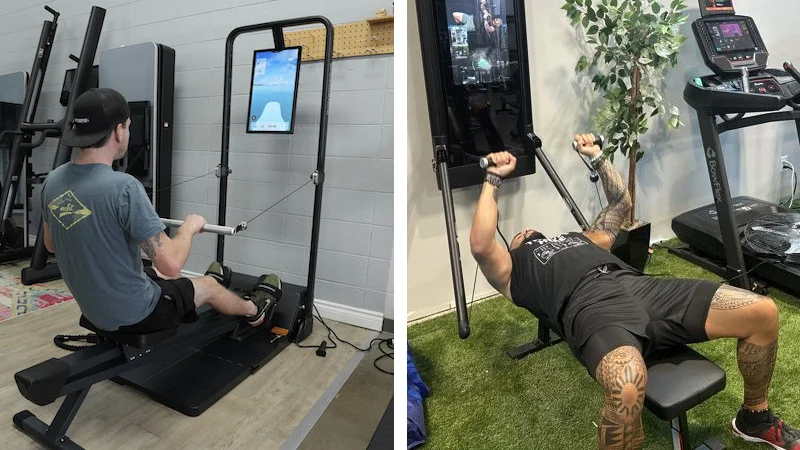
With technology developing at a seemingly unstoppable pace, smart home gym equipment has gone from a niche category to a growing force in the health and fitness industry. The Tonal 2 stands atop the digital weight training world thanks to its versatility and top-notch programming. Plus, research has actually shown that machines like Tonal have “effectively addressed common exercise barriers, including time constraints, gym accessibility, monotonous and generic workout routines, and plateauing progress1.”
However, this premium cable machine system comes with a hefty price tag that may be too steep for folks with less financial flexibility.
Enter: the Speediance Gym Monster 2.
This Tonal alternative offers a similar (but certainly not identical) connected fitness experience built around digital resistance training. With zero membership costs and no professional installation requirements, the Gym Monster has the edge in some ways.
In this Speediance vs. Tonal comparison, I’ll highlight their similarities, break down their differences, and provide direct feedback about our team’s experience with the Tonal 2 and the OG Gym Monster so you can decide which smart route to take.
Editor’s Note: While our experience notes are based on the original Gym Monster, Speediance released the Gym Monster 2 in November 2024, which included a few minor hardware and ergonomic changes. In September 2026, the brand launched the Gym Monster 3. Since we haven’t tested it yet, and the OG Gym Monster is no longer in production, this comparison piece will be largely based on the Gym Monster 2’s specs and capabilities.
Speediance vs. Tonal
The Speediance Gym Monster is a freestanding all-in-one digital weight training system that offers a maximum resistance of 220 pounds. It supports multiple training modes, including strength, cardio, and HIIT. We appreciate that Speediance includes a robust bundle of accessories with your purchase—which isn’t the case with its higher-priced counterpart. Unfortunately, it doesn’t have as deep a workout library or access to live classes.
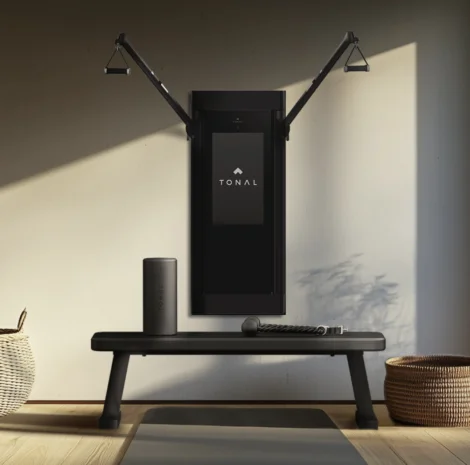
On the other hand, Tonal stands out for its interactive, ultra-connected training experience. It’s also markedly different from the Speediance Gym Monster in its design. Essentially, it’s a wall-mounted workout mirror with a built-in digital cable training system. While it stands out for its aesthetics, versatility, and functionality, Tonal takes up permanent wall space and comes with a much higher cost of ownership due to membership fees.
Speediance vs Tonal at a Glance
| Speediance Gym Monster 2 | Tonal 2 | |
| Price | $3,387 | $4,295 |
| Dimensions | 48” L x 27.16” W x 72.83” H | 5.25” D x 21.5” W x 50.9” H |
| Product Weight | 171.96 lbs | About 150 lbs |
| Max Resistance | 220 lbs (110 lbs each arm) | 250 lbs (125 lbs each arm) |
| Display | 21.5” HD touchscreen | 24” HD touchscreen |
| Connectivity | Wi-Fi 2.4G, Bluetooth 5.0 | 802.11ac 2×2 MIMO / Bluetooth v5.1 aptX |
| Subscription Fee | None | 12-month membership at $59.95/month + taxes |
| Accessories | Adjustable barbell, barbell hooks, barbell pad, handles, Bluetooth ring controller and clip, extension straps, ankle straps, triceps rope, angle adaptor | Essential Accessories Bundle ($495) or Ultimate Accessories Bundle ($595) |
| Warranty | 2 years | 2-year warranty included; extended warranty options available |
Speediance Company Overview
Founded in December 2020, Speediance is a fitness technology company and equipment manufacturer that specializes in all-in-one smart home gym systems. The brand’s flagship product is the Gym Monster Series, which is more of an apples-to-apples comparison to Tonal than the recently released Gym Nano—a portable cable training system that’s basically a direct competitor to the Beyond Power VOLTRA (a GGR favorite).
At about half the price of the Gym Monster 2, the Nano is worth looking into if you have a compatible squat rack to which you can attach it. Check out our full Speediance Gym Nano review to find out what GGR founder Coop Mitchell thought of this VOLTRA alternative.

- All-in-one smart home gym
- Digital resistance
- Compact footprint
Tonal Company Overview
Based in San Francisco, Tonal was founded in 2015 by engineer Aly Orady, who parlayed his own weight-loss journey into a product that could help others get in shape at home. The company’s first smart home gym system hit the market in 2018, and since then, Tonal has grown in popularity by continually innovating its wall-mounted strength training equipment.
I got a chance to try the second iteration the last time I was at GGR HQ, so make sure to check out our full Tonal 2 review for a deep dive on this digital training system.
- AI gets to know you and makes weight adjustments for you
- Up to 250 pounds in digital resistance
- Access to on-demand and live classes
Speediance vs Tonal: Key Similarities and Differences
RELATED: Speediance Review
Delivery and Assembly
Nobody looks forward to a stressful, complicated assembly process. However, you will need to practice some patience to get your smart home gym up and running, especially with Tonal.
Let’s get into the setup for each system.


Speediance
Good news: the Gym Monster arrives almost fully assembled.
“All you have to do is pull it out of the box,” says Sam Presley, former GGR facility manager. “The only assembly required is on the bench, which is only for the screws; and the rower, which is also a fairly quick and easy build with only a couple different components.”
Overall, you should be able to get the Speediance ready for action in about 30 minutes. That’s a fraction of the amount of time it’ll take to get your Tonal in working condition.
Tonal
Because it must be mounted to a wall, Tonal doesn’t take any chances with the delivery and assembly process. Rather than putting the pressure on your shoulders, the company provides “white glove” delivery and professional installation (at a cost).
According to the Tonal website, here’s what you’ll need to ensure the machine can operate without restrictions:
- 7 feet of unobstructed wall space
- 49 square feet of floor space
- 7 feet, 10 inches of ceiling height
- Continuous, reliable Wi-Fi connection
- 3-prong power outlet within 6 feet of installation location
Once you schedule your delivery day, you can let Tonal’s certified delivery team members take care of the rest. They deliver, mount, and set up your system. While it can cost hundreds of dollars depending on your location, it’s well worth the peace of mind given that you’re spending over $4,000 on the unit alone.
Footprint and Portability
These two products differ quite a bit in terms of the all-important footprint and portability category we evaluate at GGR. This is particularly important for those who live in a small apartment or have limited room.
After all, the Tonal requires sufficient space to move the arms and cables, as well as a ceiling that’s tall enough to accommodate certain movements. Meanwhile, the Speediance takes up more floor space.


Speediance
One of the main selling points of the Speediance Gym Monster 2 is its minimalist design. It has a floor platform that’s just over 4 feet long when unfolded. However, the footrests are foldable, which is a big plus if you’re short on space to begin with.
Is the Gym Monster the most portable home gym system around? I wouldn’t go that far. However, the fact you can move it at all already gives it a leg up on the Tonal 2. Plus, the Gym Monster 2 is about 17 pounds lighter than its predecessor, which makes it a bit easier to move (though we’d still recommend having a friend help).
Tonal
Conversely, the Tonal 2 is not portable in any sense of the word. In other words: You better find a permanent spot for it that you have no doubts about. Because it’s wall-mounted, you’re sacrificing portability for space efficiency.
If you take the glass-half-full view, the Tonal 2 actually stands above the Gym Monster 2 for its footprint-friendly design. When you’re not breaking a sweat or reviewing your workout metrics on the screen, it’s basically like having the world’s fanciest mirror hanging on your wall, taking up no floor space other than the optional bench.
RELATED: Best Compact Exercise Equipment
Versatility
Now let’s get into the real reason you’re here: What can these machines do?
As a longtime lifter who loves getting the most bang for my buck, I put versatility near the top of my priority list when assessing home gym machines. After all, who wants to spend thousands of dollars on something that’s limited in scope?
Luckily, both Speediance and Tonal give you plenty of wriggle room to try different training styles and perform a wide range of exercises from the comfort of your home.

Speediance
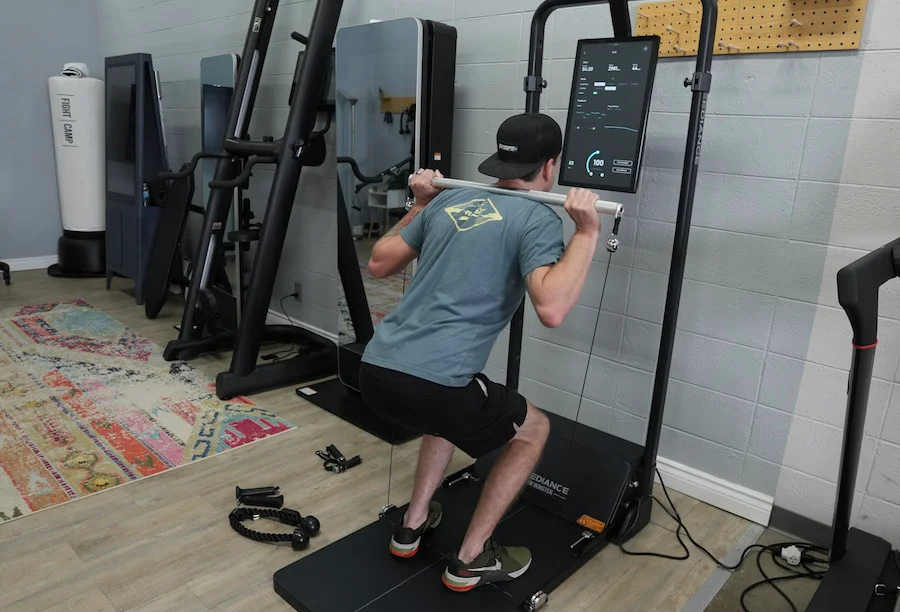
The Gym Monster 2 primarily focuses on full-body strength training. You can use this system for squats, deadlifts, bench presses, overhead presses, and all the typical cable exercises you do in a commercial gym.
Furthermore, the pulleys move along the uprights and can attach at the platform. This allows you to pull from different heights and angles, supporting both bilateral exercises and single-arm or single-leg work (otherwise known as unilateral exercises).
Another aspect we appreciate about the Gym Monster 2 is that you get multiple resistance modes. Standard mode provides conventional cable resistance, whereas eccentric mode increases the resistance during the lowering phase. There’s also a chain mode that does the opposite by increasing the resistance at the top of the movement.
Overall, I love that you can switch things up to give your muscles a different challenge. Throw in the fact that you can use the Speediance for cardio and even Pilates using the elastic resistance mode, and you have a pretty broad scope of possibilities.
“You can definitely feel a difference between having it in barbell mode versus chains,” explains one of our expert product testers who tried the original Gym Monster. “It definitely feels like a chain simulation when lifting with it.”
That being said, the 220-pound max resistance doesn’t offer quite as much room for progression. In addition, the Gym Monster 2’s narrow frame makes it less accommodating than a full-sized functional trainer, especially for bigger athletes.
Tonal
Tonal also offers rock-solid versatility—provided you pay for one of the accessories packages. While the original Tonal allowed you to perform 310 movements, the second iteration bumped that up to 315.
Like the Gym Monster 2, you can take advantage of different variable resistance training modes. You can toggle between Eccentric, Chains, and Burnout modes that mimic techniques used with barbell and free weight training. I also like that there’s an adaptive Drop Set mode that can be a game-changer when it comes to hypertrophy training.
I got a chance to try the Tonal 2 and can say I was pleasantly surprised at how effective it was at delivering a challenging workout. There are so many variables you can change—whether that’s adjusting the height and angle of the cable arms, or switching to a different training mode.
There’s also a huge movement library and selection of programs and classes that you can scroll through to find the ideal fit.
To me, this is a huge differentiator that explains why Tonal has taken the crown in the smart home gym market for quite some time.
Moreover, the Tonal 2 got another upgrade in the form of Aero HIIT—a high-intensity workout mode that combines elements of explosive strength training with cardio. While I’ll dive deeper in the next section, the Tonal 2’s Smart View camera system (another big upgrade) further bolsters the unit’s versatility.
RELATED: Vitruvian Trainer+ Review
Tech Capabilities and Smart Features
Let’s talk tech.
This is where the two systems start to separate themselves further. Speediance is marketed as more budget-friendly equipment, and you’ll see why when you compare the smart features (or lack thereof) compared to the industry titan Tonal.


Speediance
GGR founder Coop Mitchell tested the OG Gym Monster and noted that it should be easy to get started even if you’re new to working out.
“After a strength assessment, it recommends the weights for you based upon the reps, similarly to Tonal,” he says. “It’s designed for a novice, so beginners shouldn’t have any issues getting it set up and in working order.”
Equipped with a 21.5-inch rotating, tilting touchscreen, the Gym Monster 2 provides some feedback, but nothing as expansive as you get with the Tonal or the Tempo Studio. We do like, however, that some of the attachments are Bluetooth-enabled smart accessories, which means they can count your reps and automatically send that information to the machine and companion app.
To keep things tidy, here’s a high-level overview of the key smart features and tech you get:
- Digital resistance controls that adjust in 1-pound increments via Bluetooth
- Dynamic lifting modes, including Free Lift mode where you can follow your own routine
- Personalized training and tracking with strength assessments, weight recommendations, and workout data
- Smart assistance that reduces the weight when you’re struggling to complete a rep (a nice safety feature)
- Wi-Fi and Bluetooth connectivity to connect to the Speediance app
- Built-in 2.1-channel speakers for streaming workout audio and music
Overall, Speediance is still behind Tonal in terms of programming and smart capabilities. However, that comes with an important caveat.
“Tonal has been around longer and has spent much more time and money on this part of the equation,” Coop says. “Tonal’s AI is also superior, but again, Speediance is leaning into the value side more than anything.”
Tonal
There’s a reason Tonal remains the gold standard of smart home gyms: It blows everyone else out of the water from a tech perspective.
Obviously, the Adaptive Weights component is one of the most useful smart features, as the machine automatically adjusts the digital weight based on your strength, fatigue levels, and workout performance. That’s a great way to stay on track with your long-term goals and prevent burnout and minimize risk of injury.
Furthermore, Spotter Mode is another awesome feature that you see more and more of with these types of smart home gyms. Similar to the Speediance Gym Monster 2, this intelligent safety feature automatically reduces the weight if it senses you’re struggling during the concentric portion of the lift. When you complete a rep at normal speed, it’ll automatically put the weight back up.
RELATED: Concentric Vs Eccentric Training
Here’s a list of the most pertinent tech and smart features for the Tonal 2:
- A Smart View camera that allows you to receive real-time coaching cues and review your workout footage in the Tonal app
- A 4k touchscreen that lets you view coach-led workouts, exercise demonstrations (Tonal does a fantastic job with this!), and real-time training stats
- Massive workout library with access to strength training, HIIT, yoga, and guided sessions
- Integration with fitness trackers, devices, and apps like the Apple Watch, Apple Health, Strava, Apple Music, and more
Ultimately, you get more training options and smart features with the Tonal 2—which is exactly what you should expect given the nearly $1,000 price difference.
Company Policies
From warranties to returns to customer service, these policies can make a big difference in whether you remain loyal to a brand or move on to another. Here’s a brief overview of how both companies handle these matters:
Speediance
Speediance covers the Gym Monster 2 with a two-year limited warranty, while cables and accessories receive one year of coverage. However, you can also expand your coverage via a Speediance Care Plan. Here’s what the company offers:
Speediance 4-Year Care ($349)
- 4-year main unit warranty
- 2 free on-site repair visits
- 1 free cable replacement
- 1-month Wellness+ trial, an AI health coaching program
- 4-year vip priority support
Speediance 3-Year Care ($299)
- 3-year main unit warranty
- 1 free on-site repair visit
- 1 free cable replacement
- 1-month Wellness+ trial
- 3-year vip priority support
Returns must be requested within 30 days of delivery and require approval, which is standard for most fitness equipment of this sort. Keep in mind that you’ll need to return all accessories and use the original packaging to avoid additional packaging costs.
Speediance also makes the purchasing process more feasible by offering financing through Affirm. The Gym Monster 2 is also HSA/FSA-eligible.
Tonal
Tonal provides a 30-day money-back guarantee with the machine, which gives you a decent amount of time to decide if it’s the right fit. Of course, if you decide it’s not, you’re going to have to deal with figuring out what to do with the wall you just mounted it to, but you’ll have to cross that bridge when you get there.
Like the Gym Monster 2, the Tonal 2 comes with a two-year warranty on the main unit and touchscreen, which is decent but nothing to write home about. You get one year of coverage on any smart accessories. Fortunately, the company offers four- and five-year extended warranties if you want added protection and peace of mind that cost $425 and $449, respectively.
Again, just like Speediance, Tonal also offers financing through Affirm. And like the Gym Monster 2, the Tonal 2 is HSA/FSA-eligible.
Which Smart Home Gym System Should You Choose?
As you’ve learned, there are benefits and drawbacks to both of these smart home gyms. There are many factors you need to consider before you pull the trigger on one, so if you’re still not fully convinced about which direction to go, let me provide some further guidance:


Choose Speediance if:
- Tonal’s higher upfront cost and required monthly membership don’t fit your budget
- You prefer a freestanding system that you can relocate relatively easily
- You just want to train on your own and don’t need access to live classes and more interactive features
- 220 pounds is a sufficient amount of weight for your training needs
- You prefer not to drill into your walls or don’t want your equipment to have cameras
Choose Tonal if:
- You’re willing to pay more for personalized programming, expansive smart features, and the AI-powered camera system
- You want to lift heavier—you get 30 pounds of additional digital resistance over the Gym Monster 2
- You want access to thousands of on-demand and live classes across a wide range of training types
- You like the idea of a wall-mounted system that preserves precious floor space
Final Thoughts: Speediance vs. Tonal
The battle between Speediance vs Tonal is a close one, but ultimately, the right fit for you depends on your space and your preferences. It’s never a bad idea to make a pros and cons list and see how one product stacks up against the other. For some people, Tonal’s superior programming and tech features really are worth that higher price tag and recurring subscription cost. Then again, you may not need all those bells and whistles and may be better off with the more affordable Gym Monster 2.
FAQs
What are the main differences between the Speediance Gym Monster and the Tonal 2?
The Gym Monster 2 is freestanding, offers up to 220 pounds of resistance, and requires no subscription for core features. Tonal 2 requires wall mounting, provides up to 250 pounds, and adds camera-based coaching and a required membership for full functionality.
Does Speediance have a monthly fee?
No, one of the benefits of buying the Speediance Gym Monster 2 (or another strength training system from the brand) is that you don’t have to pay a monthly subscription or membership fee.
What is the difference between the Tonal and Tonal 2?
Tonal 2 increases the maximum resistance from 200 to 250 pounds and adds a built-in coaching camera, a sharper 24-inch 4K touchscreen, upgraded speakers, and Aero HIIT workouts.
What features should I look for in a smart home gym?
When shopping for a smart home gym, look for sufficient resistance, varied exercises, adjustable cable positions, useful programming, progress tracking, and automatic assistance features. Consider installation requirements, accessories, and ongoing membership costs, too, as these can all impact your ownership experience.
References
- Nguyen TH, Yamamoto T, Cho D, Nguyen TL, Goldman P, Dolezal BA. Five Years Later-The Impact of the COVID-19 Pandemic on Physical Performance and Cardiometabolic Health Using a Smart Home Gym: An Ecological Case Study. Int J Environ Res Public Health. 2025;22(5):762. Published 2025 May 12. doi:10.3390/ijerph22050762