
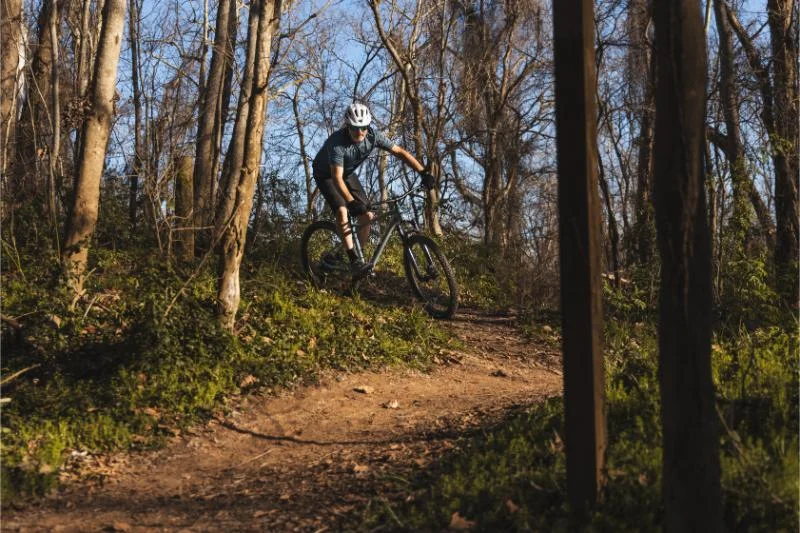
Mountain biking isn’t exactly known for being a cheap sport. The best mountain bikes can cost as much as a used car, with plenty of models sporting price tags of $10,000 and above. This is enough to discourage any budget-minded rider from participating in this outdoor activity. That’s a shame, considering that mountain biking offers incredible benefits in terms of aerobic and anaerobic fitness, according to 2022 research1.
Luckily, you don’t need to drop five figures on a bike to have a good time and reap the benefits. You can, in fact, spend as little as a few hundred dollars and have a good experience. We can help with that—below are the best budget mountain bikes, chosen by real riders, MTB coaches, and bike shop managers.
Related: Best Exercise Bikes With Virtual Courses
6 Best Budget Mountain Bikes of 2026
- Best Budget Mountain Bike Overall: Marin Bobcat Trail
- Best Ultra-Budget Mountain Bike: Ozark Trail Ridge
- Best Budget Full Suspension Mountain Bike: Specialized Stumpjumper 15 Alloy
- Best Budget Electric Mountain Bike: Aventon Ramblas
- Best Budget Downhill Mountain Bike: Transition Smuggler
- Best Budget XC Mountain Bike: Specialized Rockhopper Sport
Best Budget Mountain Bike Overall: Marin Bobcat Trail
Good for: Those who want to blend fun, function, and durability for a good price
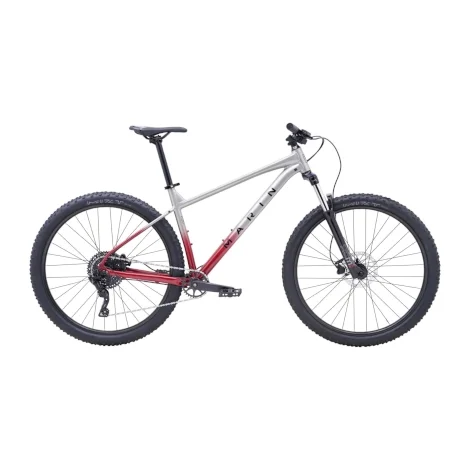








The Bobcat Trail takes the best overall spot because it’s top-tier, thanks to the under-$1,000 price tag and capable build. Based on my personal experience, it’s the best value bike.
RELATED: Best Exercise Bikes
I’ve been riding the Marin Bobcat Trail since 2022—specifically the Bobcat Trail 3, though the latest model is the Trail 5—and it’s been with me on mountain bike adventures across North America. I picked my Marin up in Miami, where it handled the mix of sugar sand and root-laced scrub forests without issue. Since then, this bike has flown through machine-built trails in swampy Louisiana, rocky backroads in the Southwest, and even some rowdy descents at lift-served bike parks in British Columbia and Anchorage. Not bad for a $999 rig! For all-around trail performance, I give it a solid 4 out of 5.
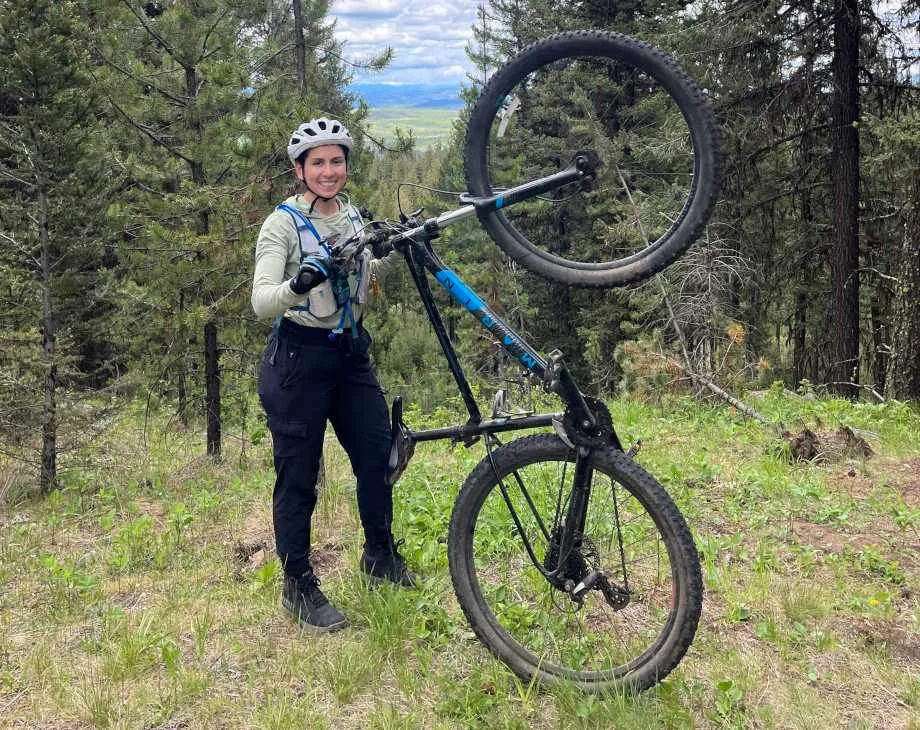
It’s definitely not optimized for every type of terrain I’ve ridden, but it’s rugged and sufficiently adaptable for just about anything I’ve thrown at it. Downhill parks definitely pushed its limits (and mine), but it survived. Thanks to a lockout on the front suspension fork, the Bobcat even works on paved rides, though it’s noticeably heavy on pavement. For weight, it gets a score of 2.75 out of 5.
What makes this bike shine is its trail-centric frame geometry, which lends itself to incredible versatility. And with 120 millimeters of front travel, it’s tuned for flowing singletrack and climbing alike.
The frame is aluminum alloy; it’s not as light or high-end as carbon, but it is more crash-resistant and budget-friendly. That’s part of what makes the Bobcat such a strong value. For $999, it’s hard to beat the level of performance and fun this bike delivers. On value, I rate it 4.75 out of 5.
RELATED: Understanding the Different Types of Exercise Bikes
| Frame material | Aluminum alloy |
| Weight | Not listed |
| Rear suspension | No |
| Dropper seat post | No (future compatible) |
| Wheel Size | 29” or 27.5” |
| Tire Width | 2.25” |
| Suspension Travel | 120 mm |
| Drivetrain Configuration | 1x |
| Cassette | SunRace 11-51T 11spd |
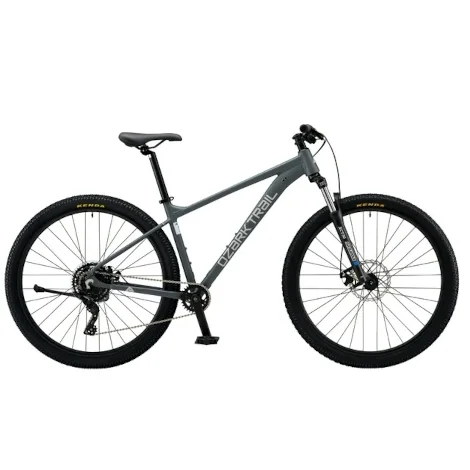
Best Ultra-Budget Mountain Bike: Ozark Trail Ridge
Good for: Casual riders who want a basic bike and/or plan to budget for upgrades




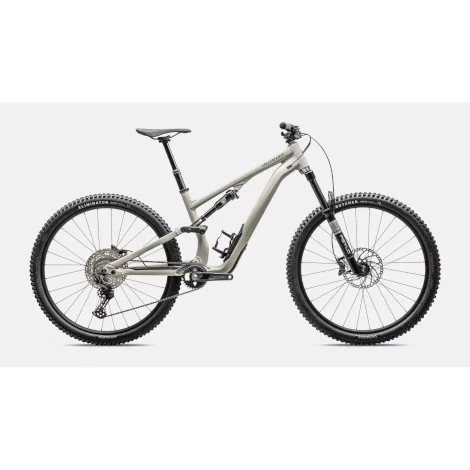
Best Budget Full-Suspension Mountain Bike: Specialized Stumpjumper 15 Alloy
Good for: Riders new and experienced who want to invest in an utra-capable bike at a reasonable price

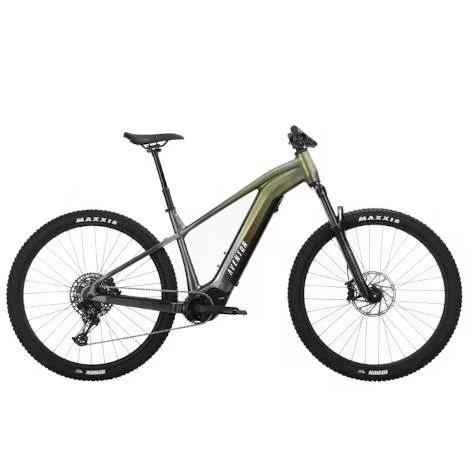
Best Budget Electric Mountain Bike: Aventon Ramblas
Good for: MTB-ers looking for help with uphill climbs and long rides for under $3,000




Best Budget Downhill Mountain Bike: Transition Smuggler Alloy
Good for: Comfortably riding technical downhill routes while keeping the budget in check
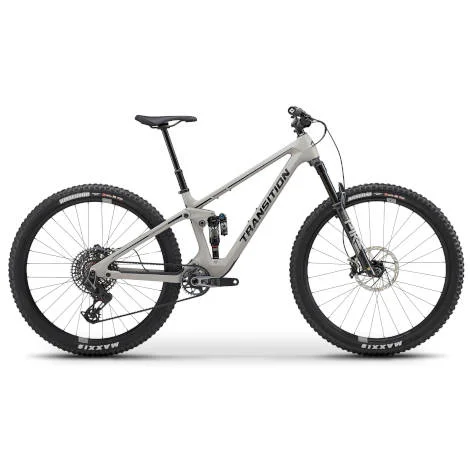
For ripping downhill tracks on a modest budget, the alloy Transition Smuggler is a top contender. “My go-to, all-around bike is the Transition Smuggler,” says Luke Burgess, general manager of the Rider’s Outpost at Madbush Falls mountain bike park.
The front fork offers 140 millimeters of travel while the rear shock provides 130, which is somewhat short for downhill bikes—but you’ll appreciate that if you ever decide to skip the chairlift and use your cycling muscles.
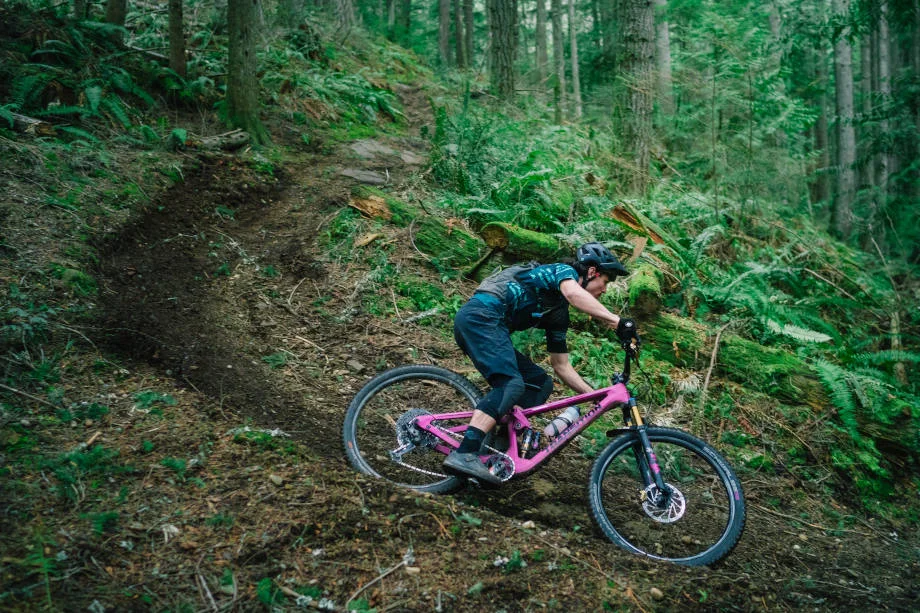
“This bike punches well above its weight class with a geometry that is perfectly at home on [downhill] terrain,” Luke says. When everyone else is riding burlier setups with 160 and 170 millimeters of travel, “you get to climb back up for more laps,” he says. A bike that can climb and descend without flaw? Easy 5 out of 5 for versatility.
At $3,499 for the alloy frame, the Smuggler is the most expensive option on our guide to budget mountain bikes. But we think it’s an excellent deal for a fully capable downhill bike that still accommodates climbs and mixed trails. (For reference, the carbon Smuggler frameset alone costs the same as the entire bike in aluminum alloy.) Plus, its aluminum frame is durable and, according to rider reviews, feels much lighter and more responsive than most would expect from such a frame.
The Shimano drivetrain features a 1x configuration with 12 speeds, providing smooth shifting with fewer parts to worry about while shaving weight. Additionally, the Smuggler comes with tubeless Maxxis tires with automatic sealant in the case of flats, 2.5 inches wide in the front and 2.4 in the rear. It also comes with a dropper seat post so you can change your riding position based on the conditions. All of the above earns the Smuggler a respectable 4 out of 5 points for value.
Related: Spin Bike vs. Exercise Bike: What’s the Difference?
| Frame material | Aluminum alloy |
| Weight | Not listed (30.5 lbs for Carbon GX model) |
| Rear suspension | Yes |
| Dropper seat post | Yes |
| Wheel Size | 29” |
| Tire Width | 2.5” (front); 2.4” (rear) |
| Suspension Travel | 130 mm rear; 140 mm front |
| Drivetrain Configuration | 1x |
| Cassette | Shimano Deore M6100 (10-51t) 12spd |
Best Budget XC Mountain Bike: Specialized Rockhopper Sport
Good for: People who plan on riding long distances across different types of trails
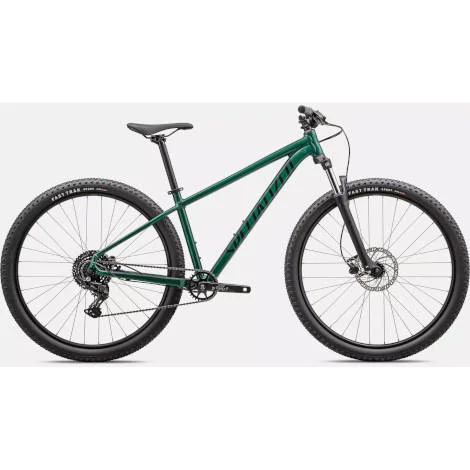


My husband picked up a Specialized Rockhopper Sport at a bike shop in West Texas and proceeded to ride it for a year and a half along our travels from the Southern U.S. to Alaska and back. He took this budget hardtail out weekly, often more frequently, on desert singletrack and backroads in the Southwest, on mixed trails in the Pacific Northwest (in springtime mud, no less), and on downhill lines in Canada and Alaska.
It earns a score of 4 out of 5 for versatility. We docked one point because even though it can handle downhill parks, it’s not particularly comfortable to ride on fast descents.
For a $750 bike, it’s an incredibly high performer. While it’s technically a trail bike, it’s never shown any hesitation on steep descents or long, flat rides. My husband’s favorite thing about the Rockhopper? Its weight. At 29.5 pounds, it’s substantially lighter than most bikes in the sub-$800 price range. Whenever I got to take a joyride on the Rockhopper, I’d feel like I could fly in comparison to riding my Marin Bobcat Trail bike, even though his bike was one size too big for me. For weight, it earns 4.5 out of 5 stars.
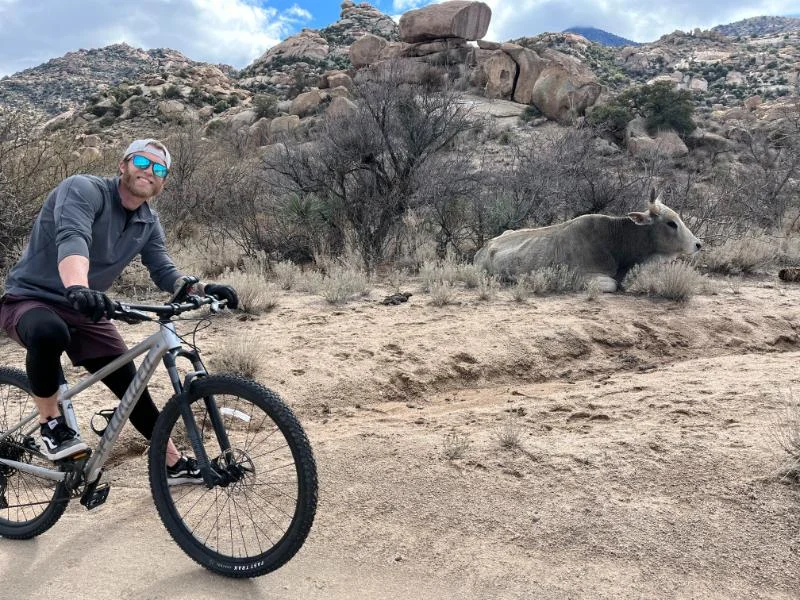
Featuring a Shimano CUES drivetrain with a 1x configuration, I love this bike’s ease of shifting thanks to the single chainring, but I do find its nine speeds to be a bit lacking. A 12-speed cassette is certainly preferable, but at the under-$800 price point, I think the nine-speed is perfectly fair. Taking that into account with all its other features, I give the Rockhopper Sport a score of 4.75 out of 5 for value—it’s one of the best deals out there.
“I honestly didn’t expect much out of this bike, given that it was so inexpensive and I randomly chose it at a bike shop (because of its price),” my husband says. “But it has been a wildly fun ride and I’m super impressed by how well it has handled on different trails that it really wasn’t built for.”
If you’ve got a little more budget and want even more oomph, check out the rest of the Rockhopper line, which includes slightly higher-end models with different components (for instance, the Sport features a Suntour fork while the Expert features a RockShox fork). “I’m all in on Specialized after riding the Rockhopper for over a year,” my husband says.
Related: The Best Air Bikes for Your Home Gym
| Frame material | Aluminum alloy |
| Weight | 29 lbs 8 oz |
| Rear suspension | No |
| Dropper seat post | No |
| Wheel Size | 29” |
| Tire Width | 2.35” |
| Suspension Travel | 90–100 mm (size-specific) |
| Drivetrain Configuration | 1x |
| Cassette | Shimano CUES CS-LG300-9, 9spd, 11-41T |
Other Budget Mountain Bikes We Researched
We researched dozens of other mountain bikes, with nearly 30 ending up on our list of recommendations. These few were strong contenders for this guide.
- Trek Marlin: The Trek Marlin was my first mountain bike and one I still highly recommend, as does Adelia Valadez, rental shop manager at Massanutten Resort. “It handles surprisingly well on singletrack and comes with a solid drivetrain that works great for climbing and casual trail riding,” she says. It was a competitor for the best overall spot in this guide, but ultimately, I’ve preferred my Bobcat Trail (which also costs a few hundred less).
- Cannondale Trail 2: This bike comes highly recommended by Jason Cowie, bike buyer for Sun & Ski Sports, who calls it “a lightweight, versatile hardtail mountain bike built for both trail adventures and everyday rides.”
- Santa Cruz Hightower: Cassie Abel, founder and CEO of Wild Rye women’s technical apparel, says the Hightower is “the perfect blend of playful and capable,” but it’s on the pricey side for budget-minded bikers.
- Specialized Turbo Levo 4: This e-bike is undoubtedly one of the best, and comes in a range of prices to suit different budgets. However, it still costs more than the $4,000 cap we placed for this budget-friendly guide.
- Rocky Mountain Element Carbon 30: Our top overall pick in our guide to the best mountain bikes, the C30 is an all-around excellent pick, but slightly above our budget cap at about $4,500.
How We Picked and Tested the Best Budget Mountain Bikes
Hours of riding, research, and consulting with mountain bike experts and enthusiasts went into this guide. Here are a few of the top factors that went into our search for the best budget mountain bikes.
Price
For this particular guide we kept all of our picks to under $4,000, with most under $2,000.
Drivetrain
We looked for 1x drivetrain configurations with at least eight speeds.
Brakes
All of our recommendations have hydraulic brakes except our ultra-budget (under $400) pick, which has mechanical brakes.
Frame Material
All of our top budget mountain bike choices have alloy frames, though several have the option to choose a carbon frame if you have more cash available.
Rear/front Suspension
We looked for components from respected and tested brands like RockShox, X-Fusion, and Fox.
Suspension Travel
We prioritized versatile bikes with suspension travel of 120 to 150 millimeters, because too little or too much travel reduces the use cases (or, at least, the cases in which it will perform well) for a given bike.
Wheels and Tires
Our recommendations primarily include bikes with 29-inch wheels, but some have options to choose 27.5-inch wheels if you desire more speed and shiftier handling. We included models with tubeless-ready tires where available, though most budget MTBs do not have tubeless tires. We looked for tire widths of 2.2–2.4 inches.
Upgrade Compatibility
Seeing as this is a budget-oriented guide, we chose bikes that have upgrade compatibility, so riders can spend more when it’s the right time.
Different Types of Mountain Bikes
Below, learn about different mountain bike styles and how they affect your ride.
- Full-suspension: Has both a front and rear suspension; absorbs more shock; ideal for downhill and highly technical routes; can feel cumbersome and slower on climbs and flat, smooth routes
- Hardtail: Only has a front fork suspension; absorbs less shock; less expensive than full-suspension; provides better handling and climbing performance
- Electric: Features a battery system to assist with uphill pedaling; can be full-suspension or hardtail
- Cross-country (XC): Built for long distances and designed with uphill performance and acceleration in mind; lightweight; often built without a rear suspension
- Trail: Widely considered the most versatile MTB category; designed with versatility in mind, usually featuring medium suspension travel and a rear suspension
- Trail XC: Blended features from XC and trail for even greater versatility
- Downhill: Built for riding downhill routes with various features, including jumps, drops, and roll-over obstacles (like rock gardens); robust rear suspension; often heavier and struggle to accelerate and climb uphill
- Enduro: Also built to handle intense downhill rides, but some downhill compromises are made to assist with climbing performance; different frame geometry than downhill to increase versatility
- All-mountain: An emerging category similar to trail bikes, generally with greater suspension travel and a more robust rear suspension to better accommodate downhill riding
- Down-country: A blend between cross-country and downhill features; not the ideal bike for either type of riding but a great way to prioritize performance and comfort in both riding scenarios
Buying Guide: What to Look for in Budget Mountain Bikes
As you shop for your new trusty steed, keep these factors in mind.
Your Intended Use
The first step is knowing what you will use the bike for. Do you want to go on multi-day bikepacking expeditions, bomb downhills with berms and drops, or have something versatile you can also use as a road bike for commuting and leisure? Understanding the bike’s primary use is how you will find the best MTB for you.
Frame Material
For a budget-friendly bike that still performs and handles well, you’re looking at aluminum alloy frame construction. Sometimes referred to as just “alloy,” this material offers the best blend of durability, weight, responsiveness, and price. You may be able to save even more with a steel frame, but at the expense of weight.
Frame Geometry
Frame geometry is very important when considering the type of riding you want to do. According to Adelia Valadez, rental shop manager at Massanutten Resort, “Geometry affects how the bike handles and how stable it feels, which really shapes the whole ride experience.” There’s a lot to consider when it comes to geometry—and a ton of numbers and ratios—but in general, remember that “slack” geometry lends itself to stability at high speeds, while “steep” geometry lends itself to nimbleness and responsiveness.
Drivetrain
Look for at least eight speeds and a 1x drivetrain configuration; 2x configurations may offer more speeds on budget models, but that comes at the expense of weight and more complexity in shifting (a.k.a. one more thing to think about while you’re riding), plus additional components to maintain.
Brakes
Always look for hydraulic disc brakes, says Valadez, noting that “they are worth it over mechanical brakes.” All of our recommendations, except the Ozark Trail Ridge (our under-$500 pick), have hydraulic brakes.
Suspension and Suspension Travel
First, decide whether you want a full-suspension bike or a hardtail. From there, decide how much suspension travel you want based on the type of riding you want to do. In general, less travel is ideal for trail and cross-country riding, while more is better for downhill and enduro riding.
Seat Post
You may want to consider a dropper-compatible seatpost that you can upgrade later on. If you start riding more technical trails, especially downhill lines, you’ll come to appreciate the versatility and comfort that a dropper post offers.
Wheels and Tires
Look for 29-inch wheels if long-distance riding and/or roll-over capability are priorities for you. Look for 27.5-inch wheels if acceleration and uphill performance are more important. Mixed-wheel setups are also available, though not typically at budget-friendly price points. For tires, a diameter of 2.2 to 2.5 inches is standard; tubeless tires are lighter and reduce the risk of flats, but most budget-friendly models come with inner tubes because they are less expensive. If you’d like to upgrade in the future, look for tubeless-ready rims.
Tips for Buying a Mountain Bike Online
First things first: Understand the type of riding you plan to do with the bike. With that in mind, shop for features that match your intended riding style. Know your nonnegotiables and where you’re willing to compromise to stay within your budget.
Additionally, know your size. Helpful measurements to have include your height and inseam length. In most cases, that’s enough to use an online size chart to find the correct bike size and seat height. Be sure to use the size chart from the brand you buy from; sizing can vary across brands.
If buying used, check the bike out in person. Ideally, you’ll get to test ride it or get a mechanic to inspect it—or both. Never buy a used mountain bike sight unseen. For new bikes, look for a warranty that matches the investment: At least one year on parts and the frame is desirable. Multiple years on the frame is ideal, but you may not find such a warranty for budget bikes.
Experts Who Contributed To This Article
- Clare Zecher, mountain bike competitor and head coach at Clare Zecher Coaching
- Luke Burgess, General Manager of Riders Outpost at Madbush Falls
- Cassie Abel, founder and CEO of Wild Rye women’s mountain biking apparel
- Adelia Valadez, Rental Shop Manager at Massanutten Resort
FAQs About the Best Budget Mountain Bikes
What is the best budget mountain bike?
Our top pick for the best budget mountain bike is the Marin Bobcat Trail. For just under $1,000, the Bobcat Trail offers incredible versatility. While it’s on the heavier side, it has performed well on everything from gravel routes in South Florida to downhill lines in Canada.
What is a good basic mountain bike?
Some good basic mountain bikes include the Marin Bobcat Trail, Specialized Rockhopper, Trek Marlin, and, for the very budget-conscious, the Ozark Trail Ridge.
How much should I spend on a mountain bike?
It depends on what type of riding you plan to do and what features you aren’t willing to compromise on. There are a lot of incredible mountain bikes, even new, for under $2,000. In the bike world, more money does get you better components, thus a higher-performing (and usually lighter-weight) bike. However, it is not at all necessary to spend thousands for a good experience, especially if you’re a casual mountain biker who rides beginner to intermediate trails.
Should you buy a second-hand mountain bike?
Buying a second-hand mountain bike is an excellent way to save money while still getting the components and features you want. Many people sell bikes in like-new condition after just a year or two of riding. Definitely take any second-hand bike for a test ride and/or have a bike mechanic check it out before you purchase it.
References
- Arriel, R. A., Souza, H. L. R., Sasaki, J. E., & Marocolo, M. (2022). Current Perspectives of Cross-Country Mountain Biking: Physiological and Mechanical Aspects, Evolution of Bikes, Accidents and Injuries. International journal of environmental research and public health, 19(19), 12552. https://doi.org/10.3390/ijerph191912552