




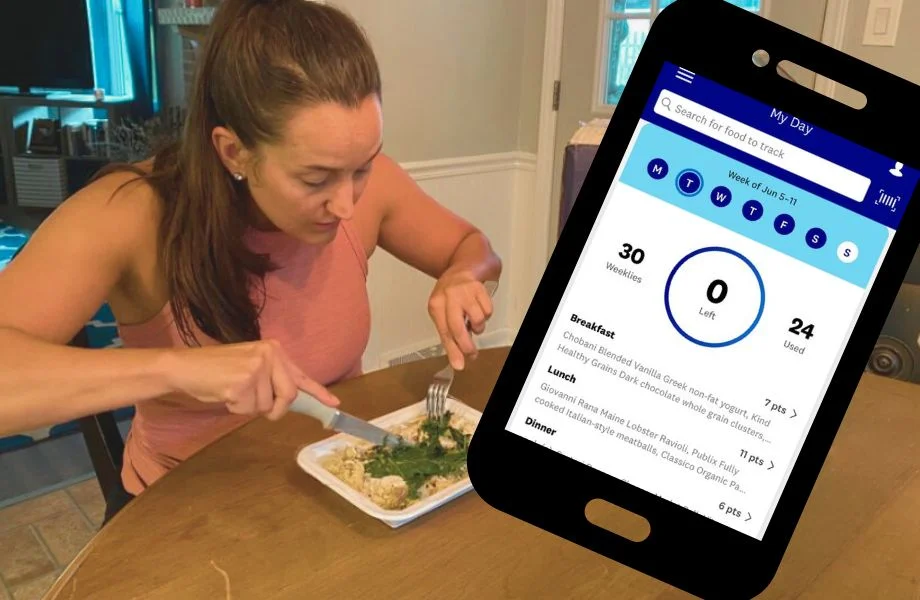
A nutrition app is a great way to keep a virtual food diary, ensuring you’re consuming the right balance of calories, macronutrients, and micronutrients to support your health and fitness goals. If you’re following one of the best weight loss programs, food tracking is often an important part of your success, and apps can help. However, with so many available options, choosing the right app can feel overwhelming, and testing them all yourself can be very time-consuming.
To help you find the perfect app, our team has put together a list of the seven best calorie counter apps currently available. Our testers have extensively used each of these apps, a team that includes certified nutrition coaches, certified personal trainers, registered dietitians, and more. Many of us have spent years using various health, wellness, and workout apps, and we understand the most important features to look for.
While testing out these apps, we tested and scored each one on the following criteria:
- Price
- Ease of use
- Accuracy
- Progress and stat tracking
- Features and community
- Platform and device compatibility
I also talked with GGR expert panelist Perry Nix, MS, RD, LD, to understand the pros and cons of each app. Without further ado, here are the best calorie-counting apps to help you reach any fitness goals you may have.
Medical disclaimer: This article is intended for educational and informational purposes only. It is not intended as a substitute for medical advice. For health advice, contact a licensed healthcare provider. GGR also recommends choosing a product that has been third-party tested for quality.
The 7 Best Calorie Counter Apps
- Best Overall Calorie Counter App – Cronometer
- Best Free Calorie Counter App – Simple App
- Best Calorie Counter App with Coaching – Noom
- Best Calorie Counter App with Recipes – WeightWatchers
- Best AI Calorie Counter App – Fitia
- Best Calorie Counter App with Barcode Scanner – MacroFactor
- Best Calorie Counter App for Muscle Gain – MyFitnessPal
Best Overall Calorie Counter App: Cronometer
Good for: People who want detailed data tracking









- Large portion of food database verified by USDA
- Fully customizable targets and metrics to track
- Forever free, but with premium version available
Cronometer is one of the most popular calorie-counting apps, and for good reason. While many apps simply track calories and macronutrients, Cronometer can provide an extremely detailed look at your micronutrient intake as well, providing a detailed look at the essential vitamins and minerals we should be consuming.
Former GGR Senior Editor Erin Chancer, CPT, CNC, tested Cronometer, and found this to be a little overwhelming, as there’s so much information to monitor, and gave Cronometer a 4-out-of-5-star rating for ease of use.
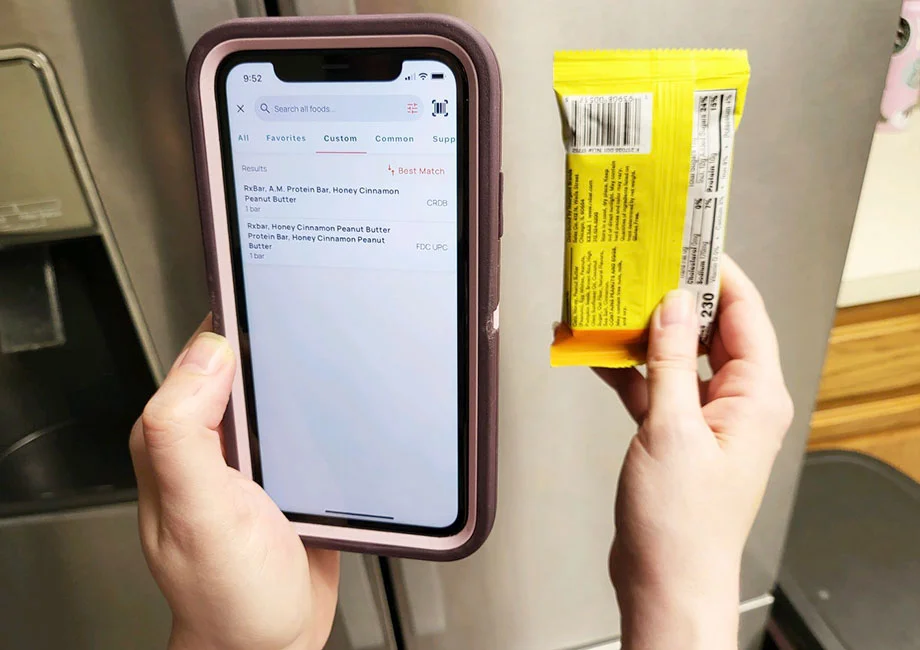
“The app is easy to use, but it’s also very dense,” says Erin. “There’s so much that you can track that it can be a lot at times, even if they break it down visually on a home dashboard.” In addition to a detailed food log that boasts tracking up to 84 essential nutrients, you can also use Cronometer to track your body measurements, blood pressure, mood, sleep, and more.
However, Erin also pointed out that tracking some of these additional metrics can be a little confusing. She said, “Anything you choose to track can then be added to your daily diary. The tracking is very generic, so you may have to assign your own scale, 1 to 5, to certain items. For example, I tried to track mood and could only enter numeric values.” Just for the sheer volume of metrics that can be tracked, she rates the stat-tracking a 4.5 out of 5.
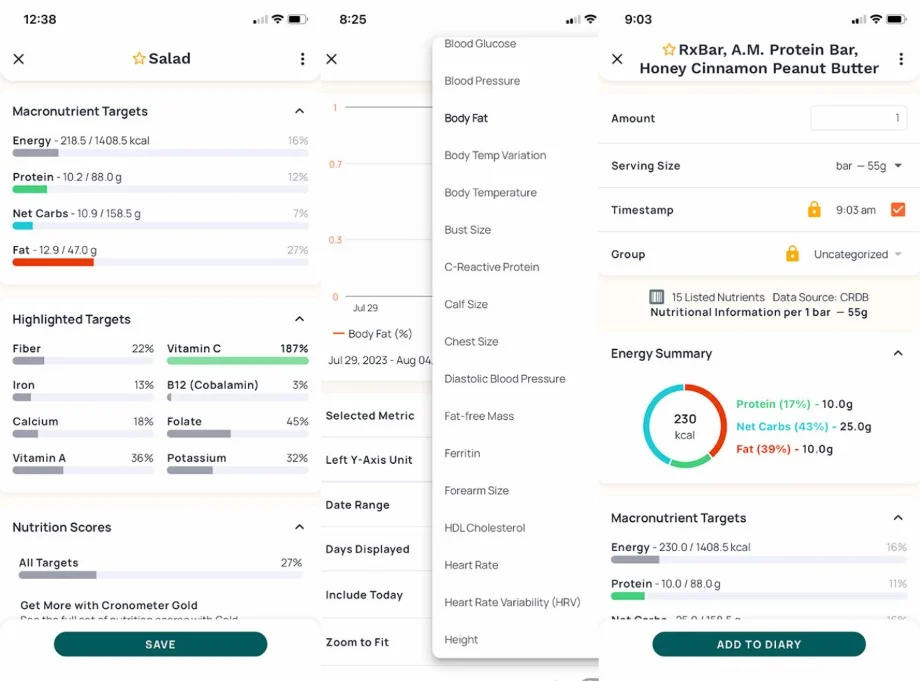
Registered dietitian Perry Nix appreciates the advanced nutrient tracking. “Cronometer tracks significantly more nutrients than most other tracking apps,” she says. “This can be incredibly helpful for those with medical conditions that can lead to nutrient deficiencies.” She notes it can also be great for athletes who want to optimize their electrolytes or B vitamins for muscle recovery.
RELATED: Best Electrolyte Powder
As a nutrition coach, one feature I particularly love about Cronometer is the verified food database. With other apps that have a public database, it’s not uncommon to type in a food and find 50+ entries with a wide range of nutritional information, while Cronometer carefully checks and approves every public food database entry (you can still create your own custom foods).
Finally, there’s a limited free version you can use to track your food, but the paid plan is relatively affordable at $8.99 per month or $49.99 per year and unlocks advanced features, like tracking intermittent fasting. With an affordable premium option and a free version, Cronometer earns a 4.5 out of 5 for its price.
If you’re looking for a highly accurate food database and robust data tracking, Cronometer is our pick for the best calorie-counting app for most folks. You can read more in our in-depth Cronometer review.
| Cost | Free; Cronometer Gold is $8.99/month or $49.99/year |
| Subscription | Monthly or annually |
| Free trial | 30-day free trial of Cronometer Gold |
| Features | Barcode scanner, calorie tracking, nutrient tracking, fasting tracking, integration with fitness trackers |
| Available on | iOS, Android |
| Compatible with | Apple (Health and Watch), Garmin, FitBit, WHOOP, Oura, Dexcom, Polar, Withings, and more |
Best Free Calorie Counter App: Simple
Good for: Those who want AI-powered coaching on a budget






Simple is an approachable nutrition app that makes calorie tracking less time-consuming by using AI-powered food recognition and photo logging. Its combination of meal tracking, intermittent fasting tools, and habit-building features makes it a strong option for beginners, though users seeking highly detailed macro analysis may want a more performance-focused app.
- Free trial available
- Premium membership available
- Supports all diet types
For those want an easy, convenient way to log your food that doesn’t require a food scale, and has a free AI-tracker, Simple is a good option. You’ll set up your profile, and the app will build you a custom plan, as well as an AI coach that you can chat with to help you along your journey.
All you have to do is snap a picture of your plate, and the AI assistant will rate your meal on a scale of 1 to 4 based on things like protein and fat content.
“This was my favorite feature of the app,” GGR founder and expert product tester Coop Mitchell says of the AI coach. “I don’t know what criteria the AI is using, but I entered a ton of different meals to see what score they got, and I felt the AI gave an accurate rating based on what I’ve learned.”
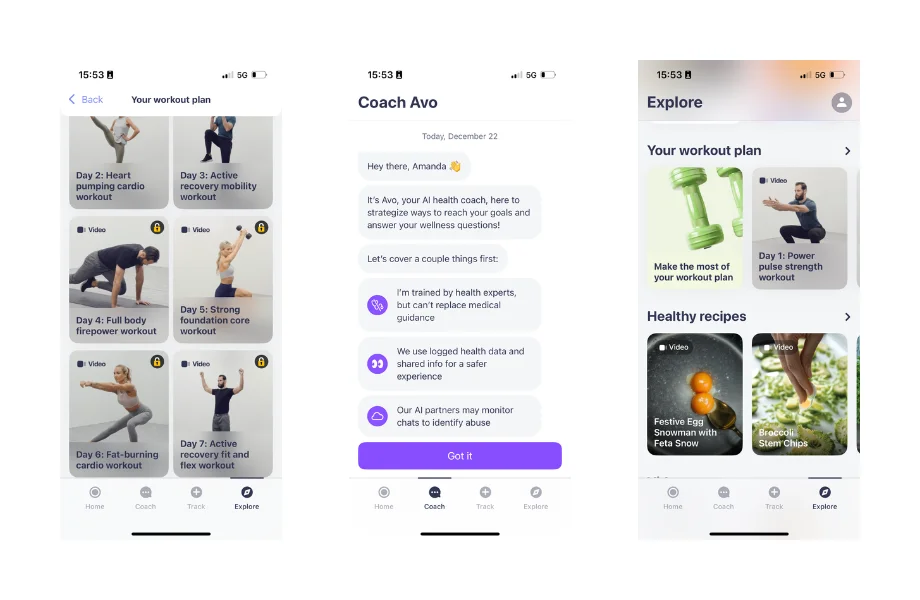
While this is convenient, it may not be the most accurate approach for those who value precision. I tested this app myself, and told it I ate “a bowl of Greek yogurt and blueberries.” The app didn’t ask what type of yogurt or how much; it simply logged a guess for me.
This is a good start to build better food awareness, and it works better with photos, but it’s worth noting that AI-powered food logging simply won’t be as accurate as using a food scale.
Coop also noted that the app uses neutral language when talking about food, so it won’t label any food as “good” or “bad” like other apps. “I actually really like this feature compared to obsessing over whether your numbers are accurate in the tracker,” he says, giving the app 4 out of 5 for safety. “There’s no body shaming and no food shaming.”
We also appreciate that it focuses on a healthy lifestyle, not just your food. Simple has a a hydration tracker, step tracker, and exercise tracker, encouraging a well-rounded approach to better health, not just a focus on restricting calories.
There’s also a free plan for Simple, so if you don’t want to spend any money, you can still log your food. However, many of the better features, like the premium daily provided after your daily check-in, are locked for free users.
| Cost | Free; paid plan costs $29.99 per month or $59.99 for 3 months |
| Subscription | Monthly |
| Free trial | Free plan available |
| Features | AI coaching, photo logging, workout plan, recipes |
| Available on | iOS, Android |
| Compatible with | Apple Health, Google Health Connect |
Best Calorie Counter App with Coaching: Noom
Good for: People who want to focus on behavior change



Noom is built on the psychology of weight loss. Instead of specific nutritional guidance, you’ll get lessons that are designed to help you break habits that may be contributing to your weight gain.
- Color-coded meal options
- Monthly or annual subscription required
- Supports all diet types
If you’ve struggled to change your nutrition habits, then Noom may be a good choice, as it focuses more on behavior change and changing your habits, rather than simply logging your meals. While you’re working on those new habits, you’ll be supported by a community and coach you can reach out to for support at any time.
Our tester loved this feature, giving Noom 5 out of 5 stars for features and resources.
“You get a personal accountability coach who texts back and forth with you in the app,” she explains. “You can literally ask them any question and they get back to you, typically within hours. Noom is all about behaviors and I feel like there is a psychologist in this app helping me. It’s very different from other apps that I have tried.”
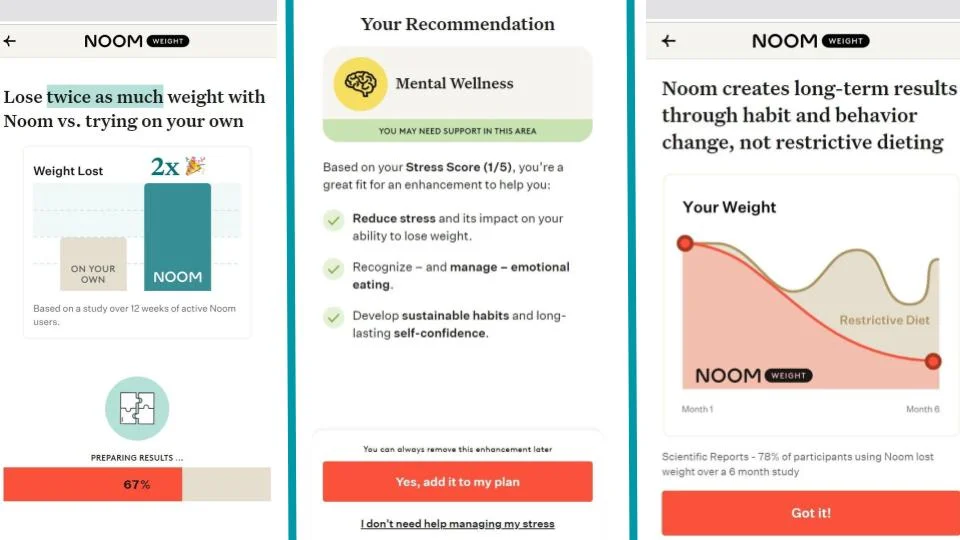
In addition to focusing on behavior change, Noom keeps the tracking approach simple. You can track your calories, but not your detailed macro intake, if that matters to you. Our tester noted that while this was a bit unusual at first, as she wanted to focus on her protein intake, the color-coding system still made sense once she got the hang of it, and she gives Noom 3 out of 5 stars for progress and stat tracking.
“Initially, I wanted to track macros, and it doesn’t automatically do that,” she explains. “Instead, it focuses calories and weight loss. What it does track that I like is the type of food you are eating, so red, orange or green foods. So that I started to learn what ‘color’ the food that I was eating was and how many calories a day those foods take up.”
While we like the habits-based approach, the pricing is a little confusing, and only earns 2 out of 5 stars.
“Noom charges you for the time that you commit to losing weight,” our tester told me. “Depending on how much you want to lose, Noom calculates how committed you are, along with a number of other factors, and determined that it would take me 7 months. So they charged me about $105 for the 7 months, and if you want to continue, you sign up for another duration of your choice.”
While we haven’t tested these features yet, Noom also offers GLP-1 prescription plans, which can cost even more.
If you’re looking for an app that focuses on overall habits and behavior change instead of macros, this is a great choice, as long as you don’t mind the unusual pricing structure. You can read more in our full Noom review.
| Cost | $70-209/month (depends on the results of your Noom quiz and projected weight loss timeline) |
| Subscription | Monthly |
| Free trial | 14 days |
| Features | Behavior tracking, community, personalized coaching |
| Available on | iOS, Android |
| Compatible with | Apple (Health and Watch), Garmin, FitBit, Polar, Withings |
Best Calorie Counter App with Recipes: WeightWatchers
Good for: Those looking for food and meal planning ideas


- Encourages nutrient-dense foods
- Monthly, bi-annual, or annual plans
- Flexible points system
One of the biggest challenges people tend to face when attempting to improve their nutrition is figuring out what to eat. If you’re changing your normal eating habits, you’ll probably be eating different food, and constantly tracking down new recipes to avoid food boredom isn’t always easy.
Thankfully, the WeightWatchers app has features to support those on a weight loss journey, including thousands of recipes ready to log, earning a 5 out of 5 for its many features and recipes.
RELATED: Noom Vs WeightWatchers
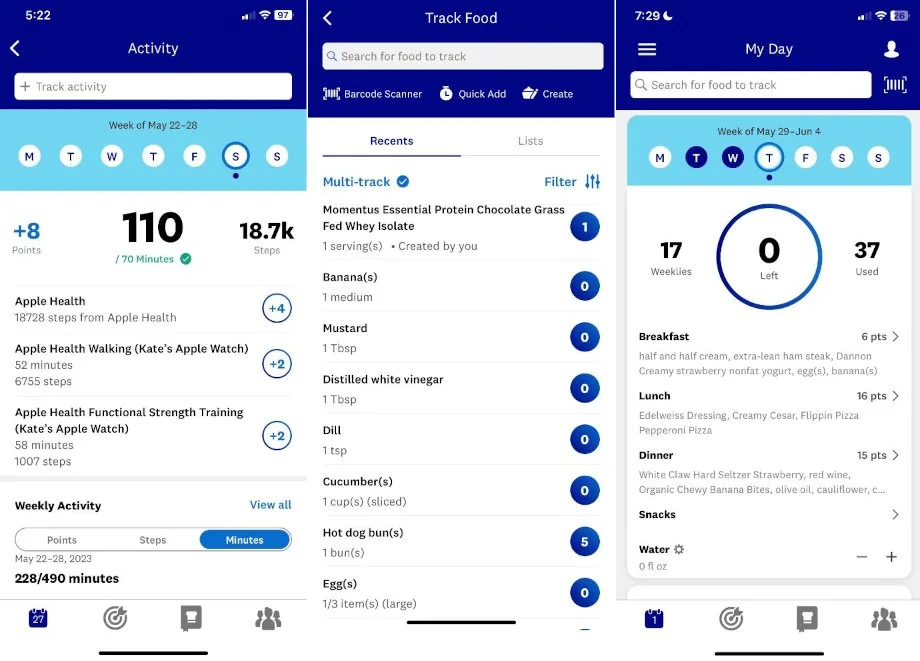
Now, this isn’t technically a calorie-counting app, but rather an app that uses WeightWatchers’ point-tracking system. Rather than tracking the number of calories in a given food, users are assigned a daily points goal, and each food, meal, or recipe is worth a certain number of points.
All you need to do is avoid going over your daily point goal, which may be easier for some than tracking macros or calories. However, because of this shift away from tracking macros, it earns only a 3 out of 5 for stat tracking. That said, you can also measure and track activity, sleep, weight, and blood sugar for diabetics.
This won’t be the best calorie counter app for muscle gain, according to Perry Nix, MS, RD, LD. “Although WeightWatchers rebranded to have more of a wellness-centered focus, the program still promotes weight loss,” she says. “They do use an all-foods-fit approach, allowing any foods into the diet, so long as it fits within your points for the day.”
Our tester, Kate Meier, NASM-CPT, USAW-L1, CF-L1, was very impressed by the large recipe database, along with several other key features, including a robust community which she rated 5 out of 5.
“There are more than 11,000 recipes, and you can track all kinds of activities. It syncs with Apple Health and other platforms as well, so you don’t have to manually input exercise,” Kate said. “There’s also a huge community on social media, in the app, and just with the millions of people who have used it.”
If you like the idea of tracking points instead of calories or macros, and want to try an app that includes over 11,000 recipes for you to try, WeightWatchers is a great app to consider. It even has a large food database; Kate says, “I only had to manually enter an item once.”
For more, check out our complete WeightWatchers review.
| Cost | $23 per month, discounts available with 6-month or 12-month plan |
| Subscription | Monthly, bi-annually, or annually |
| Free trial | No |
| Features | Track points instead of calories, thousands of recipes, supportive community |
| Available on | iOS, Android |
| Compatible with | Apple Watch, Garmin, FitBit, and other smart watches |
Best AI Calorie Counter App: Fitia
Good for: Those seeking fast, easy food tracking
Fitia is a user-friendly nutrition app that combines AI-powered meal planning with robust calorie and macro tracking, making it a strong choice for people who want a personalized approach to nutrition. While many of its best features are locked behind a Premium subscription, the app’s intuitive interface, flexible diet support, and smart recommendations make it one of the better AI calorie-counting apps available today.
- Free version available
- Supports vegan diets
- Premium free trial
For those looking for an AI-powered app to make food tracking, meal planning, and hitting your goals quick and easy, Fitia is an excellent choice. Everything is tailored to your specific goals and preferences, which you share during the onboarding process, and the plan will continue to adjust as needed to help you reach your goals.
We give it 4 out of 5 stars for ease of use. I set this app up myself to see how it went, and I was impressed with the onboarding questions. They ask a lot of information, and there’s even a chat box to share your preferences with the AI, including foods you like or don’t like, your workout schedule, how many meals you eat in a day, and more.
Once you’re set up, actually logging your food is easy, too. You can snap a photo, use your voice to tell the app what you ate, or type it in, and you’ll be good to go.
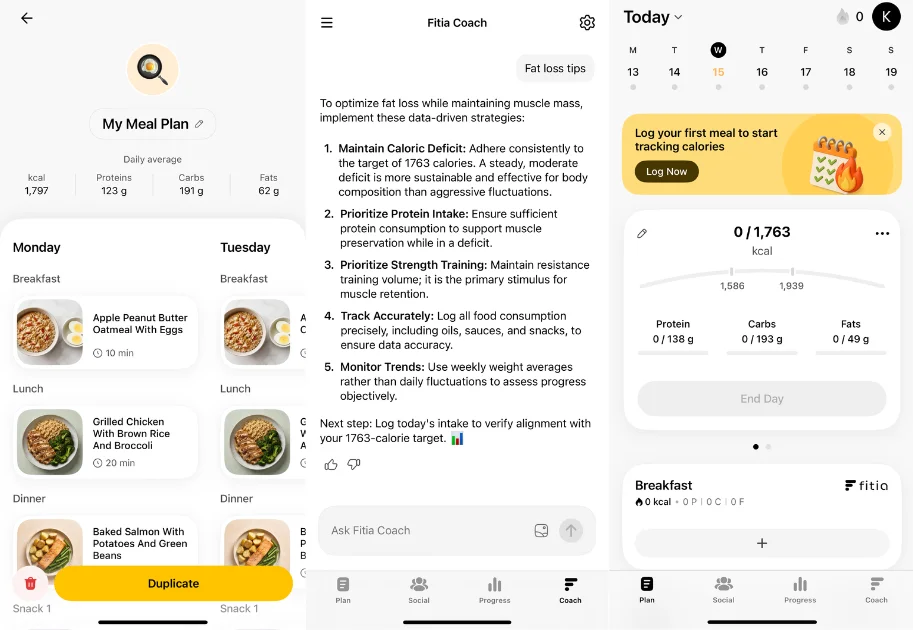
While this makes tracking your food quick and convenient, it may not be the most accurate way to log your calories and macros, even if you’re using the photo-logging feature. Fitia claims their AI photo logging feature is 30% more accurate than competitors, but we still advise using caution if you rely on this feature alone.
“The accuracy of this type of tracking leaves me highly skeptical,” says Destini Moody, RD, CSSD, LD. “There’s a speak-to-track feature that gives the example of you simply speaking into your phone, ‘I had two toasts with eggs for breakfast.’ For people who have never tracked before, it gives users a false sense of security that all they have to do is give a vague description of their meal and get accurate data, which isn’t the case.”
For example, Destini pointed out that you could have used different types of bread, or added oil or butter to your toast, and the app may not realize it.
In other words, Fitia does a great job of giving you a ballpark estimate of your calories and macros. However, if you need precise numbers, you’ll probably want to use a food scale. And for the speak-to-track feature, we recommend being as specific as possible with food sources and quantities, as Fitia pulls nutrition information from USDA data. Still, we give Fitia 3 out of 5 stars for accuracy since it depends largely on how detailed you are when dictating your meals.
It’s great for beginners, though, especially those new to tracking who just need to get started, and worry about precision later. Speaking of beginner-friendly, both Destini and I were quite impressed with the meal planning aspect of Fitia, which is often the most challenging part of healthy eating for many people. This is one of the reasons Fitia earns 5 out of 5 stars for features and resources.
“I do like the meal planning and grocery store feature, along with a barcode scanner for packaged foods for ease,” Destini told me. “The meal planner seems legit, but I would need to see how they calculate the macros they are basing the meals on to really tell. Even that said, even I as a dietitian know the tedious pain it causes to make meal plans from specific macros, so if this app can do it within your individual food preferences, that’s a great feature.”
If you want something that’s fast and easy, leaning on the power of AI to help simplify your food planning and tracking, Fitia is a great choice.
| Cost | Free plan available; $19.99 per month or $59.99 per year for individual plan, $89.99 per year for family plan |
| Subscription | Monthly or annually |
| Free trial | Free version available |
| Features | AI food logging, voice logging, text logging, meal planning, AI coaching |
| Available on | iOS, Android |
| Compatible with | Apple Health, Google Health Connect |
Best Calorie Counter App with Barcode Scanner: MacroFactor
Good for: Anyone who wants a barcode scanner and AI coaching

- Offers monthly or annual plans
- Auto-adjust calorie targets based on progress
- 7-day free trial
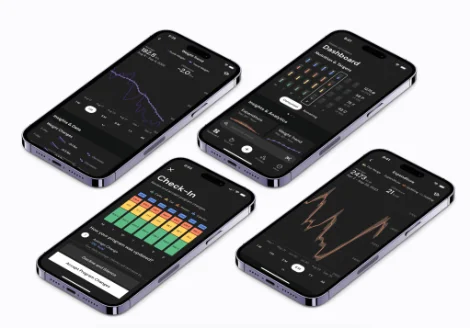
I’ve been using MacroFactor for just over a year. As a nutrition coach, it’s one of the better calorie-tracking apps I’ve ever seen or used, and easily earns a 5 out of 5 for its features and resources.
It has two unique features I really love. The first is the barcode scanner, which is extremely fast and easy to use. If you scan a barcode and it’s not in the food database, you can also scan the nutrition label and MacroFactor quickly imports all of the nutrition facts, allowing you to easily create a new food without having to manually enter the information. Because of this, MacroFactor earns a 5 out of 5 for its ease of use, too.
MacroFactor also has a great algorithm for tracking your energy expenditure with its AI Coaching. As long as you record your daily body weight and food intake, honestly, the app will calculate your exact energy expenditure after a few weeks based on what you’ve been eating and any change in body weight.
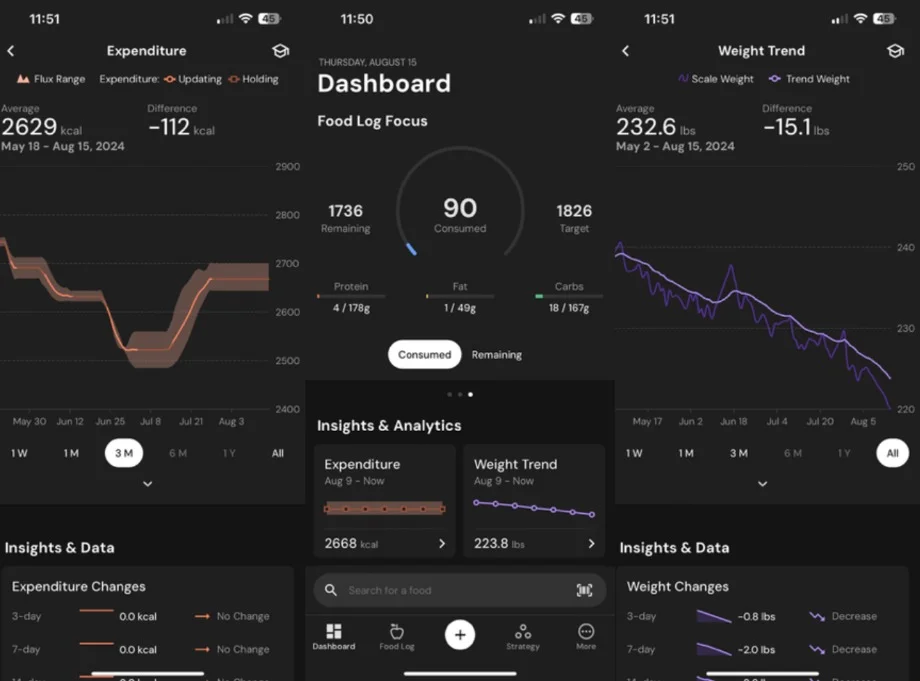
This is a great way to figure out how many calories you burn, as it’s calculated based on what’s happening in your body in real-time, rather than estimating your energy expenditure using your height, weight, and activity level.
Having this information allows the app to tell you exactly how much you need to eat to reach your fitness goals, based on your current energy expenditure. You can also use a coached, collaborative, or custom program, where you set your health goals (weight loss, weight gain, or maintenance), and the app will monitor your progress and suggest changes to your macros to keep you on track.
It’s not the cheapest food tracker at $11.99 per month, so it gets only a 2-out-of-5 score here. However, the interface, fast barcode scanning, and energy expenditure tracking with built-in coaching are well worth the cost.
| Cost | $11.99/month or $71.99/year |
| Subscription | Monthly or annually |
| Free trial | 7 days |
| Features | Built-in nutrition coaching, energy expenditure tracking, barcode scanner |
| Available on | iOS, Android |
| Compatible with | Apple Health, Google Health Connect, FitBit |
Best Calorie Counter App for Muscle Gain: MyFitnessPal
Good for: Anyone looking to build muscle and strength





MyFitnessPal is one of the OG calorie counting apps on the market. The free version is available for looking up food per item and creating recipes, but does not allow you access to the barcode scanner. The Premium version grants you access to macronutrient data, intermittent fasting, food comparison, and the barcode scanner.
What our tester says:
“I think this is one of the easiest apps I’ve ever used. It’s super user-friendly.”
- Free version available
- 1-month Premium trial
- Track tons of metrics
MyFitnessPal is one of the most popular calorie counter apps on the market, if not the single most popular app. It has a clean interface, it’s extremely easy to use and beginner-friendly, and can track exercise, steps, and more. “You can input and track just about any metric and goal in a progress tab,” adds Kate Meier, NASM-CPT, USAW-L1, CF-L1, who rates the tracking a 4 out of 5.
The paid version also has all the features we’d expect to see in an app, including the ability to set your own custom macros, use the barcode scanner, track your body weight and progress over time, and more, but it does have two things we need to call out.
The first is the public food database. Anyone can add their own food entries, and there’s no way to tell if the one you’re choosing is correct. Some food entries will have a green checkmark to show it’s been verified with a food database, but it’s still confusing.
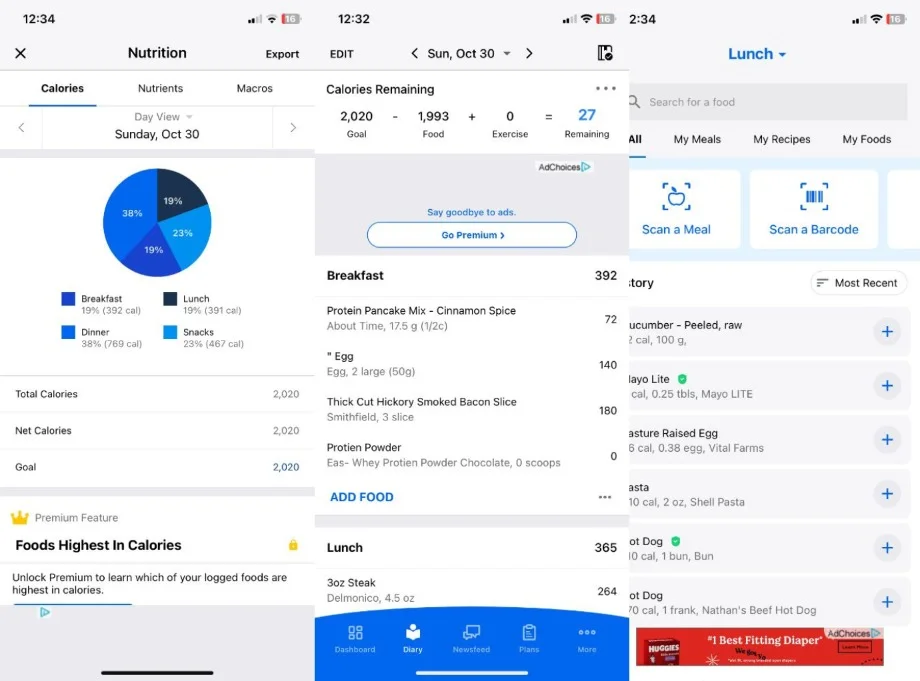
Kate tested this app and quickly noticed this as well. She said, “The one issue is that users can add foods, and those will show up when you search, and you might have to dig to really figure out which one is the right one.” For that reason, she rates the accuracy a 4 out of 5.
The second thing is the premium plan, which isn’t cheap at $19.99 per month or $79.99 per year. While there is a free version, it’s quite limited and doesn’t allow you to use the barcode scanner or set your own macros.
If you’re willing to pay the membership fee, this app is still very easy to use with a clean interface and one of the most user-friendly calorie-counting apps we’ve tested. It easily gets a 5 out of 5 for its ease of use (see what I did there?) Perry Nix, MS, RD, LD, adds, “I appreciate the visual pie graph breaking down macros that I consumed each day. It’s a helpful tool for increasing your protein or reducing fat intake.”
Even though the database can be hard to verify, we felt this was a bigger issue when looking to lose weight as calories need to be more precise, so we still recommend MyFitnessPal for those currently working on intentional weight gain.
| Cost | Free, Premium costs $19.99 per month or $79.99 per year |
| Subscription | Monthly or annually |
| Free trial | 1 month |
| Features | Macro tracking, barcode scanner, large food database |
| Available on | iOS, Android |
| Compatible with | Apple Watch, Garmin, FitBit, Strava, MapMyRun, and more |
Other Calorie Counter Apps We Researched
There are plenty of calorie counter apps to choose from, but we simply couldn’t include them all. Here are a few that came close, but didn’t quite make the cut.
- Healthi App: Healthi offers weight loss plans and allows users to track calories and macros, but it received a lower score based on our testing methodology than the other apps on our list. You can check it out in our Healthi App review.
- Foodvisor: As mentioned in our Foodvisor review, the app is very easy to use, but our tester found that the food database wasn’t always accurate. Plus, the option to log food by taking a photo didn’t work well.
How We Picked and Tested the Best Calorie Counter Apps
We didn’t just choose these apps off a list, we carefully used and tested each.
Here are a few of the most important factors we look for when evaluating a nutrition app, which we used to assign scores and determine the top eight apps.
Ease of Use
Is this app easy to use, or do you need to watch tutorials to figure it out? Most people want something simple and easy to use without too much of a learning curve, so we prioritized apps that are very intuitive and easy.
Some of the apps we chose may have more advanced tracking features available, but each should be quick to set up if you’re simply looking to record your food intake.
Progress Tracking
If you’re counting your calories, you’re probably working toward some kind of body composition goal. While all of these apps can record your food, we wanted to include apps that allow you to track all sorts of progress, including measurements, scale weight, progress photos, and more, allowing you to record most of your health and fitness data in one place.
Food Database Accuracy
Finally, an accurate nutrition database is tremendously helpful, especially for those new to nutrition and calorie counting.
While an app like MyFitnessPal is user-friendly in almost every single way, the food database includes custom user entries, which means you may be combing through dozens of entries for the same food if there’s no verified option. On the other hand, paid apps like MacroFactor may not be free, but the verified food database can save you plenty of time when logging your calories.
Features
The types and amount of features available will vary from app to app. The most basic health apps will allow you to track your food and weight, but many fitness apps have advanced features, like barcode scanners for easy logging, advanced metric tracking, and integration with the best fitness trackers. Some advanced features will only be available in the app’s premium version, however.
Compatibility
Our testers noted which platforms these apps were available on—notable iOS or Android devices. We also rated the compatibility an app had with other devices or apps. Many apps will integrate with smart watches, fitness trackers, and fitness tracker rings; some will also connect to running apps and weightlifting apps to track all your health and fitness goals in one spot.
Benefits of the Best Calorie Counter Apps
Logging everything you eat on a phone app may seem inconvenient, but apps can be a useful tool to help you reach your calorie goals. Here are a few of the biggest reasons you may want to consider using a nutrition app.
I’ve worked with hundreds of clients over the years who’ve benefited from using these apps, and to get another opinion, I also spoke with Destini Moody, RD, CSSD, LD, the head of performance nutrition for the NBA G League Ignite, to see what she thinks of these apps.
Improved Food Awareness
Even if you aren’t focused on any particular weight goal, tracking your food is a great way to build food awareness and make good dietary choices. It’s no secret that the average American diet isn’t always the healthiest, so tracking your food, even for a short period of time, can be a good way to clean things up.
In my first college nutrition course, we were required to keep a food log for two weeks, which was my first experience tracking everything I ate. This eye-opening experience helped me make a few major changes to improve my overall nutrition intake.
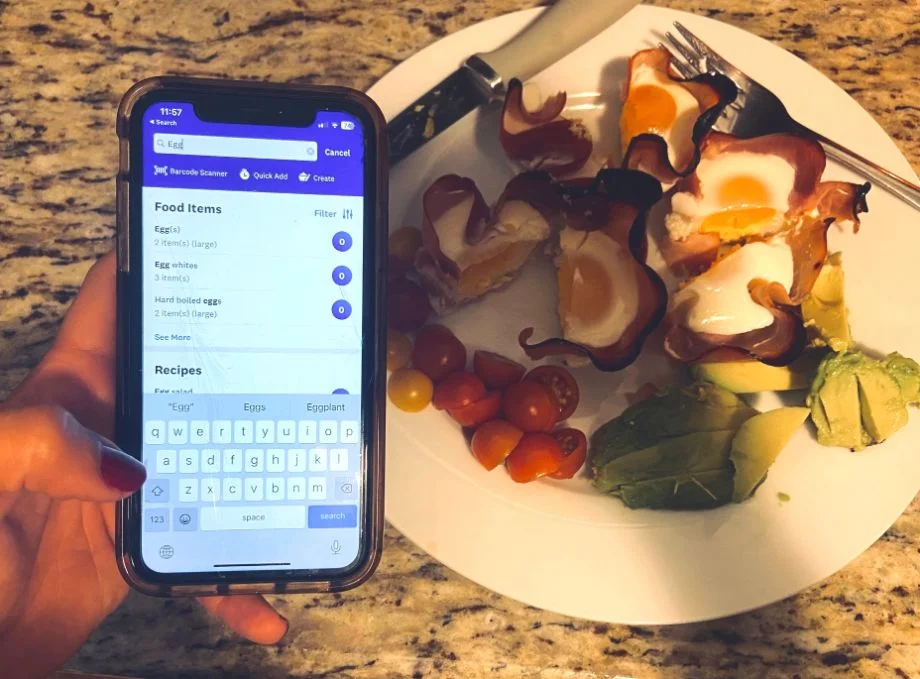
Destini had a similar experience, saying, “Tracking food can be an educational tool in that it can open people’s eyes to the true macro and calorie content of their food. When I was on a cut in grad school and using MyFitnessPal (my personal favorite tracking app) to help me track my protein and fat intake, even as a nutrition student I was shocked at how many grams of fat were contained in a cup of oats, and quickly discovered that this food alone was probably hindering my fat loss.”
Just like tracking your spending can help you accurately assess your financial situation and set a budget, being honest and looking at food logs is a good way to quantify your eating and ensure it’s aligned with your goals.
RELATED: What Should My Macros Be?
Easier Time Reaching Your Goals
For those trying to lose weight, a calorie deficit is key, and tracking your food helps ensure you’re staying in a deficit and reaching your goals as quickly as possible. There’s nothing worse than putting in the mental effort of dieting, only to see no results because you’re still eating too much food.
Whether you’re focused on weight management, athletic performance, or muscle gain, proper nutrition is one of the most important factors.
Destini offered her own insight on the topic as a sports dietitian who regularly works with athletes who need precision and accuracy to reach their goals as quickly as possible.
“As a sports dietitian, I’m intimately familiar with how tight control of your calories and macros can make or break body composition changes,” Destini said. “Even the smallest inconsistencies in your diet can significantly slow fat loss or muscle gain progress. That’s why I recommend that anyone with the time use a food tracking app to track their intake when possible.”
If your goal is weight loss, tracking your food may be the best way to see results. This 2017 study1 looked at participants in a 12-month weight management program, comparing those who rarely tracked, inconsistently tracked over the year, or consistently tracked food for the entire 12 months. Only the group that consistently tracked their food lost significant weight.
Improved Nutritional Balance
If you’re not logging your food intake, knowing exactly how many nutrients you’re consuming is impossible. While most of us don’t have to worry about major nutrient deficiencies if we’re including whole foods in our diets, certain diets can sometimes be restrictive.
For example, removing an entire food group can lead to very low intakes of important nutrients like fiber or healthy fats. That’s why many calorie-counting apps can alert you if your diet seems to be missing any key food groups, vitamins, or minerals, helping make sure you’re not missing anything important.
What to Look for in a Calorie Counter App
If you’re having trouble choosing a calorie counter from our list, here are a few of the most important factors to consider.
Cost
While many of the best calorie counter apps have a monthly fee, there are certainly free versions available, though certain features are often locked without a premium subscription.
That said, the monthly cost can vary greatly, and there’s often a discount if you pay for a year in full. We suggest trying a few apps to see which you like the most, and which you’re most likely to stick with, and purchasing a year upfront to get the best savings.
Barcode Scanner
For those who have never tried a calorie counting app with a barcode scanner, the scanner allows you to import the nutrition information of most commercial foods by simply scanning the barcode.
This will typically bring up the nutrition information, and you can simply enter the serving size you consumed to log your food. Compared to manually entering all of the information, a barcode scanner can save you significant amounts of time, especially if you’re entering food throughout the day.
Custom Macros
While many simply want to track their calories, some users may have macronutrient goals they’re aiming for. If you want to track your macros and customize your macro targets, make sure the app you’re choosing allows you to do so.
Every app on our list allows you to do this, but some apps only allow premium members to change their macro targets. If you’re going to be using a free app, you’ll want to make sure this feature is available if custom macros are important for your goals.
Automatic Diet Adjustments
Counting calories is usually associated with a specific body composition goal, such as losing body fat, increasing lean muscle mass, or both. Most apps will calculate a basic target based on your body stats, but they may or may not adjust the macros for you along the way.
Some apps on our list, like MacroFactor, allow you to set your goal weight. The app will automatically adjust your macro targets to keep you on track as you progress toward your goal. This is a powerful tool for anyone uncomfortable adjusting their nutrition plan and not ready to hire a nutritionist or registered dietitian.
Best Calorie Counter Apps FAQs
Is it bad to use a calorie-counting app?
While calorie counter apps can be very useful, Destini Moody, RD, CSSD, LD, cautions that those with eating disorders should be careful.
“The one thing I will say is that I do not recommend food tracking apps for people with an active or a history of eating disorders,” Destini said. “Those with these disorders tend to have a dysfunctional relationship with food and the weighing, measuring, and data-driven nature of food tracking apps exponentially increase the chances of one becoming obsessive over their food intake. These behaviors can exacerbate an eating disorder or cause a relapse in those with a history of one.”
This is supported by research, as this study2 showed that dietary tracking may become “harmful if the behavior becomes obsessive or if the user has poor body image.”
What is the most accurate calorie-counting app?
Many apps use verified food databases only and don’t allow users to upload foods to the public database. This includes apps such as Cronometer and MacroFactor. If you’re using an app with a public food database, be sure to carefully check each entry for accuracy before recording the food.
Is there a free calorie-counting app?
Most of the calorie tracking apps will have both free and premium plans, and you’ll often find that the best features are locked in the premium version. If you’re looking for an app that includes most features for free, including basic calorie counting, we recommend platforms like Simple or Lose It!.
Can I use a calorie-counting app with a smartwatch?
While most apps require you to use your phone to find and record food, most apps will sync with fitness devices such as FitBits, Apple Watches, Garmins, and more, using them to monitor your activity levels and record your exercise. Many apps can also sync with Apple Health or Google Fit.
These statements have not been evaluated by the Food and Drug Administration. This product is not intended to diagnose, treat, cure, or prevent any diseases.
References
- Ingels, J. S., Misra, R., Stewart, J., Lucke-Wold, B., & Shawley-Brzoska, S. (2017). The Effect of Adherence to Dietary Tracking on Weight Loss: Using HLM to Model Weight Loss over Time. Journal of diabetes research, 2017, 6951495. https://doi.org/10.1155/2017/6951495
- Hahn, S. L., Linxwiler, A. N., Huynh, T., Rose, K. L., Bauer, K. W., & Sonneville, K. R. (2021). Impacts of dietary self-monitoring via MyFitnessPal to undergraduate women: A qualitative study. Body image, 39, 221–226. https://doi.org/10.1016/j.bodyim.2021.08.010