



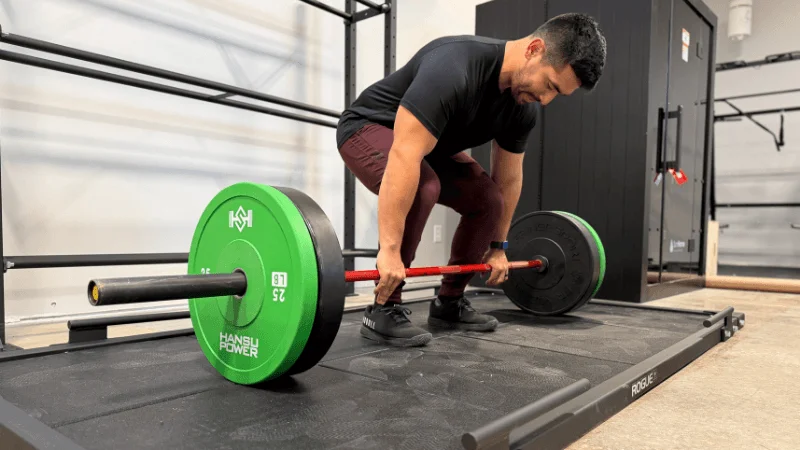
Sometimes, covering your concrete floor with horse stall mats (one of our favorite home gym flooring options) or another affordable DIY solution simply won’t cut it. After all, if you’re into powerlifting, CrossFit, or just want to increase your deadlift PR, you’ll need a stable lifting surface that can withstand the load of heavy barbells.
That’s where a deadlift platform can come in handy.
Built to reduce noise, protect your floor, and provide a slip-free foundation for your lifts, platforms are an underrated piece of fitness equipment that support safer, more effective workouts. In this Rogue Deadlift Platform review, I’ll take a closer look at a high-quality option from a manufacturer that’s produced some of our favorite squat racks, dumbbells, and other strength training accessories.
So, if you want to enhance your home gym experience, it’s time to step up your setup with a proper lifting platform.
Our Rogue Deadlift Platform Review, Summarized
The Rogue Deadlift Platform is a well-built piece that can enhance your deadlift training by providing a stable surface that also dampens some of the noise created by dropping the barbell. Made in the USA, it features an 11-gauge steel frame that’s covered by a lifetime warranty. Our tester was highly impressed by the rugged materials, rating the Rogue Deadlift Platform a perfect 5 out of 5 for durability.
How We Test Deadlift Platforms
Is the platform made from high-quality materials, such as 11-gauge steel? Is it capable of repeatedly withstanding heavy loads? We award a 3 out of 5 if the platform features solid construction, though it might not blow us away from an aesthetics standpoint. Higher scores go to ultra-durable designs that have a premium look and feel.
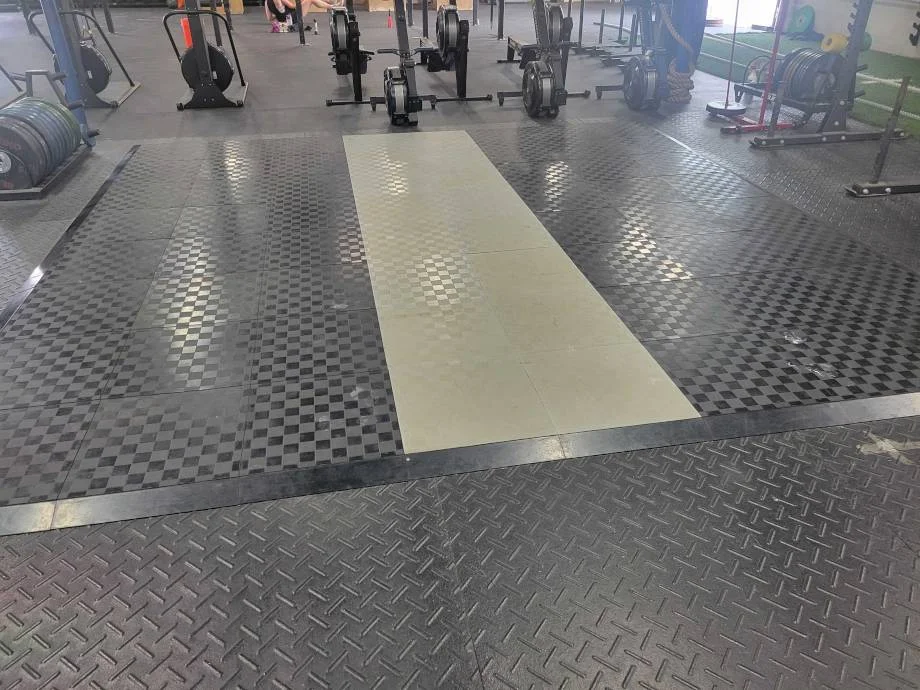
How well does the platform reduce noise when dropping a barbell loaded with bumper plates? Thick rubber tiles or composite materials can help absorb the impact and minimize the loud vibrations that can travel through the floor. To earn a 3 out of 5, the platform does a decent job of dampening the sound, but it’s still not the quietest environment.
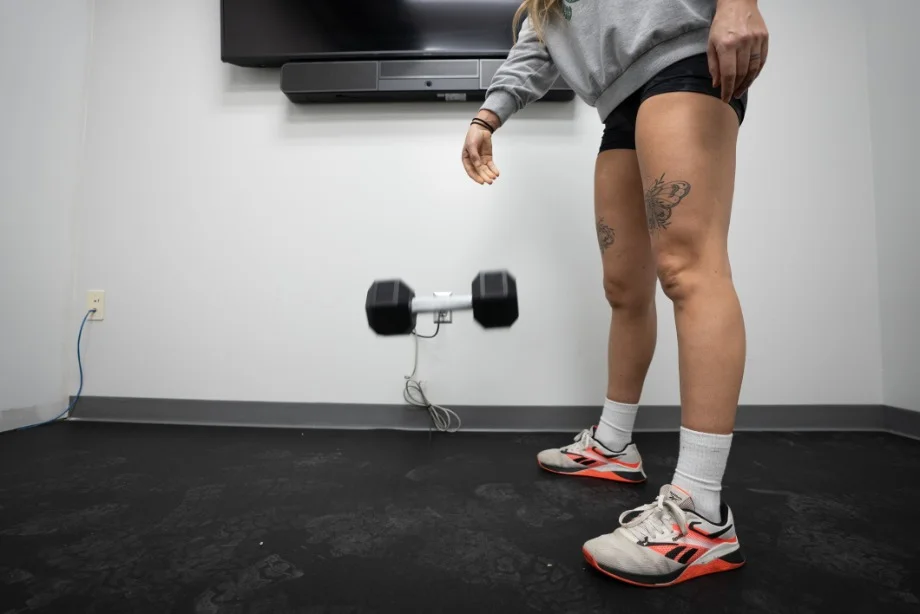
Is the platform large enough to safely perform Olympic weightlifting exercises like split jerks? Or, is it strictly designed for standard and banded deadlifts? We give a 3 out of 5 if the platform works well for deadlifts, but it may not have sufficient space for movements that require more real estate.
Following the principles from our fitness equipment testing methodology, we evaluate a number of factors during trials, including a platform’s durability and versatility to assembly needs and value. Our expert product testers build, examine, and train with these platforms (drop tests, included) over multiple session to determine accurate ratings based on a 1-5 scoring scale.
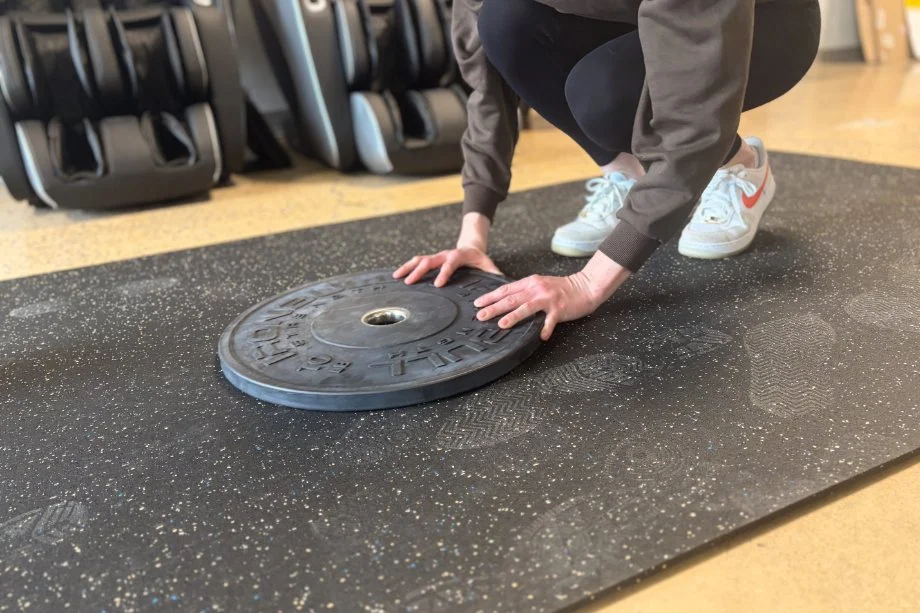
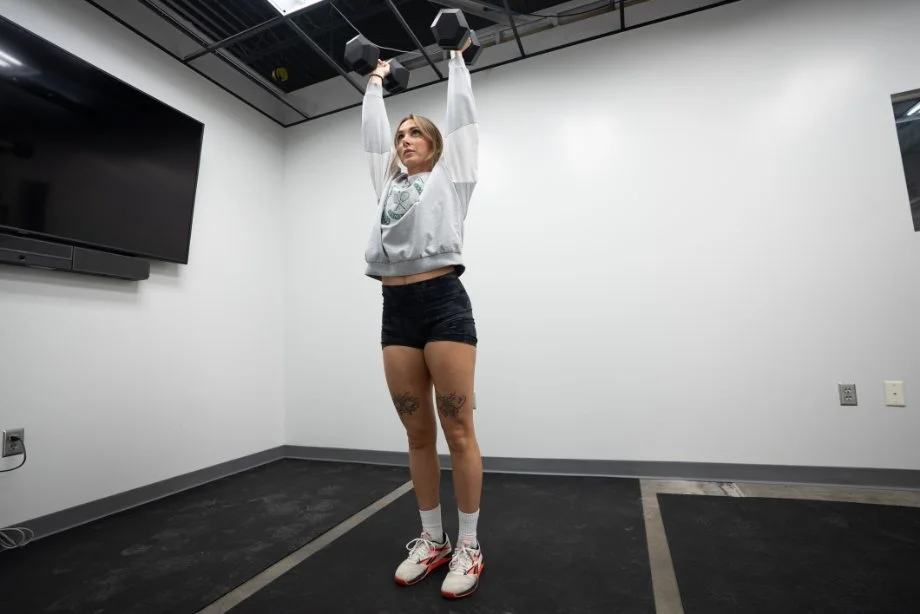
The Garage Gym Reviews team includes certified personal trainers, Olympic-level athletes, and dedicated lifters who have performed deadlifts (and other exercises) on more than 20 types of platforms and home gym flooring options, including horse stall mats and dedicated lifting platforms. We’re also quite familiar with Rogue, having reviewed products like the brand’s R-3 Power Rack, Echo Rowing Machine, and Ohio Power Bar.








What to Know Before You Buy
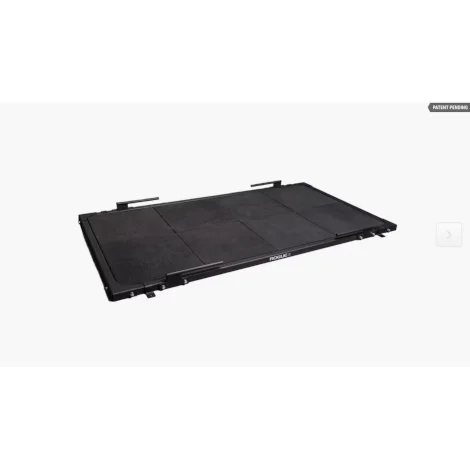
- While the platform costs around $495, you’ll have to pay an extra $100 if you want floor plates included so the frame won’t need to be bolted to the ground. This can be a worthwhile upgrade, in our opinion, that helps prevent the platform from flexing or bowing.
- You also need to factor the cost of rubber tiles ($300 for an eight-pack) into your total purchase. Rogue also offers a three-piece wood insert set for $55 that goes between the steel floor plates for a more level surface.
- The 11-gauge steel frame features a set of four band pegs that allows you to incorporate resistance bands into your deadlift training. This can be a great way to help improve your lockout strength through accommodating resistance.
Is the Rogue Deadlift Platform Worth It?
Make no mistake about it: The Rogue Deadlift Platform is more of a luxury item than a true home gym necessity. If you don’t regularly perform barbell deadlifts in your workout routine, you can pass on this for a more cost-effective option like horse stall mats. I’ve used stall mats in my garage gym and have been satisfied with their performance and durability.
However, if you’re a powerlifter, CrossFit enthusiast, or someone who has the space and need for a dedicated lifting platform, this is one of the best options on the market. Rogue is renowned for the brand’s build quality and attention to detail, and the company didn’t take any shortcuts here. Even though your total investment may inch closer to $1,000, you’re getting a well-constructed product that’s covered by a lifetime frame warranty.
Ultimately, you need to decide whether spending that type of money on a somewhat specialized piece of gear is a better solution than upgrading other aspects of your home gym. But if you determine that less noise and more stability are worth the cost, the Rogue Deadlift Platform can certainly be a viable solution.
Still deciding if the Rogue Deadlift Platform is a worthwhile investment? Read on to find out some key specs and metrics for this specialized piece of equipment.
Rogue Deadlift Platform: Key Features & Specs
| Price (Original MSRP) | Starting at $495 |
| Dimensions | 8’4” L x 4’4” W |
| Platform Thickness | 2” (frame) 1.5” (with rubber tiles only) 1.875” (with wood insert) |
| Weight | 334 lbs (tiles only) 375 lbs (wood + tiles) |
| Material | 2” x 2” 11-gauge steel frame |
| Warranty | Lifetime frame |
Workout Experience With the Rogue Deadlift Platform
GGR expert product tester Orlando Castillo is a North Carolina-based certified personal trainer and CrossFit athlete with extensive strength training experience. We called upon him to put the Rogue Deadlift Platform through the wringer to evaluate its construction, durability, versatility, and sound-dampening effects. Having trained on all types of gym flooring, Orlando was quite impressed by this premium option.
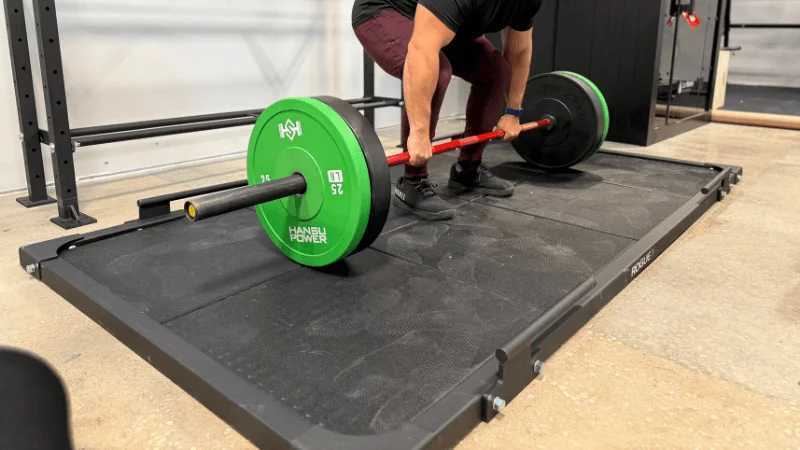
“The outer structure is incredibly solid,” he explains. “The platform offers the ideal space to perform deadlifts, which is its primary use.”
In addition to his feedback, I also gathered some insight from GGR Founder Coop Mitchell and Performance Editor Caine Wilkes, OLY, CNC, USAW-L1 on this highly rated lifting platform.
Deadlift platforms can take up quite a bit of space in a home gym, so they’re not for everyone. However, if you want a dedicated spot for heavy deadlifts, I like the Rogue Deadlift Platform. It’s a bit pricier when you add on the floor plates and rubber tiling, but it’s built with heavy-duty steel and other materials. Plus, its 4-foot-by-8-foot layout is a more compact platform option for home gym spaces.
GGR Performance Editor and Olympian weightlifter Caine Wilkes
Rogue Deadlift Platform Rating
Materials and Construction
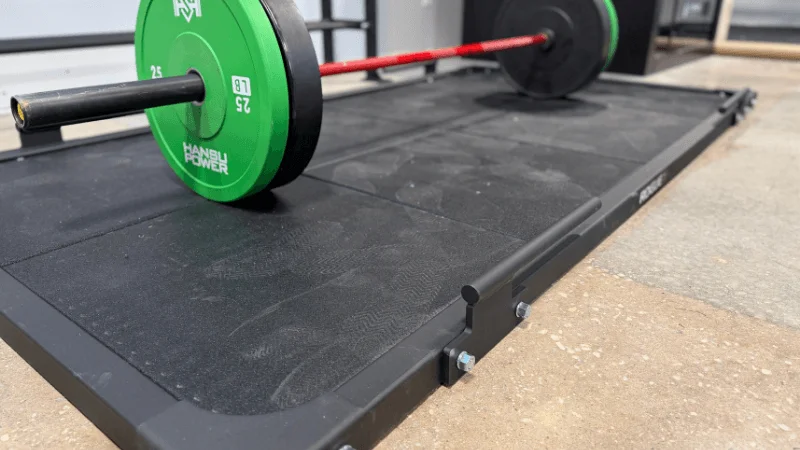
Although it fell just short of a perfect score, the Rogue Deadlift Platform earned an impressive 4.5-out-of-5 rating for construction and materials. The 2-inch-by-2-inch frame is made with 11-gauge steel—our preferred choice for everything from weight benches to squat rack uprights because of its sturdiness.
“It’s classic Rogue; the frame hardly flexes, the powdercoat is fantastic, and it’s a solid platform for heavy lifts,” says Coop Mitchell, GGR founder.
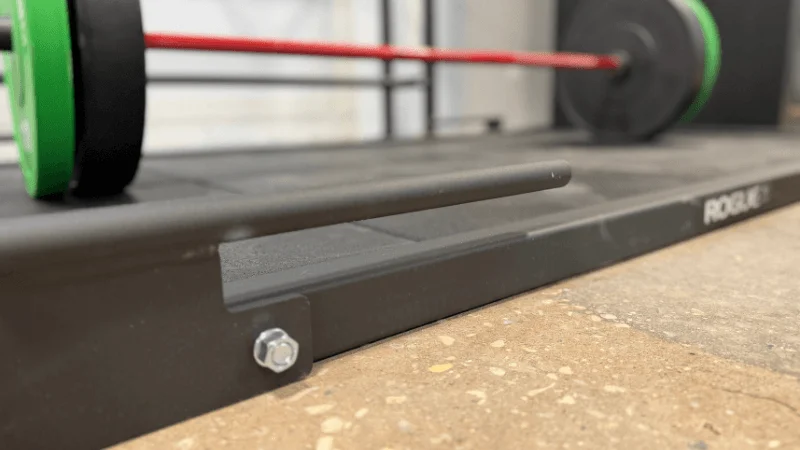
Beyond the frame, this platform includes long band pegs for attaching resistance bands to your standard Olympic barbell or longer specialty bars. This can be a useful feature that allows you to increase the tension during the concentric portion of the deadlift. According to a 2022 study1 on male classic powerlifters, using accommodating resistance led to significantly greater improvements in relative deadlift strength in comparison to traditional plate-loaded training. So, utilizing the band pegs can help you make greater gains.
“The pegs are easy to place resistance bands on and can hold any amount of tension you need,” adds Coop.
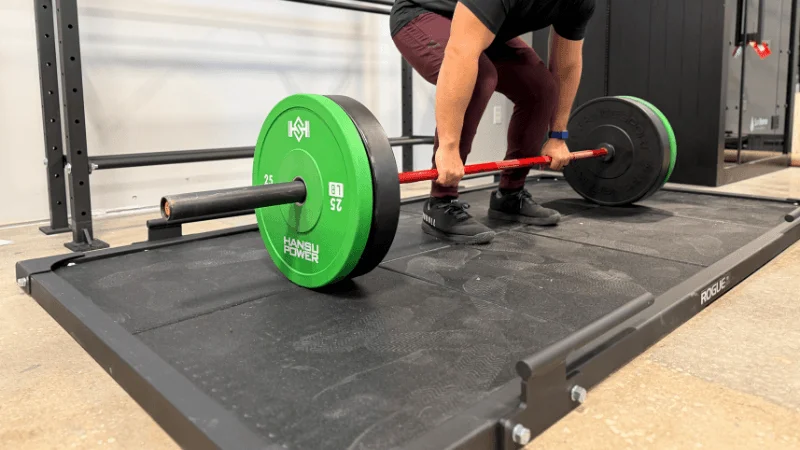
Furthermore, Orlando points out that the rubber tiles are “heavy and secure,” adding to the overall stability of the platform. Each tile weighs 28 pounds and 24 inches wide by 24 inches long with a 1.5-inch thickness. Orlando did have one minor callout, though.
“There’s a noticeable spacing between the blocks, which slightly hurts the aesthetics,” he says.
Durability
In our experience, Rogue products rate highly for durability, which should be no surprise given the high-quality build materials like 11-gauge steel. While it’s best to evaluate this category over the long term, we feel comfortable giving a perfect score of 5 out of 5 here based on our history with the brand, as well as Orlando’s evaluation.
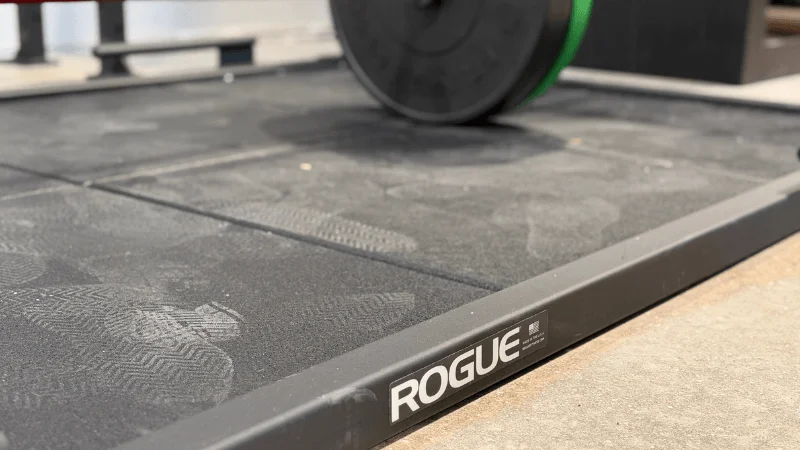
“The platform feels built to last,” he explains. “The materials are solid, and the rubber is thick enough to resist wear unless exposed to harsh cleaning chemicals or repeated friction in the same spot.”
If you’re concerned about your barbell rolling away and getting damaged, don’t fret. Orlando reports that the bar stays mostly in place with “minimal sliding or bouncing.”
Sound Dampening
Besides providing a stable, slip-free surface, a deadlift platform can also help cut down on some of the noise that’s generated from dropping weights. While this is certainly beneficial in commercial gym settings, it’s even more valuable for home gym owners who don’t want to disrupt their family members or neighbors.
So, how did the Rogue Deadlift Platform measure up in terms of reducing noise? “I gave it a 5 considering the thickness of the flooring and how well the sound and bounce of the bumper plates was,” Orlando told me.
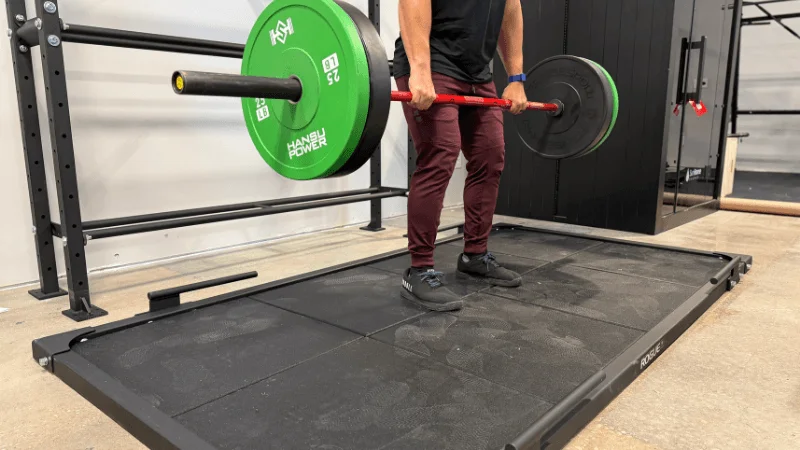
Of course, you shouldn’t expect a silent workout, but when comparing dropping a loaded bar on the bare floor or typical home gym flooring, the platform does a great job making things as quiet as they can be.
“I have used weightlifting platforms, plywood, concrete, and rubber flooring, and in this case, this is about as quiet as it can be considering all the options used,” Orlando says.
Versatility
The only category in which the Rogue Deadlift Platform failed to earn a 4 or higher is versatility. This stems from the dimensions, as it measures 8 feet, 4 inches long and 4 feet, 4 inches wide (the standard for a deadlift platform).
Earning just a 3.5 out of 5 for the category, the platform is ideal for its intended use but not well-suited for Olympic lifts. Orlando, who stands 5 feet, 9 inches, states he wouldn’t feel comfortable performing lifts like the clean and jerk due to the space limitations.
I also spoke with GGR Performance Editor Caine Wilkes, who competed at the 2020 Tokyo Olympic Games, about this product’s versatility (or lack thereof). “The band pegs would get in the way in case you have to chase a weight at all, and the 4-foot depth would make split jerks dicey for some folks,” he told me. “I usually like 6-foot by 8-foot, or 8-foot by 8-foot dimensions for Olympic lifting training platforms.”
RELATED: Equipment for Olympic Weightlifting
Installation
Few things can be more frustrating than trying to assemble a piece of fitness equipment without the proper tools or instructions. Luckily, Rogue crafted this deadlift platform with a bolt-together design and laser-cut/precision-bent gussets (the angled reinforcements used to strengthen joints).
Although Orlando didn’t assemble this one himself, he’s put together another Rogue Deadlift Platform in the past and found it to be a simple, straightforward process.
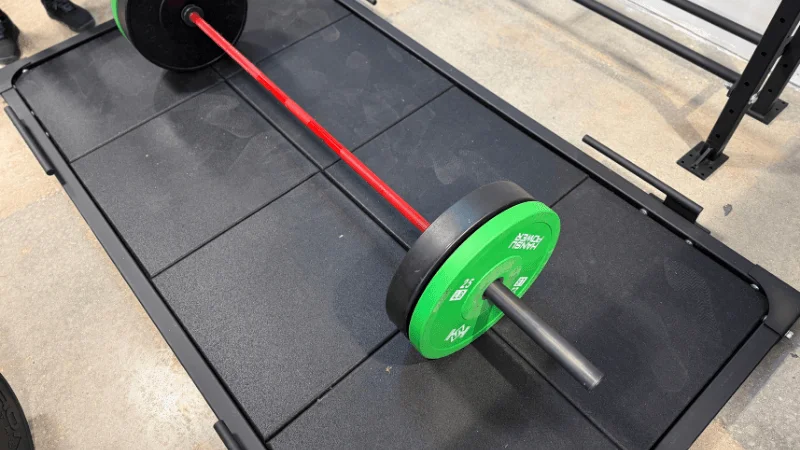
“The tiles are the only tedious part because they’re heavy,” he explains. “There are minimal gaps but nothing that would mess up a lift.”
According to Orlando, it should take about 30 minutes to put the entire platform together (tiles included). “I would not be intimidated to set this up alone, other than moving the frame around,” he says, rating the installation a perfect 5 out of 5.
Smell
Anyone who’s opened a new set of bumper plates or rubber floor mats knows there can be a particularly unpleasant, petroleum-like odor. In particular, gym equipment made from low-cost rubber often emits a strong smell that can be quite off-putting.
Thankfully, that odor doesn’t last forever, but when evaluating deadlift platforms and other rubber-based products, we pay close attention to the initial intensity and how long it takes to become more tolerable.
The Rogue Deadlift Platform earns a 3-out-of-5 rating in this category, which isn’t necessarily a bad thing. “The rubber blocks have a strong smell, initially, but it should dissipate over time, especially with cleaning,” Orlando explains. “If you like the smell of a new gym, it may actually be appealing.”
RELATED: How to Clean Rubber Gym Flooring
Price and Value
Considering the platform costs around $495 on its own, it’s fair to say that this is not a budget-friendly item. Throw in the cost of an eight-pack of rubber tiles ($300), along with foot plates ($100) and the three-piece wood insert set ($55), and this setup could total over $1,000 by the time you factor in taxes.
Is that juice worth the squeeze? While that depends on how often you deadlift, we feel confident in saying dedicated strength training enthusiasts will likely be pleased with this platform. After all, you’re getting a USA-made product that’s covered by a lifetime frame warranty, which should give you added peace of mind.
So, even though it’s more expensive than most deadlift platforms we’ve tested, we rate the value at a rock-solid 4 out of 5.
RELATED: Rogue Fitness Coupon Code
Customer Experience
Right off the bat, Rogue deserves a tip of the cap for providing a lifetime frame warranty. That’s substantially better than what we see from competitors—many of which only offer one year of coverage.
We also appreciate that this deadlift platform is HSA/FSA-eligible, meaning you can use pre-tax dollars to fund your purchase. Rogue also offers financing through Affirm, which can help make things more manageable by spreading the cost out over multiple installments.
To top it off, I can vouch for the company’s responsiveness and customer-first approach. I reached out for specific information on this deadlift platform—including the thickness, weight, and warranty—and received a detailed response in less than two hours that answered all of my questions. That earns Rogue a 5-out-of-5 customer experience rating.
Customer Reviews
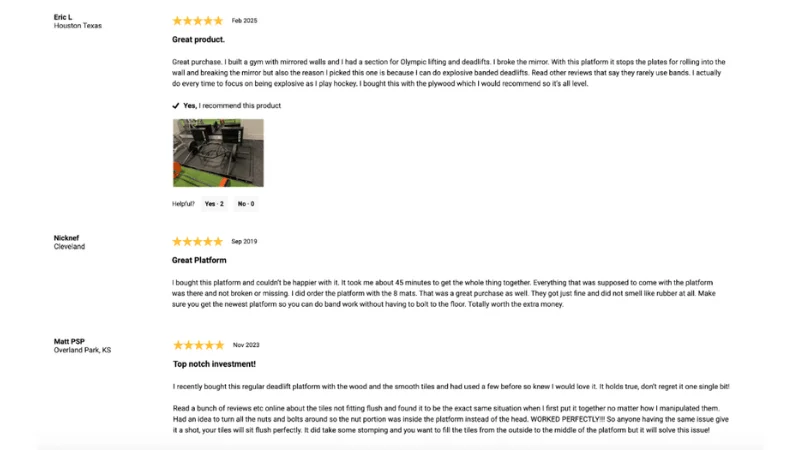
This deadlift platform has earned an average rating of 4.3 stars based on 39 reviews on the Rogue Fitness website. Customers routinely praise the excellent build quality while also mentioning the reduction in noise as standout features. Here are some direct testimonials that reflect those real-world experiences.
Rogue Deadlift Platform Vs
Although it’s a bit of a niche product category, you do have a handful of options if you’re on the hunt for a deadlift platform. Obviously, we love Rogue’s offering, as it’s built with premium materials and comes with a lifetime frame warranty. However, we’ll also acknowledge that it’s a bit pricey, which makes the Titan Fitness Deadlift Platform a viable alternative.
This Titan frame is listed for $375, but you may be able to find it on sale for closer to $300. If you go with the full setup that includes eight shock-absorbing tiles (our recommendation), Titan has it listed for around $740, which we consider a fantastic value.
On the other hand, if you have a bigger budget and need more training space, you could go with the Valor Fitness Olympic Platform. At $1,499, it’s even more expensive than the Rogue Deadlift Platform but it offers better versatility in a raised silhouette that measures over 8 feet long and nearly 7 feet wide.
| Rogue Deadlift Platform | Titan Fitness Deadlift Platform | Valor Fitness Olympic Platform | |
| Price (Original MSRP) | Starting at $495 | Starting at $374.99 | $1,499 |
| Dimensions | 8’4” L x 4’4” W | 99” L x 59.5” W | 101” L x 81.5” W |
| Platform Thickness | 2” (frame) 1.5” (with rubber tiles only) 1.875” (with wood insert) | 2” | 1.25” |
| Weight | 334 lbs (tiles only) 375 lbs (wood + tiles) | 110 lbs | Not disclosed |
| Material | 2” x 2” 11-gauge powder-coated steel (optional rubber tiles) | 2” x 2” 11-gauge powder-coated steel (optional rubber tiles) | High-impact rubber tiles, bamboo-lined boards, steel frame |
| Warranty | Lifetime frame warranty | 1-year warranty | 1-year warranty |
Final Verdict of Our Rogue Deadlift Platform Review
The Rogue Deadlift Platform earned high marks from our team for its sturdy construction, solid sound-dampening effects, and easy installation. While it may not be a foundational piece for every home gym owner, anyone who’s hyper-focused on improving their deadlift should consider it a worthwhile investment in their strength training game.
- If you go all-in on all the options, you’re looking at a total cost of about $1,000.
- Coop recommends using your own double-plywood center for a more rigid base while pulling.
- Check out the Rogue 8’ x 8’ Oly Platform if you need a larger surface that supports a wider range of strength training exercises.
Rogue Deadlift Platform Review: FAQs
Is a deadlift platform necessary?
A deadlift platform isn’t necessary, as you can lift safely on a level surface that’s covered with appropriate home gym flooring like horse stall mats. However, a dedicated platform can help protect your floor and your equipment while also reducing noise and improving overall stability.
What are the pros and cons of the Rogue Deadlift Platform?
The Rogue Deadlift Platform has several standout features, including its sturdy 11-gauge steel frame, integrated band pegs, and 1.5-inch-thick rubber tiles. While we don’t have any concerns about the build quality or overall design, it’s fair to point out that this is a fairly expensive investment once you factor in the cost of the floor plates and rubber tiles. That said, we appreciate that the frame is covered by a lifetime warranty.
How thick should gym flooring be?
GGR Performance Editor and Olympian weightlifter Caine Wilkes recommends no less than a half-inch-thick rubber mat if you plan on heavy lifting or dropping weight from overhead.
RELATED: How Thick Should Gym Flooring Be?
References
- Ferland, P.-M., Tremblay, N., Allisse, M., Comtois, A. S., Bui, H. T., & Leone, M. (2022). The accommodated resistance training method significantly improves deadlift relative maximal strength more than the classic plate loaded method in male classic powerlifters. Gazzetta Medica Italiana – Archivio per le Scienze Mediche, 181(7–8), 507–515. https://doi.org/10.23736/S0393-3660.21.04646-5