

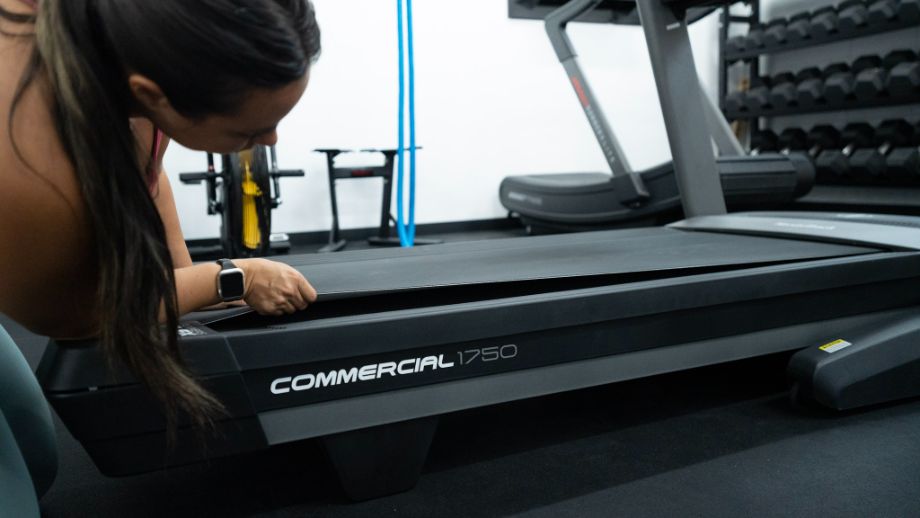
If you have a treadmill in your home workout space, you understand it takes a little bit of maintenance to keep it in top shape. There are many parts to a treadmill, but the most obvious one is the running belt, also known as the walking belt, track, or treadmill belt.
Knowing how to adjust a treadmill belt can help keep this vital component at the right tension and aligned in the center so you can safely exercise (and extend the life of your machine). This process is generally the same across most treadmill models, but we recommend checking your owner’s manual before taking any of the following steps.
Signs You Need to Adjust a Treadmill Belt
No matter the thickness of the belt material, you will likely have to do a treadmill belt alignment at some point. As such, it’s important to be aware of the signs that your running deck is in need of a quick tune-up.
The most common indicator of a misaligned belt when the belt shifts to one side. Your treadmill belt may be slowly drifting too far to the right or left, and this can cause the belt to stretch unevenly or fray. You might also notice that the belt feels like it’s stalling or having trouble turning over. Slipping or underfoot skipping sensations can also be cause for concern.
The good news is, though, that this is one of the easiest parts of treadmill maintenance—you just need to be attentive when these signs arise during your workout routine.
Reasons Your Belt Tension May Need Adjusting
Over time, rubber stretches out and may become too loose. This is the most common reason you may need to adjust your treadmill belt tension. A loose belt that’s too slack can become unstable and skip as it revolves over the rollers. This can pose a tripping hazard and may cause the treadmill to stop functioning completely if not addressed.
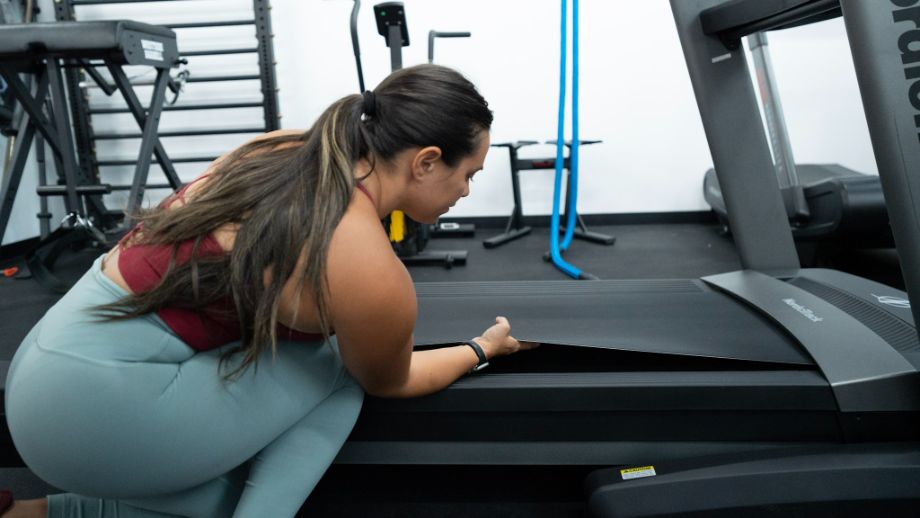
If you aren’t sure whether you need to adjust your treadmill belt tension, see how far you can lift your walking belt from the treadmill deck. If you can lift it more than 4 inches at the center (as seen in the photo above), you will need to adjust your belt tension before your next workout. If the belt slips or skips randomly, this could be another sign to adjust the tension. In most cases, applying lubrication and tightening the belt should resolve the issue.
RELATED: How to Lubricate a Treadmill
If you adjust the tension on the rear roller bolts and the belt is still skipping, the issue may not be tension-related. Check to see if the drive belt may be loose. The drive belt connects the motor to the front roller and propels the belt. If the drive belt is loose, it can cause the front roller to speed up and slow down sporadically, making the belt “skip.” Please refer to your user manual for instructions on tightening the drive belt, and check your warranty information to see if this issue is covered.
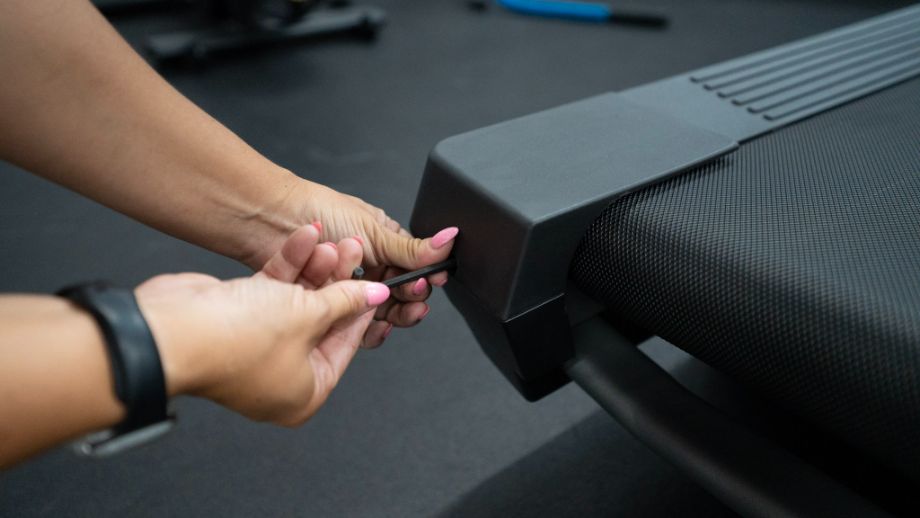
4 Steps to Tighten Your Treadmill Belt
If your treadmill running belt is too loose, tighten it using the following steps:
- Turn off the treadmill and disconnect it from the power source for your safety.
- Locate the adjustment bolts at the rear of the treadmill, typically near the running deck end caps.
- Tighten the treadmill belt. Most treadmill manufacturers use an adjustment point that requires either a hex key or Allen wrench. Turn the left and the right bolt one at a time, one-quarter turn at a time to the right. Alternate between the left and right bolts to make sure they are adjusted in sync.
- Place your hand under the belt and lift to check its tautness. You have reached the proper tension when the belt lifts about 3 to 4 inches from the running deck. Do your best to avoid over-tightening, as this could lead to other treadmill issues. This can also be a good time to apply treadmill lubricant to the belt if you have not done so recently.
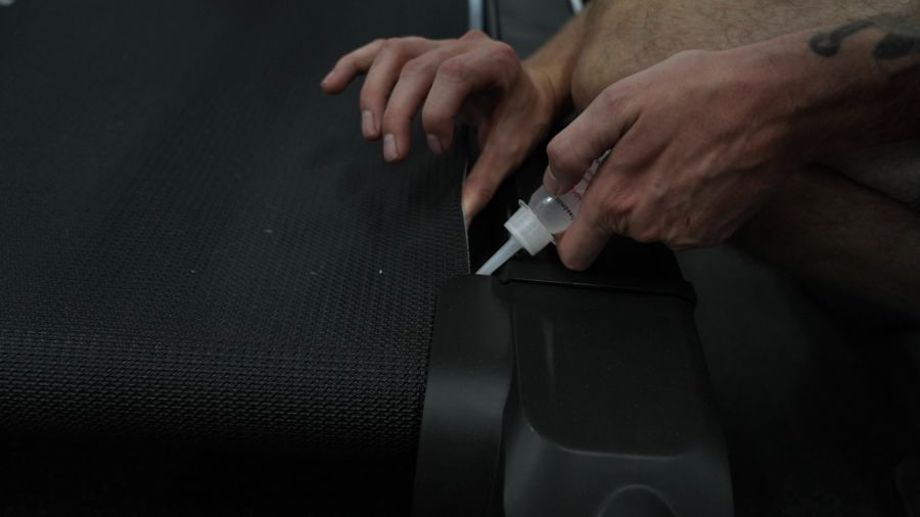
4 Steps to Loosen Your Treadmill Belt
If your treadmill belt is too tight, you may experience slipping, which can pose other treadmill safety hazards such as errant trips or excessive wear and tear. You should be able to lift the belt 3 to 4 inches off the platform at the center. If you cannot fit your hand under the belt, or it lifts less than 3 inches, follow this four-step protocol:
- Turn off the treadmill and disconnect it from the power source for your safety.
- Locate the roller adjustment bolts at the rear of the treadmill by the running deck end caps.
- Loosen the treadmill belt with the appropriate hex key or Allen wrench. Turn the left and the right bolt one at a time in one-quarter increments to the left. Make sure you turn the left and right one after the other so they are adjusted in sync.
- Keep turning the bolts until you can place your hand under the belt and lift up comfortably. If the belt lifts about 3 to 4 inches from the deck, it is set to the appropriate tension.
RELATED: How to Move a Treadmill
4 Steps to Align Your Treadmill Belt
Over time, the running belt can begin to shift left or right. If left unresolved, this can cause the belt to stretch unevenly or drift to one side where it may rub excessively and potentially tear, leading to permanent damage. To prevent this, follow these simple steps:
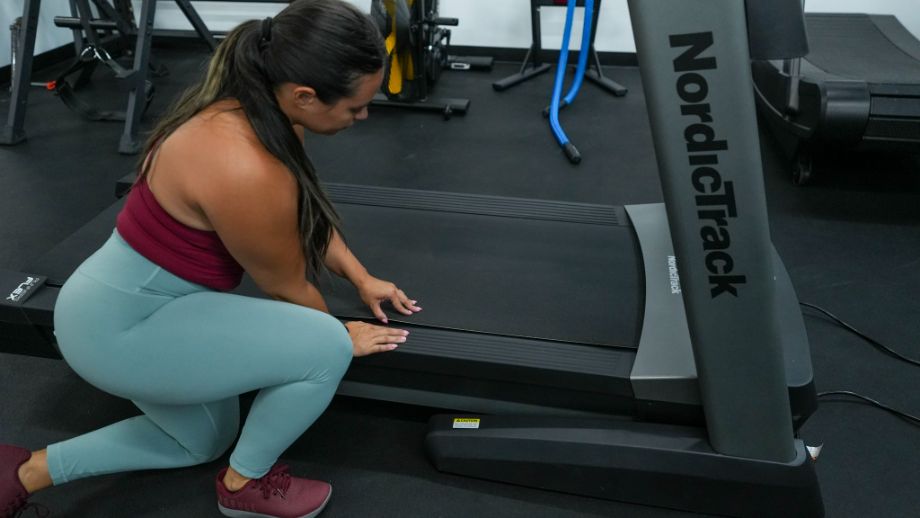
- Turn off the treadmill and disconnect the power cord for your safety.
- Determine which direction the belt has drifted on the treadmill deck—you will be working on the side the belt has shifted toward.
- Locate the tension bolts at the rear of the treadmill by the running boards.
- If the belt has moved to the left, locate the bolt on the left side and turn it in quarter-turn increments to the right.
- If the belt has moved to the right, locate the bolt on the right side and turn it in quarter-turn increments to the right.
- Manually push the belt, let it rotate a few turns, and watch the belt slowly shift. Keep turning the bolts in quarter turns and rotating the belt until it’s back to the center.
- Plug the treadmill back in, set it to about 3 MPH, and confirm the belt stays centered and runs smoothly in operation.
RELATED: Best Treadmills for Running
Troubleshooting Tips
Troubleshooting treadmill belt issues doesn’t have to be intimidating. Most problems look scarier than they are, and some small tweaks (and a healthy amount of patience) can get things running smoothly again. Here are a few common issues you may face—and how to fix them:
- If your belt drifts, confirm the treadmill is on a level surface and that the belt is clean and dry. With the treadmill running at a slow speed (about 2–3 MPH), examine the belt and determine which direction it’s drifting during revolutions. Power down the tread and unplug the machine before making any adjustments. Use an Allen key to turn the two rear roller bolts in small increments (about a quarter-turn per adjustment). If the belt drifts left, tighten the left bolt (or slightly loosen the right), and if it drifts right, tighten the right bolt (or slightly loosen the left). Let it run for 30 to 60 seconds between adjustments to assess the change, and avoid over-tightening (too much tension can strain the motor and rollers).
- If you notice a burning smell, stop the treadmill and check for excessive friction from a dry deck or overly tight belt.
- Contact the manufacturer or service provider if the belt doesn’t track straight after several adjustments, you notice visible belt damage, the deck appears worn, the treadmill sends error codes, or you hear grinding or clicking from the rollers or the motor compartment. These can be warning signs of larger dilemmas that call for professional repair or replacement.
RELATED: How to Clean a Treadmill
Final Thoughts
Although treadmills require some upkeep, most issues have quick, beginner-friendly fixes—often as simple as re-centering the belt, making a small tension adjustment, or cleaning around the deck. And when you’re unsure, your user manual can be a trusted resource for specific guidance. Ultimately, you don’t need to be a trained technician to troubleshoot your way out of a treadmill issue. Follow the protocols we outlined above, stay patient, and you’ll be able to dial in a smooth, stable belt that keeps your treadmill running as it should.
How to Adjust a Treadmill Belt FAQs
How do you align a treadmill belt?
To align a treadmill belt, determine which side the belt has shifted to by turning the treadmill on to 3 MPH and allowing for a few rotations. Once the side is determined, locate that tension bolt at the rear end of the treadmill. With the treadmill powered down and unplugged, use a hex or Allen wrench to turn the bolt a quarter turn to the right. Manually push the belt, let it rotate a few turns, and watch the belt slowly shift. Continue in quarter-turn increments until the belt is centered.
How do I adjust the tension on my treadmill belt?
To adjust the tension on your treadmill belt, locate the bolts near the rear of the treadmill. To add tension, use a hex key or Allen wrench and turn both bolts one quarter turn to the right (clockwise). To loosen the belt, turn both bolts one quarter turn to the left (counter-clockwise). Check the belt, continue to turn bolts a quarter at a time until you can fit your hand snugly between the belt and treadmill deck at its center point—your belt should be able to lift 3 to 4 inches up from the deck.
Why does my treadmill belt keep moving to one side?
Your treadmill belt may shift from one side to the other over time. This can happen naturally as you use your machine. If your treadmill belt keeps moving to one side, it is most likely due to an imbalance of tension. To fix this, determine which side the belt slips to. Power down and unplug your machine for safety, locate the tension bolt on the shifted side, and adjust the tension according to our steps above.
How do you tell if your treadmill belt is too loose or too tight?
Slide your hand between the treadmill belt and deck at the center of the running surface. If you can lift the belt from the center more than 3 to 4 inches, it is too loose. If you cannot lift the belt more than 3 inches, it is too tight. You should adjust the belt accordingly.
How often should I adjust my treadmill belt?
We recommended checking the alignment and tension every two to three months, or if you notice slipping, drifting to one side, or unusual noise. Follow our alignment protocol above to re-center your treadmill belt, or refer to your machine’s user manual for more specific instructions regarding the noticed issue.