





As a certified personal trainer who embodies mind-body-soul wellness, I’m often asked, “What do you do to meditate?” Sadly, many people struggle to just get started — let alone make it a habit.
While I’ve developed a method to focus on the present moment, I understand some folks need extra help calming their mind and strengthening their connection with themselves and the world around them. Ironically, the same tech-driven society that can promote some unhealthy habits also offers some incredibly helpful tools to build mental, emotional, and physical alignment.
RELATED: Exercise and Mental Health
The best meditation apps provide a pathway to a more present, peaceful, and powerful self with features like guided meditations, journal prompts, breathwork exercises, and more. To help you stay cool, calm, and collected, the Garage Gym Reviews team tested more than 10 meditation apps using our fitness equipment testing methodology, assigning scores on a 1-5 scale to evaluate relevant factors such as:
- Pricing
- Setup
- Ease of use
- Instruction
- Extra features
So, whether you’ve been following meditation practices for years or you have no clue where to start, take a deep breath and open your mind and heart to the possibility that a mobile app might be the missing ingredient in the self-care recipe for a more balanced, less-stressed you.
The 9 Best Meditation Apps
- Best Overall Meditation App: Headspace
- Best Meditation App for Sleep and Relaxation: Calm
- Best Free Meditation App: Insight Timer
- Best Meditation App for Guided Meditation: Aura
- Best Meditation App for Breathwork: The Breathing App
- Best Meditation App for Beginners: Buddhify
- Best Meditation App for Athletes: Nordic Flow
- Best Meditation App for Journaling: Happier
- Best Free Science-Based App: Healthy Minds Program
Best Overall Meditation App: Headspace
Good for: All-around mindfulness and habit-building via daily meditations, sleep tools, and mood check-ins










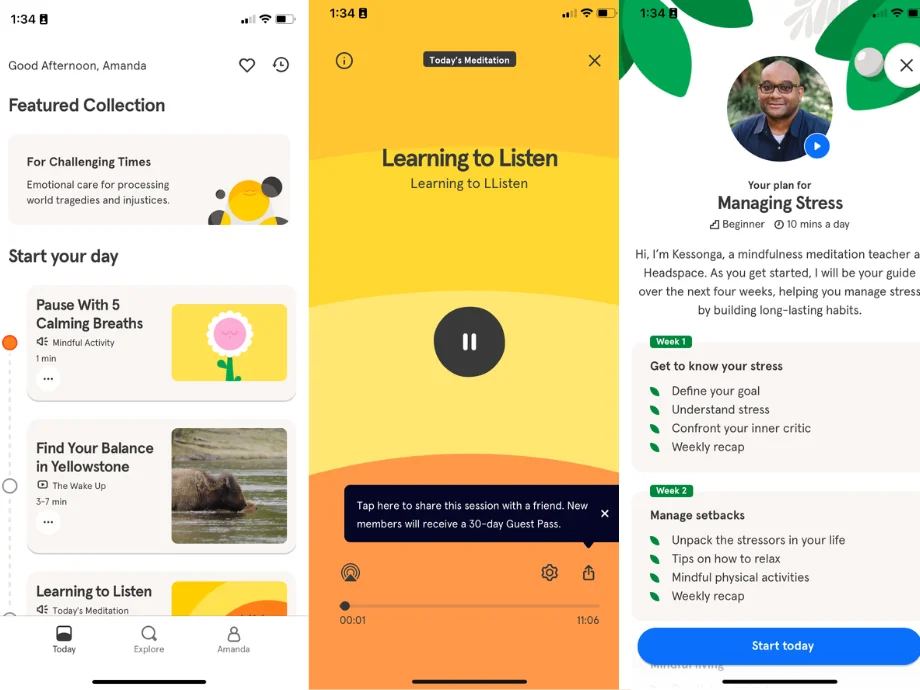
Headspace offers a well-rounded approach to mindfulness by combining meditation, sleep aids, and physical movement. While it requires a subscription for full access, its comprehensive features make it a valuable tool for those looking to enhance their mental well-being.
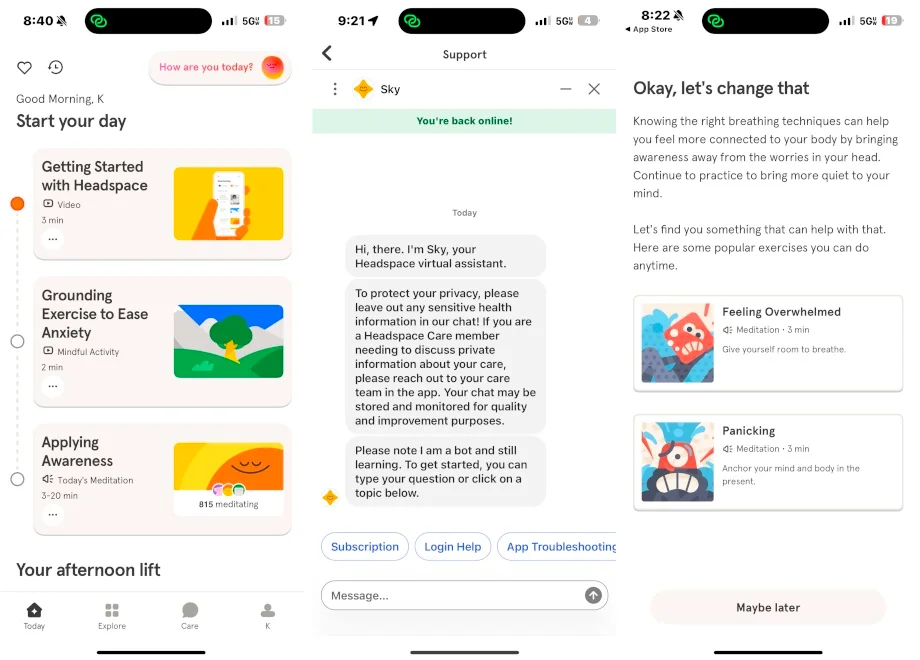
If you’ve been searching for the best meditation app, chances are you’ve come across Headspace. A popular platform that’s well-priced and easy to use, Headspace earned the topspot on our list. At $12.99 per month or $70 for an annual subscription, Headspace received a near-perfect 4.5-out-of-5 pricing rating from our product tester.
“The price is worth it and reasonable for someone who is interested in meditation and improving their focus, stress, and mental health, particularly if you can afford to pay up front and enjoy the discounted cost,” she says.
Don’t worry about committing right away, either. Headspace gets a 5-star free trial rating since you can try it for 14 days. This gives you ample time to explore its features, which aren’t difficult to find.
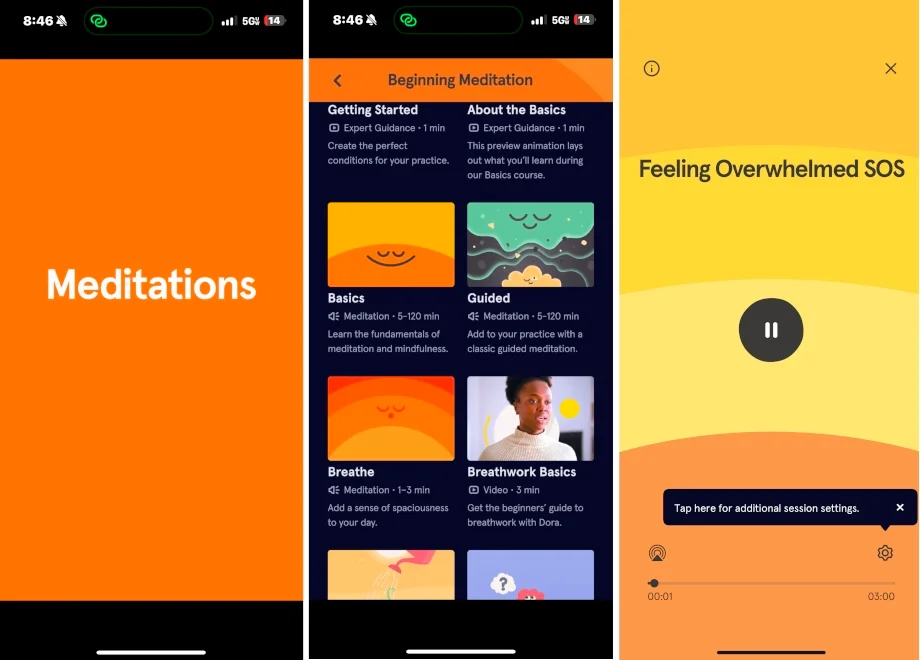
“The app interface is very clean and it’s a pleasant user experience. Everything from the fonts to the colors to the white space in between icons is nice and obviously well-thought out,” reports our product tester, rating the ease of use a 4.75 out of 5. “The meditations, lessons, and modules are organized into categories and you can search for key terms, but there’s no filtering option. I think that would be a good addition.”
Perhaps the most impressive feature about Headspace is the high-quality instruction for its meditation courses. Our tester gave it a 5-out-of-5 rating in this category.
“The beginner-level meditations are nice because they’re short and sweet, and the voice talks pretty consistently, so you have something to focus on other than the fact that your thoughts are going crazy when they shouldn’t be!”
| Price | $12.99/month or $69.99/year |
| Free Trial? | 14 days |
| Best For | All-around mindfulness and habit-building |
| Platforms Supported | iOS, Android |
| Notable Features | Daily meditations, sleep tools, focus music, mood check-ins |
Best Meditation App for Sleep and Relaxation: Calm
Good for: Anyone who struggles with getting quality zzz’s



Calm excels in providing tools for better sleep and relaxation. Its diverse content and user-friendly design make it a top choice for those seeking to improve their mental well-being, though full access comes at a premium.
It’s no secret that getting sufficient sleep is critical for optimal health and performance. Unfortunately, many people struggle to fall asleep — let alone stay asleep throughout the night. The Calm app could be the answer to your rest problem, as our team selected it as the best meditation app for sleep and relaxation.
Our product tester noted that the app is “very intuitive” and only takes a few minutes to set up. She rated it a 5 out of 5 for both ease of use and setup.
“The onboarding was very quick and easy. They only asked about two pages worth of questions and then sent you to the app,” our tester explained.
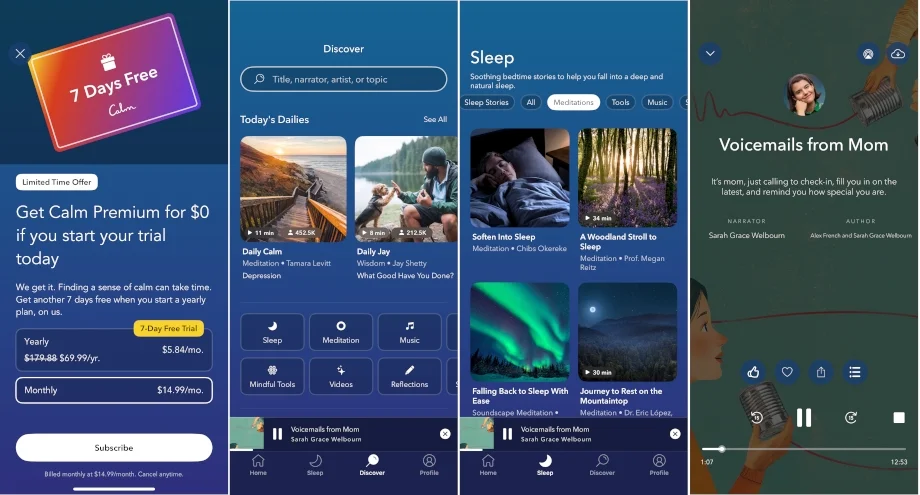
Also earning a 5-out-of-5 rating for price, you get plenty of valuable resources for your investment, including sleep stories, different meditation types, and even motivational content. Calm offers multiple subscription options: $14.99 per month, $69.99 per year, or $399.99 for life.
“They also offer a seven-day free trial, and once you get on the app you can give your friends a 30-day free trial,” our tester noted.
Offering a Spotify-like interface, you can search for different “artists” or narrators and sort meditations by style (sleep, motivation, etc.). Our tester did have one minor callout, however.
“My only complaint is that they have the amount of users who liked each exercise but not a rating. So if 88,000 people tried/listened to a sound and liked it, they have that stat but I’m curious why there’s no star rating system. I felt a little lost trying to figure out which items were the best for me but it just took some trial and error.”
One other area where Calm fell short is extra features, as it only earned a 2-out-of-5 rating.
“They have a streaks tool and tracking systems, but that’s about it,” our tester reports.
| Price | $14.99/month or $69.99/year |
| Free Trial? | 7 days |
| Best For | Sleep stories and relaxation |
| Platforms Supported | iOS, Android, Web |
| Notable Features | Sleep stories, breathing exercises, soundscapes |
Best Free Meditation App: Insight Timer
Good for: Meditation timers, courses, and content that won’t cost you anything




Insight Timer is a meditation powerhouse with an enormous library of content. While it may be overwhelming at first, it’s one of the best free options out there—especially if sleep or recovery is your goal.
You don’t necessarily have to sign up for a monthly subscription to experience the benefits of a meditation app. In fact, Insight Timer has the world’s largest library of free guided meditations, offering more than 270,000 tracks from psychologists, spiritual leaders, and mindfulness teachers. That helps it earn a 5-out-of-5 rating for price.
There’s also a premium version available for $60 per year — a budget-friendly option worth considering.
“At about $5 a month, I think it’s worth the money if it’s something you want to use regularly,” our tester explains.
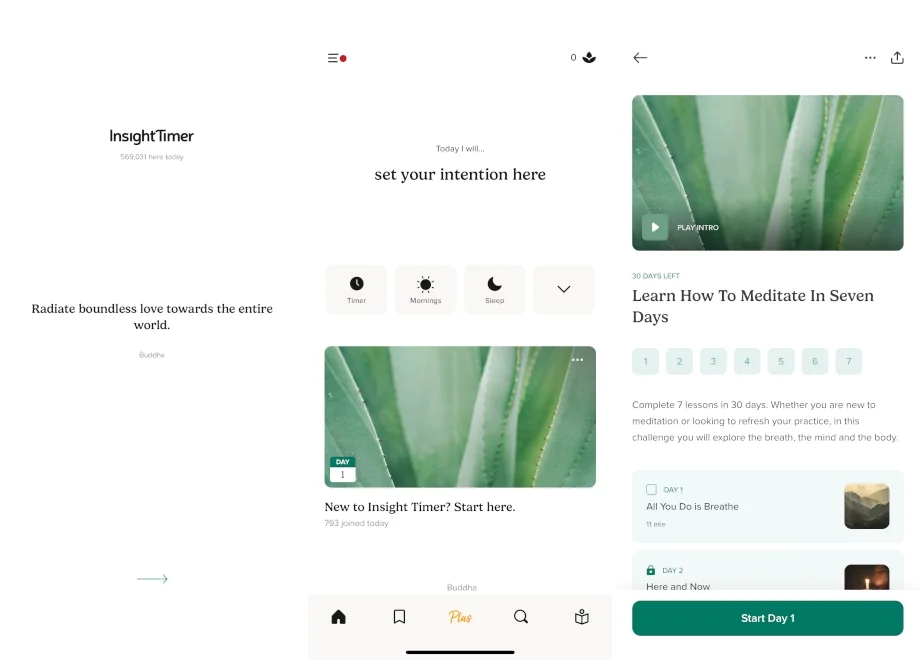
Like many of the apps that made our list, Insight Timer earned a 5-out-of-5 rating for setup.
“It was super intuitive. The first few questions asked about what your goals of using the app are, what you are looking to gain from their experience and a few personal questions about participation preferences. It lets you choose how little or much you’d like to engage in it in your everyday life,” our tester reports.
Furthermore, Insight Timer took home a perfect score (5 out of 5) for instruction. You have multiple ways to access courses and information, including pre-recorded sessions and live sessions.
“During the actual sessions, it gives you the option to respond on your phone with a gauge saying if you are feeling good, okay or not well. It lets you log these feelings throughout the session to see how your perception has changed throughout,” our tester explains.
| Price | Free (premium version available for $9.99/month or $59.99/year) |
| Free Trial? | No trial needed |
| Best For | Budget-friendly access to an expansive library of free guided meditations |
| Platforms Supported | iOS, Android, Web |
| Notable Features | 130,000+ free meditations, timer, courses, live events |
Best Meditation App for Guided Meditation: Aura
Good for: Easy-to-follow guided meditations that are personalized based on your needs

Aura is a polished app that’s perfect if you want a personalized, audio-based approach to stress relief and sleep. It’s not cheap, but if you value tailored experiences, it delivers.
One lesson I’ve learned over the years that applies universally: Don’t be afraid to ask for help. The concept of meditating can be confusing, which is the exact opposite of what it should be. So, if you need to lean on an app for support, Aura is a fantastic option.
Priced comparably to several other platforms on this list, our tester rated it a 4-out-of-5 for value.
“The price is pretty good at about $70 a year, and you get access to exclusive content and a huge variation of it,” she noted. “You also get to join in live therapy sessions or watch past ones, which is a nice bonus.”
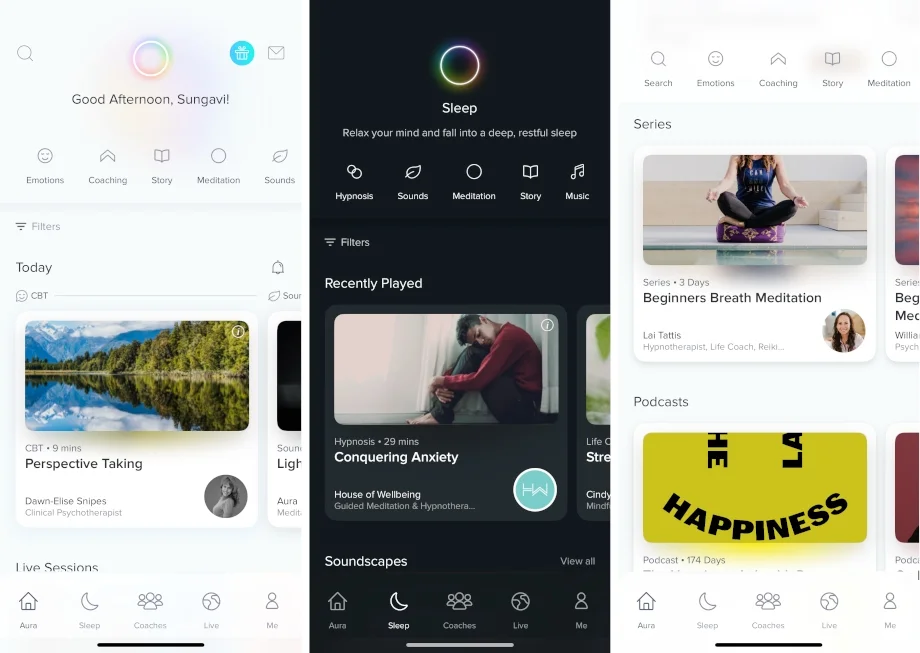
Earning dual 5-out-of-5 scores for setup and ease of use, our tester had high praise for the user experience.
“The UX is amazing—bright, colorful, and super easy to understand. It also takes you through a personalized quiz at the beginning to customize your experience,” she reports. “Everything is clearly labeled and intuitive and the forms are engaging to fill out.”
Aura also offers some extra features that earned a 4-out-of-5 rating. In addition to a personalized dashboard, there are other video resources available to help give you more guidance.
One of the few callouts our tester had was with customer service. She rated Aura a 3 out of 5 in this category.
“You can only contact customer service through email, and I also don’t like that it leaves the app to take you to the email function.”
That said, Aura generates almost universal positive feedback on the Google Play Store and Apple App Store, so this is really a small gripe in the grand scheme of things.
| Price | $11.99/month or $69.99/year |
| Free Trial? | 7 days |
| Best For | Personalized guided meditations |
| Platforms Supported | iOS, Android, Web |
| Notable Features | AI-driven recommendations, mood tracking, therapist-created content |
Best Meditation App for Breathwork: The Breathing App
Good for: Learning and practicing breathwork techniques for free


The Breathing App is a minimalistic but effective tool for breath control and calming your mind. It’s not loaded with extras, but that’s the point—and why beginners love it.
Studies show that controlled breathwork practices can enhance your mood1 and help you manage stress. The GGR squad had a chance to work with a professional breathwork expert during a virtual session, and I can confirm it’s an effective tool to have in your self-care arsenal.
Aptly named, The Breathing App easily takes the crown for the best meditation app for breathwork. We love that there’s a fully free version available, helping it earn a 5-out-of-5 rating for price.
“The free tier option satisfies the core need of the app since you can customize the resonance and the length of the meditation even with the free subscription. The subscription unlocks a set of preset meditation options depending on what your goals are, like calming, energizing, etc.” our product tester reports.
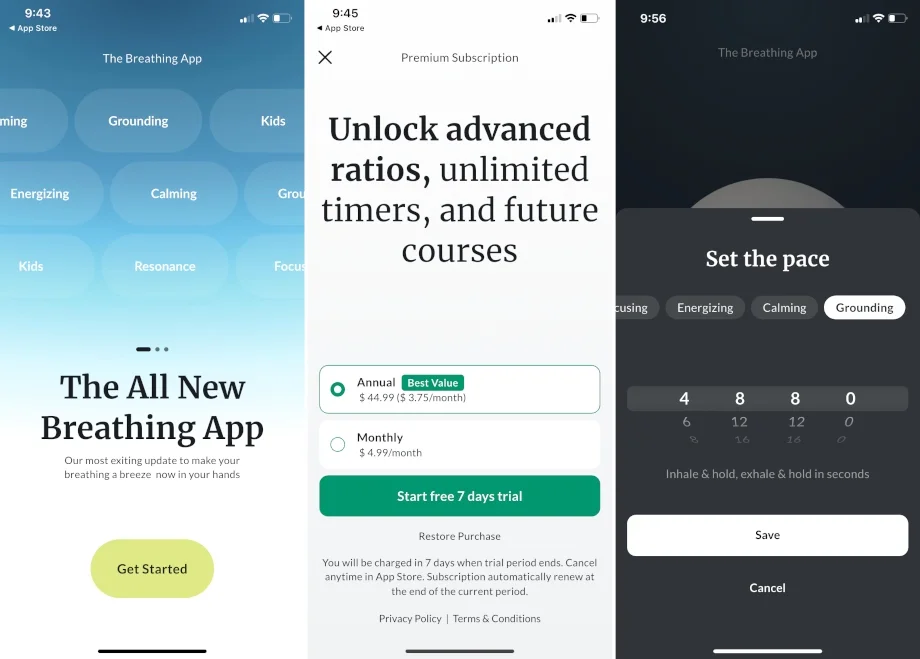
Also earning perfect marks for ease of use and setup, our tester liked that The Breathing App is easy to navigate and clutter-free.
“It has a clean color palette that makes it easy to see and read text. Nothing about this app is overwhelming or confusing,” she reports.
However, that simplicity is a bit of a double-edged sword.
“There aren’t many options in terms of customization or variety in the meditations,” our tester reports, giving a 3-out-of-5 rating for instruction. “There are a variety of types of breathing exercises based on how long you inhale/exhale/hold, which is why I give it a three. It meets expectations but doesn’t offer much in the way of customization or variety in the overall experience.”
Unfortunately, our tester didn’t have a particularly promising customer service experience, giving The Breathing App a 1 out of 5 in this category.
“They have an easy to access ‘contact us’ form directly in the app, but after more than 24 hours they still have not responded,” she reports.
| Price | Free version available |
| Free Trial? | N/A |
| Best For | Breath control and nervous system regulation |
| Platforms Supported | iOS, Android |
| Notable Features | Custom breathing patterns, heart rate variability (HRV) support |
Best Meditation App for Beginners: Buddhify
Good for: Those who are interested in learning the basics of meditation


Buddhify offers a unique and affordable approach to meditation, ideal for those seeking quick, activity-based sessions. Its user-friendly design and offline access make it a convenient option for busy individuals.
Just getting started can be half the battle. But as someone who practices meditation routinely, I can tell you that it’s not as complicated as it may seem. Beginners can lean on Buddhify to help kickstart their mindfulness journey, as this budget-friendly app offers more than 200 guided meditations on topics such as stress, sleep, anxiety, and difficult emotions.
Earning a perfect price score of 5 out of 5, you only have to pay a one-time fee of $5 for iPhone users or $3 for Android users. There’s also an optional membership with a $30 annual fee that unlocks more features, including “Together,” “Formal,” and “Transmission” modes.
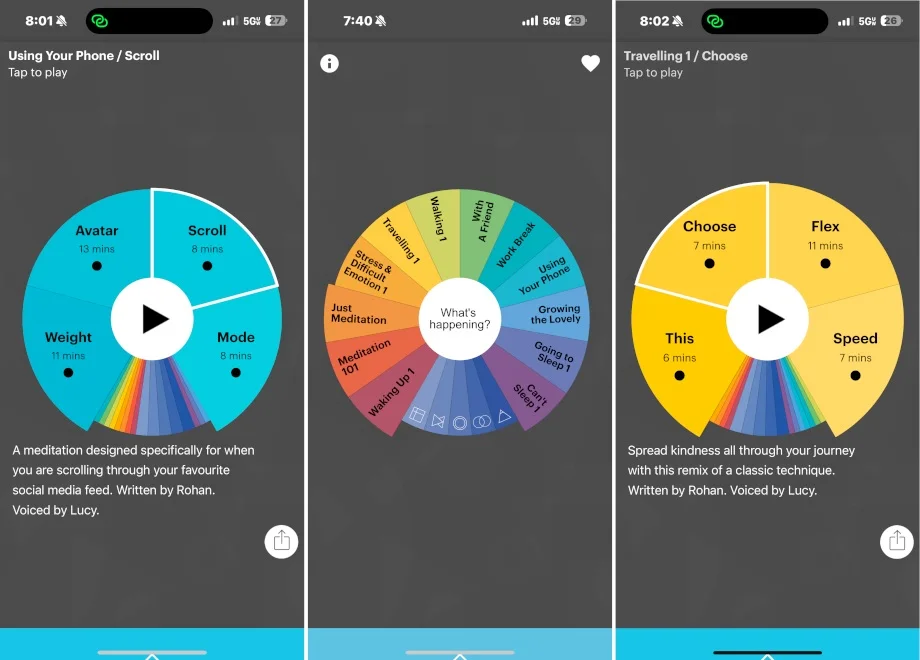
Our team gives Buddhify a 4.5 out of 5 for ease of use, particularly because of the unique wheel interface. This colorful wheel categorizes different meditation types by activity or mood, with options such as “Waking Up” and “Can’t Sleep.” This makes it easy for inexperienced meditators to get started on addressing a specific problem they’re dealing with.
Another reason Buddhify earned the nod as the best meditation app for beginners is the sessions are short and sweet. Most meditations are under 12 minutes, meaning you don’t have to carve out a huge chunk of time.
Unfortunately, this affordably priced and user-friendly app lacks advanced features that you see with other platforms. With no progress tracking, reminders, or community aspect, we rate it a 2 out of 5 for extra features.
| Price | One-time payment of $4.99 (iOS) or $2.99 (Android) |
| Free Trial? | N/A |
| Best For | People who are new to meditating, on-the-go sessions |
| Platforms Supported | iOS, Android |
| Notable Features | Wheel-based meditation selector, offline access, no subscription needed (just one-time payment) |
Best Meditation App for Athletes: Nordic Flow
Good for: Athletes who want to enhance their performance by strengthening their mindset




Nordic Flow is a sleek, focused tool for breathwork and cold exposure training. While it won’t replace a broader meditation app, it’s a solid fit for athletes chasing resilience and mental grit.
As someone who played rugby for 12 years, I’ll be the first to tell you that having a clear head is one of the biggest keys to staying on top of your game. By the same token, a cluttered, unfocused mind or an inability to control your emotions can prevent you from being your best.
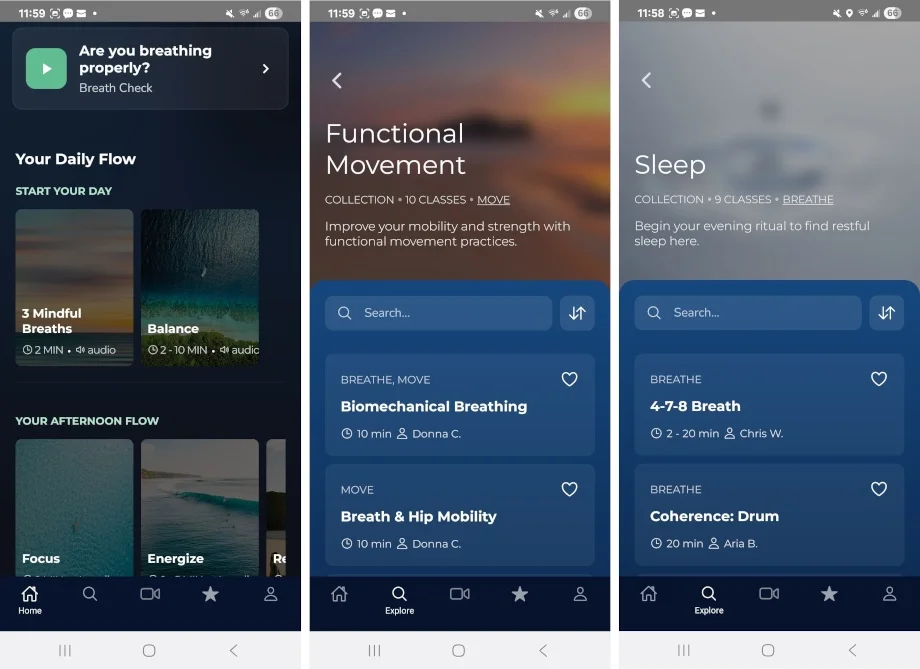
Whether you’re into powerlifting, swimming, or any other sport, it’s a wise idea to invest in your mental health to optimize your physical performance. Our team recommends athletes look into Nordic Flow—a mindfulness-focused app that offers athlete-specific meditations, breathwork training, and recovery routines.
Although there is a paid subscription option, GGR managing editor Amanda Dvorak doesn’t think you have to shell out your hard-earned dollars on Nordic Flow.
“The free version feels pretty robust, which I appreciate. The monthly price is $9.99 and the yearly price is $69.99, which seems a bit higher than some other apps,” she explains.
Unlike other apps that made the cut, Nordic Flow’s setup process proved a bit challenging. Amanda rated it a 3.5 out of 5 in this category.
“I had a few issues getting started. I at first tried the ‘sign up with email’ option and it took a while to load, so I started over and tried to manually sign up with my email address, but it then kept asking me to confirm the email address even though I never received an email asking me to do so,” she explains.
However, once she got everything sorted out, everything went pretty smoothly.
“The app asks you to do an initial breathing test where you inhale and then exhale for as long as possible. Interestingly, I cannot find anywhere in the app where it logged my initial score, but I remember thinking I did better than I thought I would,” Amanda says.
Luckily, Nordic Flow delivers where it matters most: instruction.
“There’s a large variety of different sessions, whether you want to calm your mind, fall asleep more easily, balance your emotions, or even do some altitude training. There are several different coaches so it’s easy to find one who best suits your needs. There are also classes for things like menstrual cramp relief and various pregnancy breathwork sessions, which I think offer a unique touch,” Amanda explains.
If you’re an iOS user, please click here to receive a free one-month trial. If you’re an Android user, you can use code NF1MTH when signing up to receive the free one-month trial.
| Price | Free version available, or $9.99/month or $69.99/year |
| Free Trial? | 7 days (One month for iOS users who use this link or Android users who use the code NF1MTH when signing up) |
| Best For | Mindfulness for physical recovery and enhanced performance |
| Platforms Supported | iOS, Android |
| Notable Features | Athlete-specific meditations, breathwork training, recovery routines |
Best Meditation App for Journaling: Happier
Good for: Learning how to integrate gratitude journaling into your routine

Happier is a simple yet powerful app that encourages reflection and gratitude. While it’s less about guided meditation, it’s a solid tool for building emotional awareness and a daily mindfulness habit.
As someone who writes for a living, I’m not necessarily keen to wrap up my work day and do more writing. However, other folks may benefit from taking a few minutes to jot down their wins, goals, and obstacles. If you’re in that camp, Happier is a great place to start.
At $100 a year (or $14.99 per month), the price isn’t exactly the most budget-friendly. Our tester rated it a 3 out of 5 in this category, but noted that you do get a seven-day free trial to evaluate Happier’s features.
Luckily, it earned perfect scores for setup and ease of use.
“I liked that this app asked more questions during the setup process. With Calm, it asked very few questions and kind of threw you into the app. With the Happier app it asked 10+ questions and then gave you 3-5 courses or exercises to try,” our tester reported.
As for instruction, Happier earned a score right in between (4 out of 5). Our tester found both positives and negatives, stating that some of the courses were “a little too simplistic.” She also offered a suggestion that would improve the user experience.
“I wish some of the courses had a background noise so I knew it was still working and then I could fully relax.”
In terms of extra features—there aren’t many.
“It has a tracking feature that shows how many minutes, courses, and days I listened/practiced meditation but that was about it,” our tester noted, giving a 3-out-of-5 rating for this category.
| Price | $14.99/month or $99.99/year |
| Free Trial? | 7 days |
| Best For | Gratitude journaling and mindfulness practices |
| Platforms Supported | iOS, Android, Web |
| Notable Features | Daily journal prompts, mood tracking, science-backed positivity tools |
Best Free Science-Based Meditation App: Healthy Minds Program
Good for: Data-driven users who want a structured, science-based mindfulness program



The Healthy Minds Program offers a robust, science-based approach to mental well-being without any cost. Its structured content and research-backed methods make it an excellent choice for those seeking a comprehensive and free mindfulness resource.
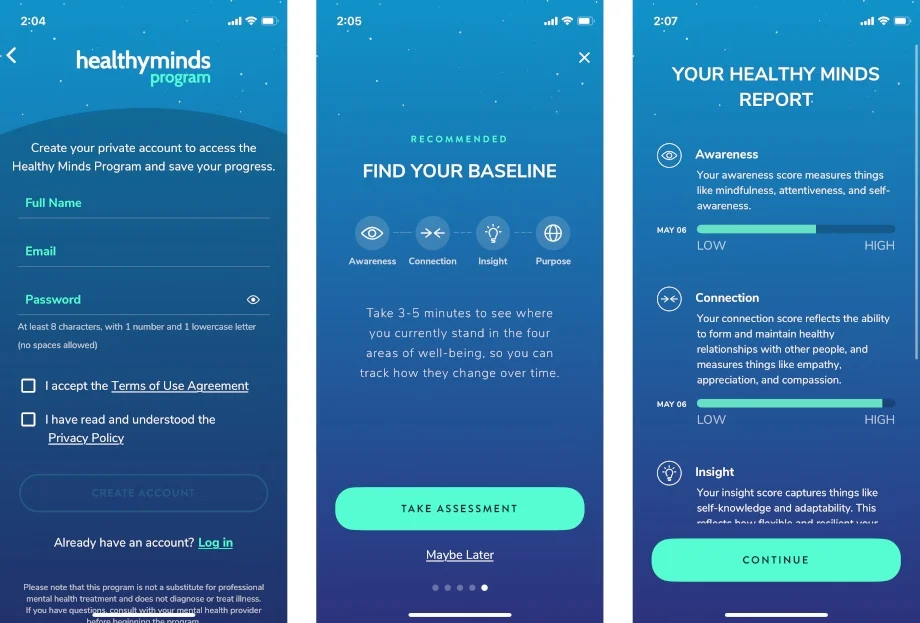
If you like nerding out, the Healthy Minds Program is a science-based meditation app that’s completely free. At the beginning, you complete a baseline assessment that evaluates your mental well-being across several categories, including awareness, connection, and insight. From there, the app tailors a personalized mindfulness journey complete with a roadmap of meditation courses and practices.
Obviously earning a 5 out of 5 for price, this free app is also incredibly easy to navigate. Our tester gave it a perfect score in this category, noting that everything is laid out well.
“The page has a simple visual to show how far you’ve progressed, with hyperlinks to the next practice picked for you. The app has a very intuitive UI and is extremely easy to use,” he reported.
Furthermore, despite not costing a dime, this app delivers excellent instruction that rivals that of other apps that do require a subscription.
“There are meditations for sleep, relationships, compassion, micro-meditations, attention, and more. Each category consists of multiple “series”, which follow similar structures of a combination of “practice” and “learn” modules. The app also offers an unguided practice timer, where you can set a timer, speaker, then practice in silence,” our tester explains.
The only reason he docked a point is that Healthy Minds doesn’t offer much apart from standard meditations.
“Other paid meditation apps offer stories, sound experiences, and movement programs that can deepen the mindfulness of a meditation practice,” he explains.
He also gave a less-than-perfect score (3.5 out of 5) for extra features. While Healthy Minds offers reminders, streaks, and a comprehensive “path” set for each user, our tester felt it lacks interaction and community.
Still, given the fact it’s free, it’s hard to knock Healthy Minds too much.
| Price | Free |
| Free Trial? | N/A |
| Best For | Evidence-based mindfulness |
| Platforms Supported | iOS, Android, Web |
| Notable Features | Modular learning path, podcast-style lessons, mental well-being training |
Other Meditation Apps We Researched
During our journey to help you stay cool, calm, and collected, we came across several other worthy contenders for the best meditation apps. Here are some other platforms to consider that didn’t quite make the cut for us but may offer value for you:
- Simple Habit: With sessions that are about 5 minutes long, this app is best for those who want to complete a quick, practical meditation session during their busy day.
- Smiling Mind: An excellent resource for families and teachers, this app was developed by Australian educators and psychologists to help provide structured mindfulness programs tailored to specific age groups.
- Sattva: Based on ancient Sanskrit traditions, this platform uses authentic mantras, chants, and guided meditations to help users who are seeking spiritual guidance and mindfulness.
- Breethe: Much more than just a meditation app, Breethe involves elements of hypnotherapy and life coaching.
RELATED: Best Health Apps
How We Picked and Tested the Best Meditation Apps
Whether we’re testing the best protein shakes or the best weight loss apps, there’s always a method to our madness at GGR. When it comes to finding the top mindfulness and meditation apps, here’s what we look at:
Pricing
How expensive is the monthly or annual subscription? Does the price justify the amount of tools and guidance offered? Is there free content available?
Apps that cost less than $10 per month or only have a one-time charge earn a 5-out-of-5 rating. Meanwhile, ones that cost more than $35 per month fall on the opposite end of the scoring scale.
App Setup
Is the app confusing to set up or navigate? Or is the installation process such a breeze that it can be completed in less than 5 minutes?
Ease of Use
To get a perfect score, the user experience has to be amazing and seamless. However, if the app has a messy interface and isn’t user-friendly, it will receive a low score.
Instruction
Does the app go above and beyond by providing specific instructions for meditating or guided journaling? Are there adequate visual and verbal instructions for you to follow?
Extra Features
Reminders, streaks, notifications, or other extra features add more value and functionality. Some apps excel at offering a complete package of tools, while others aren’t as robust.
Customer Service
How responsive is the customer service team? Are you able to address any subscription or payment issues promptly? Is the cancellation or refund process difficult to navigate?
App Store Ratings
We also care about what other users have to say about each app. Checking the reviews and ratings on Google Play and the Apple App Store often gives an accurate overview of the pros and cons of each app.
Benefits of Meditation Apps
Experienced meditators like myself and some of my GGR colleagues can sing the praises of mindfulness exercises, journaling, and breathwork, which has been shown to help reduce stress and improve mental health2. Meditation apps offer a structured approach, often with instructor or expert-driven content. While you don’t necessarily have to use an app to get in the zen zone, it can certainly be helpful, especially for beginners.
Let’s take a closer look at some of the benefits of utilizing meditation apps (and practicing mindfulness meditation in general).
May Help Reduce Stress and Anxiety
While exercise is one way to get some stress relief, sometimes you need to take the opposite approach. Meditation apps provide an accessible tool to manage stress and anxiety. In fact, a 2024 study3 on the real-world impact of the Headspace app found that it significantly reduced perceived stress levels.
GGR Staff Writer Ben Emminger has utilized meditation practices for several years and believes it’s an effective way to stay grounded in what can be a chaotic world.
“We as people are constantly dealing with stressors, so I’ve found it imperative to take some time each day to ensure you’re centered. It not only allows you to catch your breath in a given moment, but also grants your mind time to pause and stop,” Ben explains.
“This can help you see perceived problems in a new light when you go to revisit issues, or even realize that the ‘problems’ aren’t really noteworthy to begin with.”
RELATED: Exercise and Stress
Can Help Improve Sleep Quality
Waking up feeling refreshed and rejuvenated can be a problem for some people. But for many, falling (and staying) asleep is an even bigger challenge. Meditation apps like Calm are designed to help you get better sleep with guided meditations and soothing soundscapes.
A 2019 study4 on the efficacy of our top meditation app for sleep found that Calm “is an effective modality to deliver mindfulness meditation in order to reduce stress and improve mindfulness and self-compassion in stressed college students.” Many sleep-focused meditation apps help users establish better sleep hygiene protocols that can lead to better rest.
Can Enhance Focus and Productivity
In my experience, meditation is a fantastic way to get laser-focused on what you desire most. For some, it might help you mentally prepare to take on a big work task. For others, it might help you get in the zone to crush a gym session. Either way, even taking just a few minutes to de-clutter your brain, set an intention, and get #LockedIn can unlock a new level of productivity.
GGR Senior Staff Writer Caine Wilkes, OLY, CNC, USAW-L1, worked with a sports psychologist in preparation for the 2020 Tokyo Summer Olympics.
“As a competitive athlete, I think working on your mental focus and mindset is just as integral as physical training, especially in a sport as technical as Olympic weightlifting. Training your mentality will help build good habits and thoughts that’ll allow you to “flex” those muscles when the time counts, like at a competition,” he explains.
Caine worked with his sport psychologist on practicing mindfulness and slowing his breathing, allowing him to notice when his emotions were “bubbling up” and observe them without reacting too strongly.
“Being able to be mindful certainly helped me through a particularly emotional competition and kept me focused on the lifts at hand, leading to a top-10 finish at the Olympics.”
Experts Who Contributed To This Article
FAQs About the Best Meditation Apps
Is Headspace or Calm better?
While both apps earned high marks from our team, we put Headspace at the top of our list since it provides a variety of tools and structured approach to meditation. However, if you’re specifically looking for a sleep-focused app, Calm is a great choice.
What mindfulness app is free?
There are several free mindfulness and meditation apps, including Insight Timer and Healthy Minds. Smiling Mind is another free app that we considered for this list.
What is the best meditation app?
Our team selected Headspace as the best meditation app because it’s easy to use, offers excellent instruction, and provides great value for the price.
What are the best meditation apps for beginners?
While there are several solid options, we rank Buddhify as the best meditation app for beginners. This platform doesn’t require a subscription (just a one-time purchase) and provides simple meditations that you can complete in less than 10 minutes.
References
- Balban, M. Y., Neri, E., Kogon, M. M., Weed, L., Nouriani, B., Jo, B., Holl, G., Zeitzer, J. M., Spiegel, D., & Huberman, A. D. (2023). Brief structured respiration practices enhance mood and reduce physiological arousal. Cell reports. Medicine, 4(1), 100895. https://doi.org/10.1016/j.xcrm.2022.100895
- Fincham, G.W., Strauss, C., Montero-Marin, J. et al. Effect of breathwork on stress and mental health: A meta-analysis of randomised-controlled trials. Sci Rep 13, 432 (2023). https://doi.org/10.1038/s41598-022-27247-y
- Callahan, C., Kimber, J., Hu, E., Tanner, L., & Kunkle, S. (2023b). The Real-World Impact of App-Based mindfulness on headspace members with moderate and severe perceived Stress: observational study. JMIR Mhealth and Uhealth, 12, e52968. https://doi.org/10.2196/52968
- Huberty, J., Green, J., Glissmann, C., Larkey, L., Puzia, M., & Lee, C. (2019). Efficacy of the mindfulness meditation mobile app “CALM” to reduce stress among college students: randomized controlled trial. JMIR Mhealth and Uhealth, 7(6), e14273. https://doi.org/10.2196/14273