


Did you know that leading a sedentary lifestyle has been shown to increase your risk for cancer, metabolic diseases, musculoskeletal diseases, and death? Probably. But how can you become more active? It can be as easy as taking more steps every day.
That’s right—simply walking more daily can set you up for success. Treadmill walking workouts can be appropriate for all fitness levels, especially if you have one of the best treadmills in your home, and they provide a great form of exercise for most people.
The CDC recommends that adults get 150 minutes of moderate-activity exercise per week to improve health and wellness markers and maintain a healthy weight, and walking definitely fits the bill. Walking may seem too “easy,” but as a certified personal trainer (CPT), I think it’s one of the most under-utilized forms of exercise there is!
Below, I’ve created three treadmill walking workouts with my own knowledge as a certified personal trainer to help you get off on the right foot.
GGR Recommends – Best Overall Treadmill
After testing more than 50 treadmills, the NordicTrack Commercial 1750 is our pick for the best overall treadmill. It earned 4.4 out of 5 stars overall, with noteworthy features that include both incline and decline settings, a 4.25 CHP motor, iFIT integration, and a cushioned deck.
Treadmill Walking Workouts at a Glance
We’ll get into specific workouts you can try later in this article, but if you just need a handy reference table to save and help you get started, we’ve got you covered.
Whether you’re a beginner, intermediate, or advanced fitness enthusiasts, this will help you find a good starting speed and incline to use in your next workout. Your individual fitness level is the most important factor, so you may need to go slightly slower or faster than we recommend, or use different incline settings.
RELATED: Best Treadmills Under $2,000
| Fitness Level | Goal | Duration | Speed | Incline | Effort |
| Beginner | Increase walking endurance | 20-30 minutes | 2-3 MPH | 0-1% | Easy |
| Intermediate | Active recovery, Zone 2 cardio | 30-45 minutes | 2-4 MPH | 2-3% | Moderate |
| Advanced | Challenge your cardiovascular system | 30 minutes of intervals or steep incline walking | 3-5 MPH | 3-5% | Hard |
3 Treadmill Walking Workouts (With Sample Routines)
While it’s easy enough to hop on a treadmill, hit start, and get to walking, having a more structured plan can give you a better experience.
We shared general guidelines above, but we know a lot of people want specific workouts they can try the next time they step on a treadmill.
Whether you’re looking to increase your daily step count with an easy walk, improve your health with some steady-state active recovery work, or really push yourself with walking intervals, here are three great treadmill workouts to try.
Beginner Treadmill Walking Workout
Best for: Increasing your daily step count and getting in more movement
When you’re new to exercise or new to treadmills, it’s best to keep things simple. Even a slow, leisurely walk is a great way to increase your daily activity level, which can help improve your health and burn more calories.
Sample Workout
- Start at an easy pace, around 2 MPH.
- If comfortable, increase to around 3 MPH.
- You can walk as long as you want, but starting with 20-30 minutes is a great goal for beginners.
Treadmill Incline Walking Workout
Best for: Zone 2 work, active recovery
When you’re ready to increase the challenge, it’s time to add some incline. Even if your speed stays exactly the same, walking at a slight incline will elevate your heart rate, but not as much as a hard run. This sort of low-intensity walking works great for zone 2 cardio, or active recovery between hard workouts.
Sample Workout
- Walk at 3 MPH for five minutes to warm up.
- Increase the incline to 2-4%, looking for an intensity that’s slightly challenging, but still easy enough to maintain a conversation. You should be breathing harder, but not out of breath yet.
- Aim for 30-45 minutes at this incline.
- Finish by walking for another 3-5 minutes with zero incline and a slower speed to cool down.
RELATED: 12-3-30 Workout
Japanese Walking Method
Best for: Shorter workouts that are challenging and effective
If you’re short on time, this method of interval walking, often called the Japanese Walking method, can provide plenty of health benefits in a short amount of time. It has become quite popular on social media.
This 2007 study1 from researchers at Shinshu University in Matsumoto, Japan, compared adults who alternated between brisk walking and steady-state walking. The interval walking group experienced greater improvements in aerobic fitness, thigh muscle strength, and blood pressure than those who walked continuously at a moderate pace.
Sample Workout
- Walk at an easy pace for five minutes to warm up.
- Walk at a fast pace for three minutes, at a pace that’s challenging but sustainable for all three minutes.
- Return to a slow walk for three minutes.
- Alternate fast and slow walking for at least five total rounds, which gives you a 30-minute interval walking workout.
GGR Recommends – Best Treadmill for Walking
If you want a durable treadmill that can handle running, walking, and offers plenty of incline, we love the Sole F63 treadmill. It received a 4.3-out-of-5-star rating overall, and offers an above-average top incline of 15%. It also offers a lifetime warranty on the frame and motor, and can reach speeds up to 12 MPH.
How Hard Should a Treadmill Walking Workout Feel?
You’ll often hear treadmill workouts described as easy, moderate, or hard. This is helpful, but if you’re new to treadmill workouts, it may not be clear what those terms actually mean.
The easiest method is to use the RPE scale, which stands for rate of perceived exertion. You can see the chart below for a more detailed breakdown.
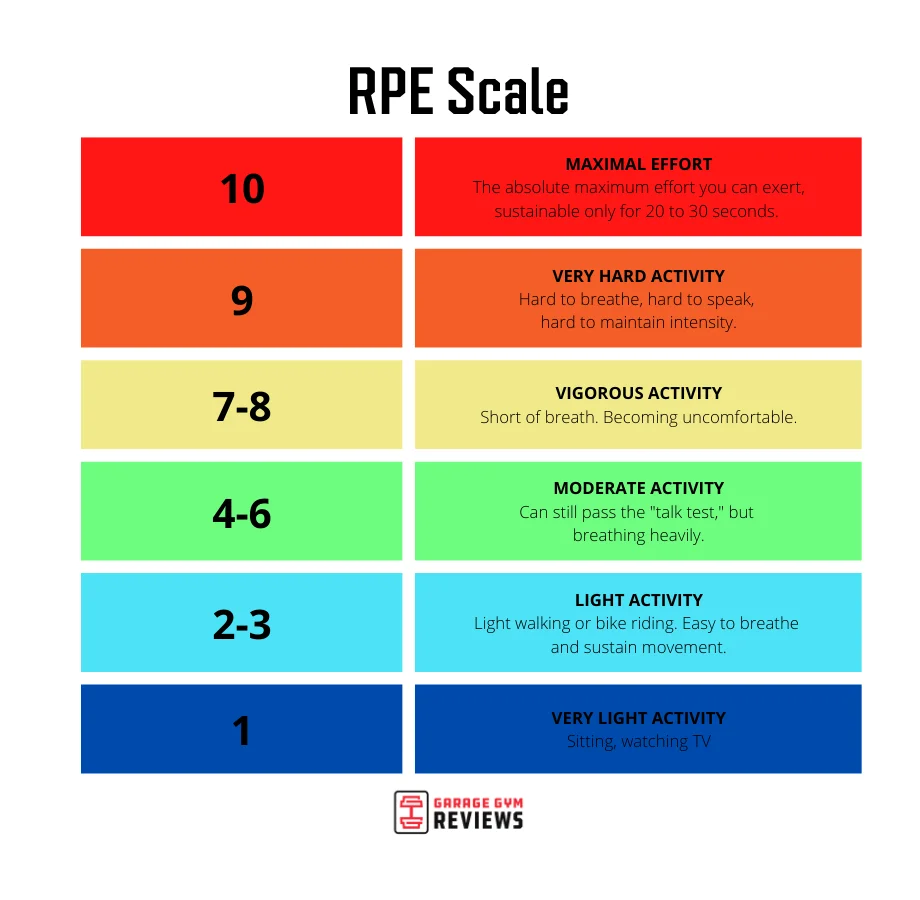
On an RPE scale, a 1 is a very light activity, like sitting or watching TV. When you get into the 4 to 6 range, you can still pass the “talk test,” but you’re breathing heavier. An RPE of 10 is all-out maximal effort, as hard as you can go.
And let’s also bust a myth right here: Because we’re at an RPE of 4, many would also say this could be considered one of the best walking treadmill workouts for weight loss. Why? Because at an RPE of 4, you’d be in the purported “fat-burning” zone, which is where you’re working at around 55 to 60% of your maximum heart rate. The “fat-burning zone” is generally considered a myth—you can burn fat with higher-intensity exercise as well—so if fat loss is your goal, don’t let the low- to moderate-intensity workouts keep you in a chokehold; feel free to mix it up.
Generally, easy workouts should be around 1-3 RPE. A 4-6 RPE would be a moderate workout, while anything above 6 would fall in the range of a challenging, hard workout.
Treadmill Walking Speed: How Fast Should You Walk on a Treadmill?
Before you hop on your treadmill and see how fast you can go, we recommend having a general idea of the speed you should be using and what you’re hoping to accomplish.
RELATED: Best Treadmills for Walking
Your individual fitness levels determine the exact speed to use, but here’s a guide to help you get started. Your incline determines the pace you’ll use, too, but here are the speeds we recommend.
| Goal | Speed | Why This Works |
| Increase activity | 2-3 MPH | This is low enough for most people to do for quite some time, making it a great choice if you need an easy way to get more steps |
| Active recovery | 3-4 MPH | This helps you push yourself a bit more and increase blood flow, without creating too much fatigue |
| Challenging workout | 4-5 MPH | This is getting close to running speeds and will probably work well for challenging intervals |
What Incline Should You Use on a Treadmill?
Incline walking is a great way to increase the challenge, without creating excessive wear and tear on the joints from running faster. Some of the best incline treadmills can reach inclines of up to 40%, but most people won’t need anywhere near that much. Even an 12% incline, the average incline we’ve seen on home treadmills, is more than enough for a great workout.
“Incline walking is my favorite form of zone 2 cardio,” says GGR senior staff writer Matt Dustin, CSCS, PN1-NC. “It’s low impact and doesn’t bother my knees, but I can really elevate my heart rate by adjusting the incline to provide a good challenge.”
If you’re not a regular treadmill user, here’s a guide to help you find the right incline for your training goals. Keep in mind, these are general guidelines, and you may need higher or lower incline settings depending on your fitness level.
| Goal | Incline | Why This Works |
| Active recovery pace | 1-2% | This is enough to get the blood flowing, without creating too much fatigue |
| Zone 2 cardio | 2-4% | For most, this will be enough to elevate your heart rate |
| Challenging intervals | 5-8% | At this level, you’re going to be working pretty hard, which provides a great challenge |
Treadmill Walking Benefits
Treadmill walking—and just walking in general—is good for your body and your mind.
“Walking is one of the best ways to complement your strength training routine for a variety of reasons,” says Lauren Strong, former GGR staff writer and certified personal trainer. “Heart health and reducing your risk of heart disease is at the top of that list. I also like that the impact of walking helps stimulate new bone tissue formation, or what is more often referred to as ‘bone density.’”
RELATED: Best walking shoes for seniors
Health benefits aside, here are the reasons we love walking on a treadmill.
| Benefit | Why It Matters |
| Low-impact training | Walking on a treadmill may be easier on the joints than higher-impact forms of training, like running or jumping. |
| Convenience | You don’t have to worry about whether, and you can stop anytime without worrying about being too far from home. |
| Safety | Walking in extreme climates can be dangerous, so can walking alone, depending on where you live. Treadmills keep you safe in your own home. |
| Consistent pacing | You can adjust the speed and incline whenever you want, and don’t have to deal with hills and uneven terrain outdoors. |
Treadmill Walking Workout: Final Thoughts
Getting your steps in on the treadmill doesn’t have to be boring. Mixing in intervals and incline work can make your treadmill walking workout even more effective.
- Walking in general is an underrated form of exercise, both for physical and mental health.
- Treadmill walking can be safer than walking outside, and it’s easier to control your speed and incline.
- Consider a treadmill walking workout for beginners, an interval treadmill walking workout, or a treadmill walking incline workout to get started.
Best Treadmill Walking Workouts: FAQs
Below are some frequently asked questions about treadmill walking workouts.
What is a good treadmill walking workout?
This depends on your goals. If you’re looking for a beginner-friendly walking workout routine, try just 20 or 30 minutes at an RPE of 4, which means that while you’re breathing heavier than normal, you can maintain a conversation. You can also experiment with intervals or incline in your treadmill routine to reap other benefits for your cardiovascular system and lower-body muscles.
Can you get a good workout walking on a treadmill?
Yes! Walking is one of the easiest, most beneficial forms of exercise you can partake in. You may see HIIT treadmill workouts all over the place, but low-intensity cardio like walking can improve your heart health, decrease your risk for disease, and increase your non-exercise activity thermogenesis (NEAT) value, which can contribute to weight loss.
Is walking on a treadmill a good way to lose weight?
To lose weight, you need to be in a caloric deficit, which means you burn more calories that you consume. While your nutrition should drive much of the deficit, you can also utilize exercise to help with weight loss goals. Walking is a great low-impact option to add to your fitness routine.
References
- Nemoto, K., Gen-no, H., Masuki, S., Okazaki, K., & Nose, H. (2007). Effects of high-intensity interval walking training on physical fitness and blood pressure in middle-aged and older people. Mayo Clinic proceedings, 82(7), 803–811. https://doi.org/10.4065/82.7.803