
Rowing workouts often take a back seat to running or cycling, likely because it’s not as familiar to many exercisers, especially beginners. Most of us have been running or riding our bikes since we were little, but have spent less time paddling in the water. As such, getting on a rowing machine can feel a little more intimidating than other exercise machines, at least until you get proper rowing technique down.
If you’re looking for some ideas to get you started, we’ve got you covered. From rowing machine workouts for beginners to more advanced Tabata-style sessions, we’ve developed the best rowing machine workouts for all fitness levels. We’re aware that rowers aren’t the most intuitive piece of cardio equipment, so we also want to spend some time helping you refine your technique so you can get the most out of every stroke.
Medical disclaimer: This article is intended for educational and informational purposes only. It is not a substitute for health or medical advice. For medical advice, contact an appropriate healthcare provider.
What Is a Rowing Machine?
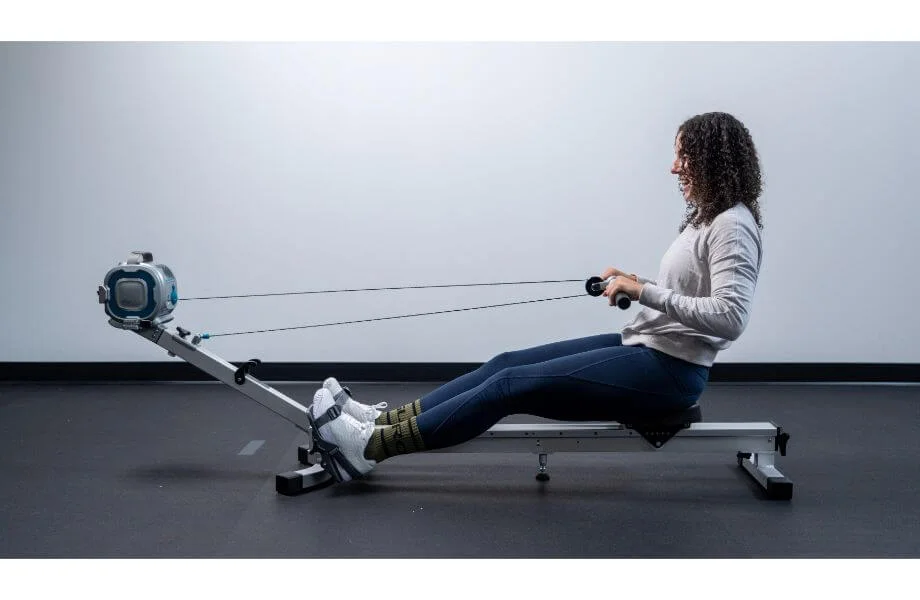
A rowing machine—also referred to as an ergometer (erg)—is a cardio machine that mimics the experience of rowing on water. It’s a low-impact, full-body burner popularized in CrossFit boxes for its ability to provide cardio and strength training in one workout without heavy joint strain.
There are four types of rowing machines (five if you include hybrid models):
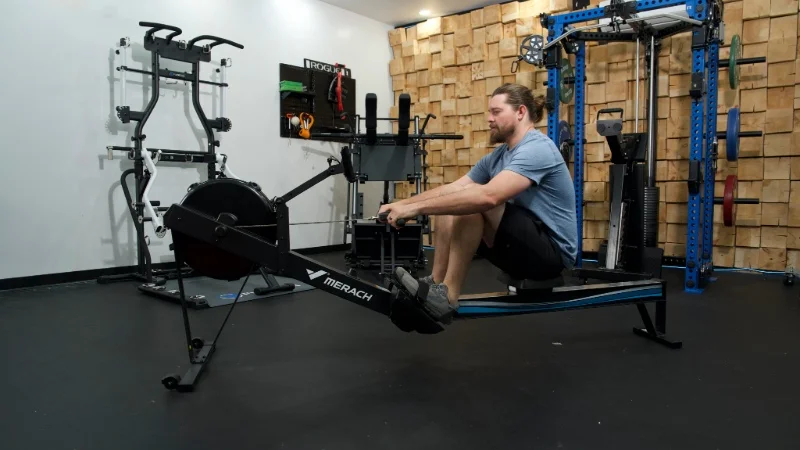
- Air: Resistance is powered by air blowing through a flywheel.
- Magnetic: Magnets in the flywheel that move closer together to create more resistance as you generate more power.
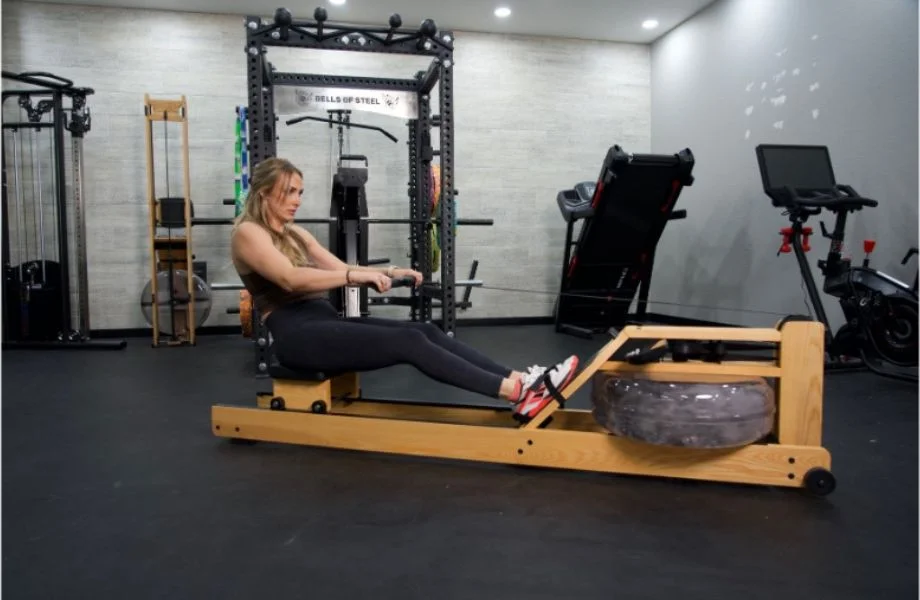
- Water: This type of rower is similar to an air model, however, resistance comes from a water tank and is closer to what you might experience rowing on water,
- Hydraulic: A hydraulic rower employs pistons that use air or water to generate resistance.
RELATED: Air vs. Magnetic Rowing Machine: Which Is Best?
GGR Recommends – Best Rowing Machine
After putting dozens of models through our in-depth rowing machine testing methodology, the uber-popular Concept2 RowErg is our top pick for home gym owners. A staple in CrossFit boxes and commercial gyms for years, this reliable, durable machine offers incredible value based on its sub-$1,000 price point. Earning an impressive overall score of 4.6 out of 5, you can read more about our team’s experience in our complete Concept2 RowErg review.
Benefits of Rowing Machine Workouts
There are many underrated rowing benefits. Aside from being an effective cardiovascular workout, rowing can improve muscular endurance, increase lower- and upper-body strength, and contribute to weight loss by boosting fat oxidation.
Rowing is also a versatile workout that can act as cardio and high-intensity resistance training in one. Because the movement works a lot of muscles at once, it allows you to maximize your results, according to John Gardner, a NASM-certified personal trainer and the CEO and Co-Founder behind Kickoff, a remote personal training platform.
Due to the full-body effort required during rowing, it’s not easy to slack on a rowing machine, Gardner says. You can get impressive results from quick rowing workouts—especially if you up the intensity.
Using an indoor rowing machine can also be good for your mental health. Aside from the mood boost that goes hand in hand with the release of endorphins, the steady rhythm involved in rowing can help relieve stress and physical and mental tension, according to Caley Crawford, NASM-certified personal trainer and Director of Education for Row House.
And since it’s low-impact, it’s gentler on your joints than running or plyometrics.
Rowing Machine Technique
Getting a good rowing machine workout is all about your form. It’s not as easy as hopping in the seat and grabbing the pulley. But to get started, you’ll want to keep four steps in mind: catch, drive, finish, recover.
You can check out our full expert guide on how to use a rowing machine for detailed explanations on each step, but here’s a quick rundown of each phase:
- Catch: The starting position of the rowing stroke, where you sit with a neutral spine, bent knees, a slight forward lean, and the handle closest to the flywheel.
- Drive: The power phase of the stroke, where you push with your legs to drive the handle away from the flywheel.
- Finish: The end of the rowing stroke, where your legs are fully extended, your torso leans slightly back, and the handle is pulled to your lower ribs.
- Recovery: The return phase of the stroke, where you extend your arms, hinge forward at the hips, and bend your knees as you move back to the catch position.
Reading about proper rowing technique is helpful, but seeing each phase in action makes it much easier to put it all together. Let GGR Editor Amanda Capritto, CPT, CNC, CES, CF-L1, show you how it’s done.
Common Rowing Mistakes
Proper rowing technique is essential for staying safe and getting the most out of every stroke. Before you increase the resistance or pick up the pace, avoid these common mistakes that can derail your workout.
Fortunately, each one has a simple fix that can help you row more efficiently and confidently.
| Mistake | Why It’s Wrong | How to Fix |
| Gripping the handle too tightly | Creates unnecessary tension in your forearms, shoulders, and neck | Hold the handle lightly with both hands, almost like your fingers are hooks |
| Pulling with your arms first | Starting the stroke with your arms reduces your power output and places extra stress on your shoulders and biceps | Initiate every stroke by driving through your legs and finish by pulling with your arms |
| Rounding your back | A rounded spine decreases efficiency and can increase stress on your spinal erectors | Keep your chest up, brace your core, and maintain a neutral spine throughout the stroke |
| Leaning too far back at the finish | Excessive layback wastes energy and places unnecessary strain on your lower-back muscles | Finish with a slight backward lean (roughly 10-15 degrees) while keeping your core engaged |
| Rushing the recovery phase | Recovering too quickly reduces your control, making it tough to keep a consistent rhythm | Follow the “drive fast, recover slow” motto where the recovery takes about twice as long as the drive |
7 Types of Rowing Machine Workouts (With Sample Routines)
There are countless rowing machine workouts designed to help you achieve different goals. Whether you’re looking to build endurance, increase speed, burn more calories, improve your stroke consistency, or tackle challenging CrossFit WODs, pairing your workouts with a dedicated heart rate monitor can help ensure you’re rowing at the appropriate intensity for each session.
Below, we’ve outlined several of the most effective rowing machine workouts, complete with sample routines you can use as a baseline. These workouts cover everything from low-intensity, steady-state sessions that build your aerobic base and stamina to high-intensity interval workouts that challenge your speed, power, and metabolic conditioning.
1. Steady-State Rowing
Best for: Improving cardiovascular endurance, building an aerobic base, burning calories
Steady-state rowing involves maintaining a consistent, moderate pace for an extended period. Rather than sprinting, the goal is to keep your heart rate elevated while rowing at an intensity you can comfortably sustain while holding a conversation.
Sample Workout:
- Warm up for 5 minutes with easy rowing.
- Row for 30-45 minutes at a stroke rate of 18-22 strokes per minute (SPM) while maintaining a comfortable, conversational pace.
- Cool down with 5 minutes of easy rowing, followed by light stretching.
RELATED: Steady-State Cardio vs HIIT
2. Interval Training
Best for: Improving aerobic and anaerobic endurance, boosting rowing performance
Interval training alternates short bursts of high-intensity rowing with periods of active recovery. This approach challenges both your aerobic and anaerobic energy systems while keeping workouts ultra-efficient.
Sample Workout:
- Warm up for 5 minutes
- Repeat for 5 rounds:
- 40 seconds at 50% to 80% of full effort
- 20 seconds slow (10% to 50% of full effort)
- 2 minutes rest
- Cool down for 5 minutes
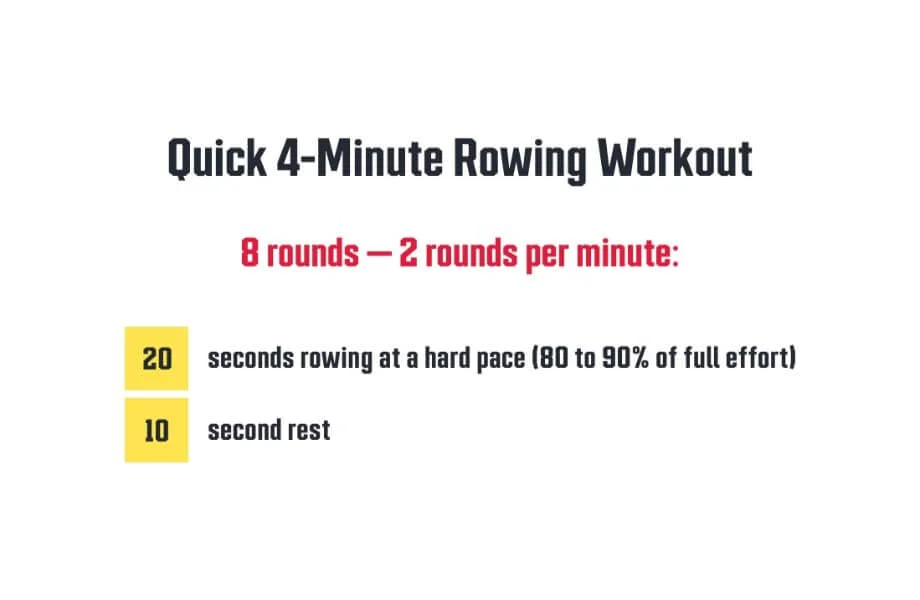
Training Tip: If you’re stretched for time, this efficient, Tabata-style workout will get the job done in less than 10 minutes.
3. Sprint Rowing Workout
Best for: Building speed, power, and anaerobic capacity
Sprint workouts focus on maximum effort over short distances or time intervals. These sessions teach you to generate more force with every stroke while improving your ability to recover between max-effort periods.
Sample Workout:
- Warm up for 5-10 minutes
- Perform 10 rounds of the following:
- 30-second sprints at near-max effort (30-36 SPM)
- Recover with 60-90 seconds of easy rowing between each sprint
- Cool down for 5 minutes.
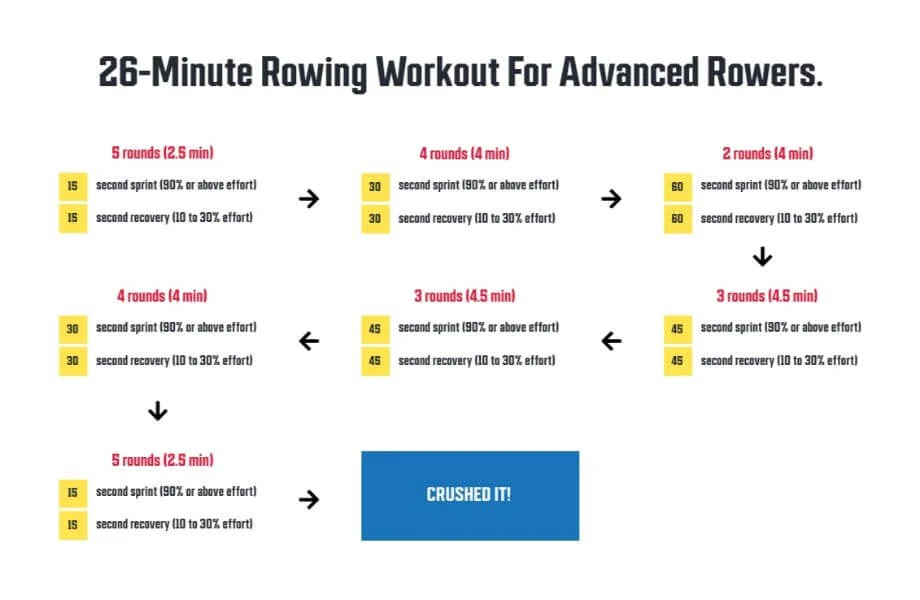
Training Tip: When you’re ready to take things to the next level, give this advanced sprint workout a try.
4. Pyramid Rowing Workout
Best for: Improving pacing, endurance, and mental fortitude
A pyramid workout gradually increases the length of each work interval before working back down again. The constantly changing intervals help prevent boredom while training multiple energy systems.
Sample Workout:
- Warm up for 5-10 minutes
- Row:
- 1 minute hard
- 2 minutes hard
- 3 minutes hard
- 4 minutes hard
- 3 minutes hard
- 2 minutes hard
- 1 minute hard
- Recover for 1 minute of easy rowing between each interval
- Cool down for 5 minutes
5. Distance-Based Rowing Workout
Best for: Race preparation, improving pacing
Rather than rowing for time, distance workouts challenge you to complete a set number of meters while maintaining a consistent pace. This approach helps you develop pacing awareness, improve endurance, and track your progress more easily over time.
Sample Workout:
- Warm up for 5-10 minutes
- Row 5,000 meters at a sustainable pace (20-24 SPM)
- Try to maintain an even split throughout the session
- Cool down for 5 minutes
Training Tip: Beginners can start with 2,000-3,000 meters before increasing their distance.
6. Power Rowing Workout
Best for: Developing leg drive, building strength and explosive power
Instead of focusing on speed, power workouts prioritize generating maximum force with each stroke. This will help you develop the explosive leg drive needed to generate maximum power output.
Sample Workout:
- Warm up for 5-10 minutes
- Complete 8 rounds of:
- 1 minute powerful strokes (18-22 SPM)
- 2 minutes of easy recovery
- Cool down for 5 minutes
7. Recovery Row
Best for: Active recovery, improving your technique
While the other types of rowing workouts are meant to push you, recovery sessions are designed to promote blood flow without placing too much stress on your body. Pencil these in the day after a tough workout.
Sample Workout:
- Warm up for a few minutes
- Row for 20-30 minutes at an easy, relaxed pace (18-20 SPM)
- Finish with light stretching or mobility work
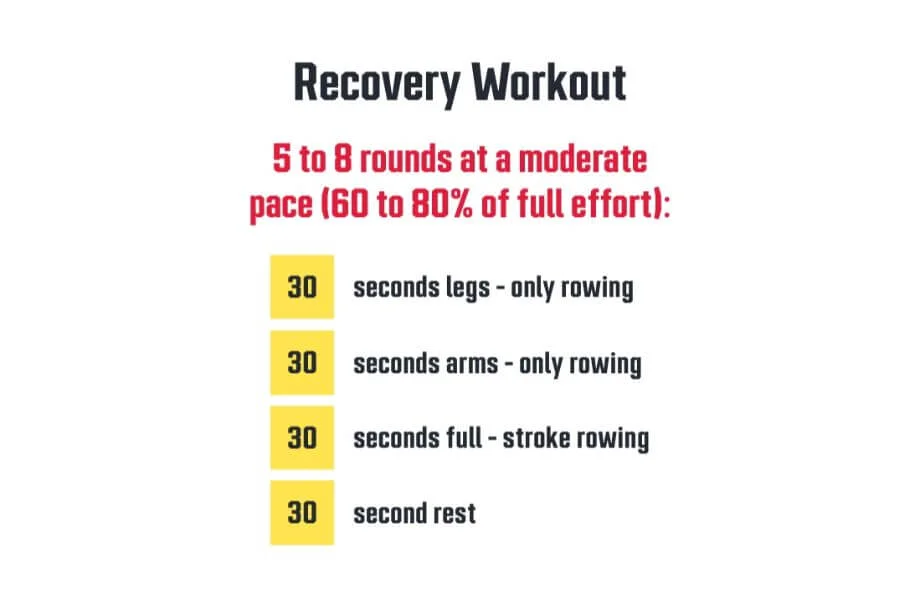
Training Tip: You can also break up your recovery workout into segments. Here’s a routine you can follow that goes from using only your legs to completing a full stroke.
Rowing Machine Workouts: A Sample Training Week
Variety is one of the keys to staying engaged with your training routine. So, if you’re ready to build your weekly workout calendar around a rower, here’s a seven-day plan you can follow:
| Day | Type of Workout | What to Do |
| Monday | Steady-State | Row for 30-45 minutes at a sustainable pace, focusing on your technique. |
| Tuesday | Strength | Perform compound lifts like the deadlift, back squat, and other key movements to balance your cardio training. |
| Wednesday | Intervals | Complete 8 to 12 rounds of 30-60 seconds at a fast pace, followed by 1-2 minutes at an easy pace. |
| Thursday | Active Recovery | Incorporate walking, foam rolling, yoga, and mobility work to give your body a break |
| Friday | Power | Complete 8-10 rounds of: 1 minute of powerful strokes (18-22 SPM), followed by 2 minutes of easy recovery |
| Saturday | Cross-Training | Run, swim, cycle, or perform another non-rowing activity for 30-45 minutes. This could also be an opportunity to get in another strength training session. |
| Sunday | Rest | Take a full rest day to let your muscles recover |
How to Track Your Rowing Progress
While it’s easy to see the visual fruits of your labor with strength training, rowing progress is typically measured by performance rather than appearance. As your technique and fitness improve, you’ll notice changes in metrics like pace, distance, stroke rate, and heart rate.
Here are some practical ways to track your progress as you become more comfortable using an erg:
- Monitor your split times: As your fitness improves, you’ll be able to maintain a faster split with the same (or less) effort. This is a key metric that directly correlates with your progress.
- Use a fitness tracker: Whether it’s an Apple Watch Series 10, the Garmin vivoactive 6, or another one of our top-rated fitness trackers, these devices can track metrics like your heart rate, calories burned, and training zones.
- Log your workouts: Record details like the distance, duration, average stroke rate, and how challenging the workout felt.
- Take advantage of technology: The best rowing apps offer structured programs and interactive features that can enhance your training experience. Some of our favorites include the Hydrow App and the beginner-friendly Ergatta App.
Rowing Machine Workouts: FAQs
Is rowing a good workout?
Rowing is an excellent form of cardio exercise, and it’s also one of the only non-weight-bearing sports that engage all the major muscle groups, like your quads, glutes, and hamstrings. In other words, it can give you a total-body workout.
Is 20 minutes of rowing enough?
A 20-minute rowing session can be a great workout, and an excellent addition to your daily cardio routine. However, if you want to meet 150 minutes of exercise per week, as recommended by the Department of Health and Human Services’ Physical Activity Guidelines for Americans—you’ll have to add in some other forms of exercise, such as bodyweight strength training or training with weights like dumbbells or kettlebells.
Is rowing good for fat loss?
Like all cardio workouts, rowing can help you burn calories, which can translate to weight loss when combined with a balanced lifestyle. Rowing is also a full-body workout that helps you build lean muscle, and studies show that rowing can lead to a greater rate of fat oxidation, or fat burning, than other forms of cardio, such as cycling on an exercise bike. However, it’s important to keep in mind that proper nutrition is vital to optimal fat loss.
How long should you exercise on a rowing machine?
There’s no set period of time you should exercise on a rowing machine. You can get a quick heart pump in by doing a 4-minute HIIT-style workout or, if you have more time (and you’re a more advanced rower), you can bump up to 30-minute HIIT-style or steady-state rows. The baseline recommendation is to get in 150 minutes of exercise every week; how you want to break that up is up to you.
What muscles does a rowing machine work?
A rowing machine primarily works your quadriceps, hamstrings, glutes, lats, rhomboids, traps, biceps, shoulders, and core, making it one of the most effective full-body cardio exercises. It’s also easier on your joints compared to a stair climber or treadmill.