

The kettlebell swing is a ballistic strength training movement that is a low-impact, high-intensity exercise that can improve your cardiovascular conditioning, grip strength, and even the power and look of your glutes. Swings are a fundamental kettlebell movement and, arguably, the best kettlebell exercise.
Do you know one way to double this fun?
If you guessed double kettlebell swings, collect your $200 as you pass go. You’ll lift more weight with double kettlebell swings, leading to a more intense cardiovascular workout. Plus, it can further increases grip strength and help reduce muscular and strength imbalances between sides.
And this is just scratching the surface of the benefits of the double kettlebell swing. This certified personal trainer will tell you how to do the double kettlebell swing, why you should do it, and the various muscles it works. Ready to swing for better-looking glutes, hamstrings, and forearms? Then, let’s go.
How To Do The Double Kettlebell Swing
Only attempt the double kettlebell swing when you feel comfortable with bodyweight swings and the single kettlebell swing.
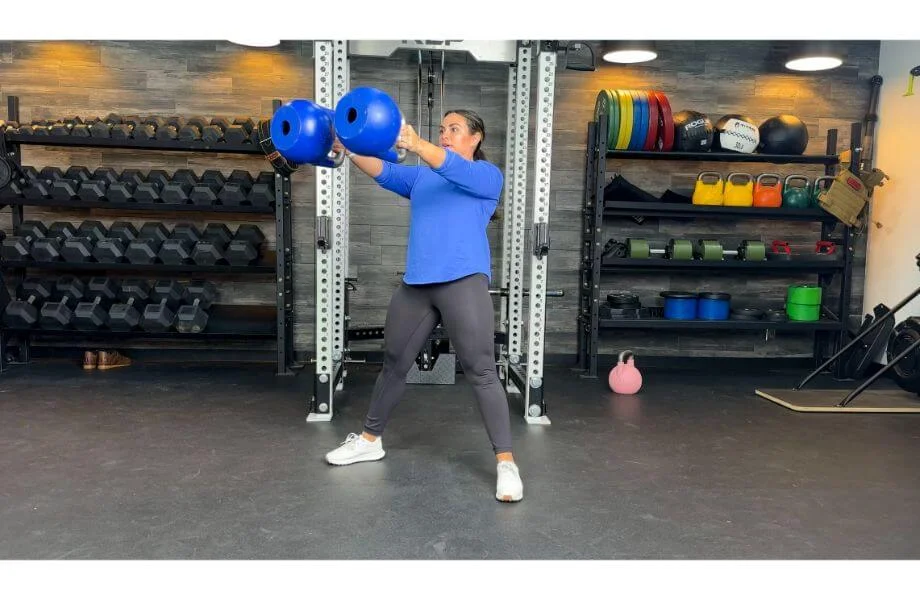

- Stand in a wider-than-shoulder-width stance with two kettlebells just in front of you. You must stand wide enough for two kettlebells to fit between your legs.
- Hinge with your shoulders down and chest up and reach forward to grip a kettlebell in each hand with your wrists in a neutral position and palms facing each other.
- Get your chest up, and squeeze your armpits together to engage your upper back.
- Use your forearms to cushion against your inner thighs as you hike the kettlebells behind you.
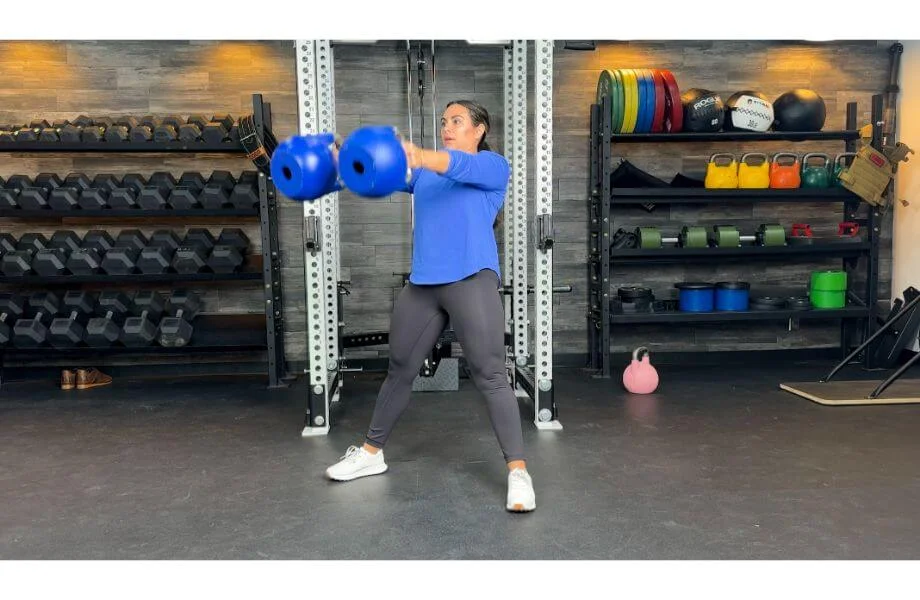
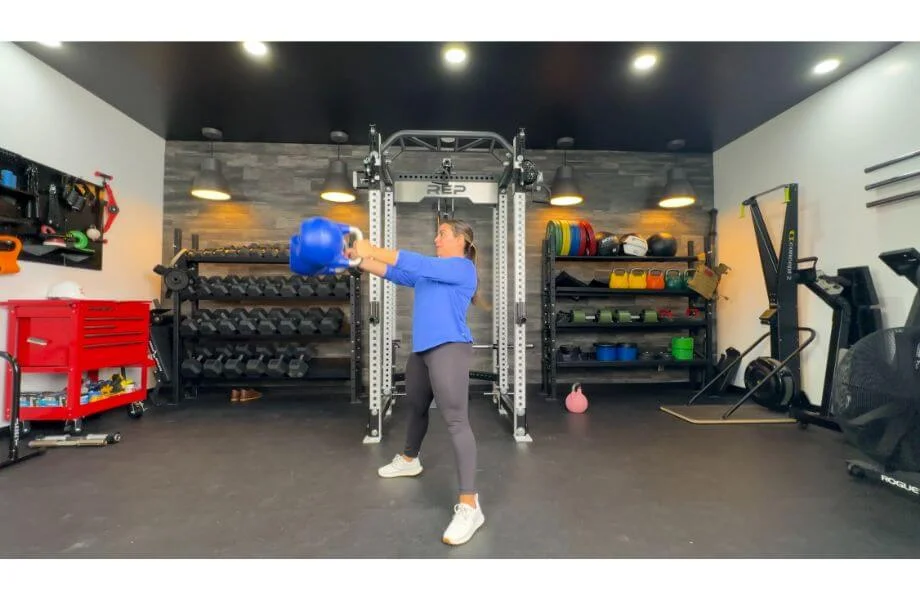
- Snap your hips forward, using the momentum of your ballistic hip hinge to swing the weights up near chest height.
- Your finishing position should look like an upright front plank.
Repeat in a continuous loop for desired reps.
RELATED: Best Kettlebell Exercises
8 Benefits of The Double Kettlebell Swing
Double kettlebell swings are more brutal than performing the single kettlebell swing, and they will have you sweating and swearing under your breath. But for all this difficulty, there are many benefits of kettlebell swings, which we’ve listed below.
You Can Lift More Weight
Although you’ll have less weight in each hand than using both hands on the single kettlebell, you can swing more weight. For instance, if you usually swing a 35-pound heavy kettlebell, you can likely swing 26 pounds in each hand for a total of 52—a 17-pound increase.
Better Cardio Workout
Even when using a lighter weight in each hand than you would for the regular single kettlebell swing, your total weight per swing will be higher. This total load can not only improve strength, but also your cardiovascular conditioning and fat-loss potential, as well. A small 2021 study1 showed that swinging heavier loads can increase your heart rate during your double kettlebell swing workout.
Recruits More Muscle Groups
Whether one or two kettlebells, the swing is a powerful full-body movement pattern that will get more than your glutes rocking. Like lifting heavier weights, being able to swing heavier loads has been shown to increase muscle engagement2 across your whole body, specifically the hip and ankle muscles.
RELATED: Best Adjustable Kettlebells
Help Fix Muscular and Strength Imbalances
The double kettlebell swing requires you to do two swings simultaneously, one with each arm during the swing motion. You’ll need to lock everything in—like your hips, core, upper back, and grip—to keep good technique. But with a single kettlebell, if a dominant side exists, it may take over. Doing the swing with two ‘bells can expose any imbalances that you need to address.
Increases Grip Strength
Since your arms work independently, double kettlebell swings are a great grip strength exercise. By controlling the load with each hand throughout the range of motion, without each hand having to shoulder the load (see what I did there), your grip strength in each hand can improve.
RELATED: Best Grip Strengtheners
Improved Coordination and Balance
Due to their offset load, kettlebells increase the engagement of the body’s stabilizers to remain on two feet and swing with good form. But when you swing with two ‘bells in a ballistic fashion, you will need to prevent the ‘bells from smacking together at the top of the swing, and this concentration can help improve your coordination.
Adds Variety to Training
Single kettlebell swings are great, but it helps the mind, body, and soul to change things up occasionally to keep you engaged and challenged to prevent boredom and overuse injuries. Throwing in some double kettlebell swings may be the spark you need for glute gains.
Improved Mental Toughness
Double kettlebell swings are tough on your grip, lungs, and legs. When you’re doing them, you may think, “Geez, these are really hard. I’m going to quit now.” When you put those thoughts to bed and complete the set, you can improve your mental toughness and physical capacity to do stuff.
RELATED: Exercise And Mental Health
Double Kettlebell Swings Variations
Once you’ve mastered swings, you can take your kettlebell workout program to the next level with different variations. Here are three other exercises you can perform that each serve a unique training purpose:
Double Kettlebell Clean
The kettlebell clean is a terrific way to develop explosive strength and power. However, this multi-step exercise can be a bit challenging, so it’s best to practice each part independently until you get comfortable.
How to do it:
- Stand with your feet shoulder-width apart with a kettlebell between your feet on each side.
- Hinge at the hips and grab both handles while maintaining a neutral spine.
- Initiate the movement by hiking the kettlebells back between your legs.
- Drive through your hips to swing the ‘bells upward.
- As they rise, rotate your wrists and guide the kettlebells into a front-rack position at shoulder height. Make sure to keep your core braced throughout the movement.
- Reverse the motion by allowing the kettlebells to fall back into the backswing.
- Repeat for the desired number of reps or time.
RELATED: Clean and Press Workout
Double Kettlebell Snatch
Like the clean, the kettlebell snatch requires precise coordination and body control to perform safely and effectively. This full-body movement involves swinging the kettlebells directly overhead in a smooth, fluid motion.
How to do it:
- Stand with your feet about shoulder-width apart with two kettlebells on the floor between your feet.
- Hinge at the hips and grab both handles while maintaining a neutral spine.
- Hike the kettlebells back between your legs to generate momentum for the swing.
- Brace your core and drive your hips forward to propel the kettlebells upward.
- As they rise, “punch” your hands through the handles to guide them into an overhead position.
- Lock your arms out overhead, making sure to keep your biceps close to your ears and your core engaged.
- Carefully lower the kettlebells back into the backswing and repeat for the desired number of reps or time.
RELATED: Full-Body Kettlebell Workout
Double Kettlebell Squat
It’s no secret that squats are one of the best leg exercises, and the double kettlebell variation can provide a nice change of pace from traditional barbell back squats. Not only can it challenge your legs, core, and upper-body stability, but it can also reinforce proper squat mechanics, which can pay dividends when you hit the squat rack again.
How to do it:
- Place two kettlebells in between your feet and carefully clean them into the front-rack position at your shoulders.
- Stand with your feet about shoulder-width apart with your toes slightly pointed out.
- Keep your elbows tucked and your chest upright.
- Brace your core and drive your hips down and back until your thighs are parallel to the floor, making sure not to lean forward.
- Drive through your heels to return to the starting position.
- Repeat for the desired number of reps or time.
RELATED: 21 Best Squat Variations
Try These Double Swings Kettlebell Workouts
The double kettlebell exercises below will be performed as a triset; you will only put the kettlebells down once you finish the triset. Keep the repetitions between six and 12, depending on your fitness and strength levels. Rest a little between exercises and two to three minutes at the end of each triset.
Repeat between two to five times, depending on your fitness level. If you are a beginner, start on the low side. If you’re a more advanced lifter, do three to five rounds.
Swing, Squat, Press
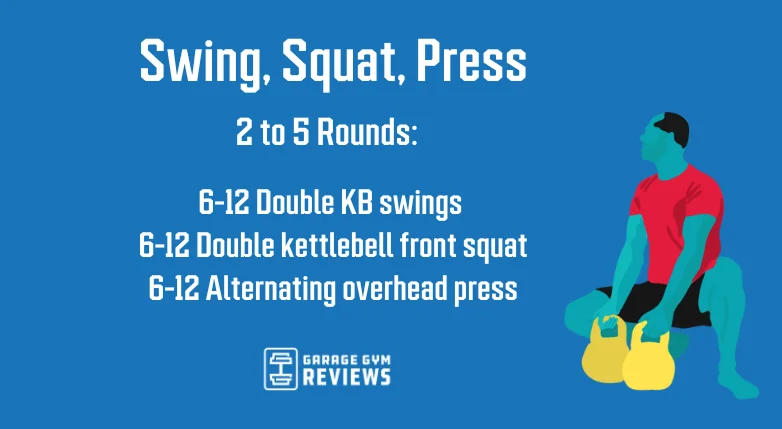
2 to 5 Rounds:
- 6-12 Double kettlebell swings
- 6-12 Double kettlebell front squat
- 6-12 Alternating overhead press
Swing, Clean, Snatch
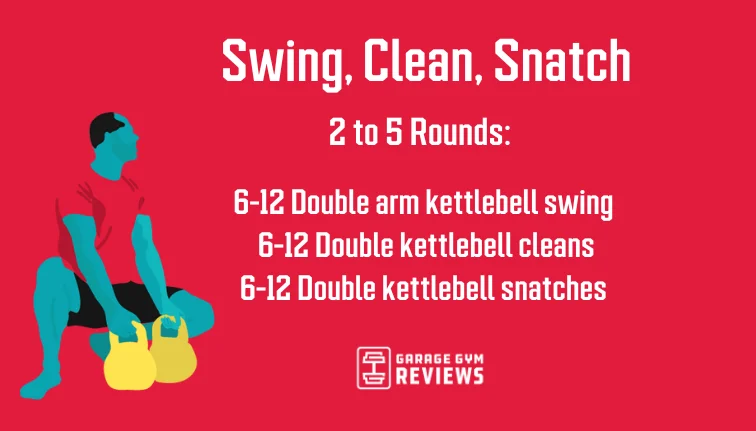
2 to 5 Rounds:
- 6-12 Double-arm kettlebell swings
- 6-12 Double kettlebell cleans
- 6-12 Double kettlebell snatches
Swing, Snatch, Carry
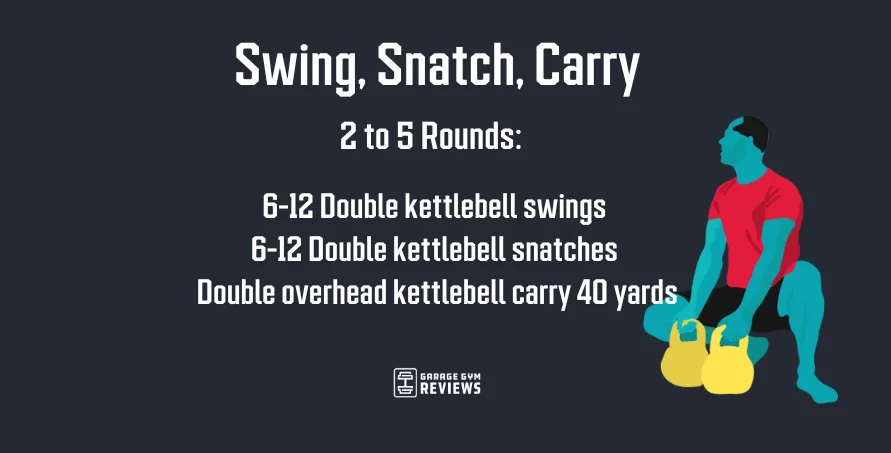
2 to 5 Rounds:
- 6-12 Double kettlebell swings
- 6-12 Double kettlebell snatches
- Double overhead kettlebell carry (40 yards)
Deadlift, Swing, Clean or Snatch
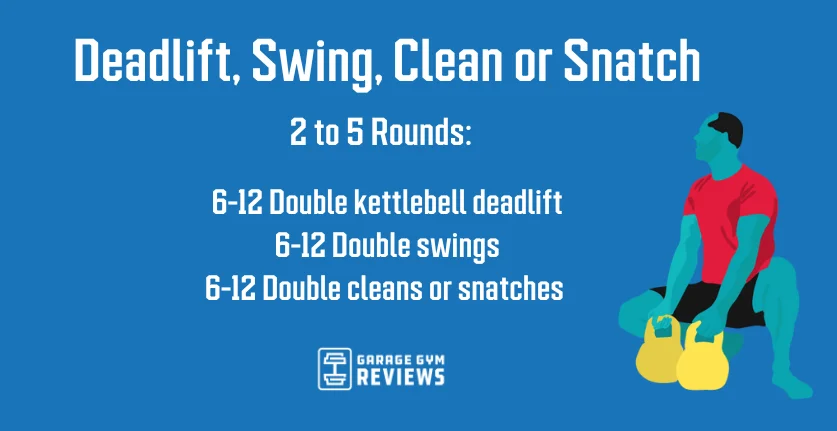
2 to 5 Rounds:
- 6-12 Double kettlebell deadlift
- 6-12 Double swings
- 6-12 Double cleans or snatches
What Muscles do Double Kettlebell Swings Work?
Double kettlebell swings are full-body exercises but mainly focus on the below-mentioned muscles in the posterior chain:
Hamstrings
If your hamstrings are not sore the day after a set of swings, you are doing them wrong. They are the prime mover, along with the glutes, when it comes to swings. They contract eccentrically and concentrically as they assist the glutes with hip extension.
Glutes
Glutes are another prime mover, and the point of doing kettlebell swings is to get a strong, popping set of glutes. Finishing with your glutes at lockout can ensure better form and a better “baby got back” look.
Upper Back and Lats
During the kettlebell swing, engaging the upper back and lats and keeping them tight can ensure better form and that the muscle of the glutes and hamstrings to do their job correctly.
Lower Back
The lower back muscles, known as the erector spinae, play a similar role as the upper back during kettlebell swings. They contract isometrically to keep the spine neutral and for the larger muscle of the hamstrings and glutes to do their job.
Forearms
If you cannot grip it, you cannot swing it. The forearm flexors and extensors co-contract to ensure a neutral wrist during the kettlebell swing. Kettlebell swings can improve your grip strength and endurance.
What Type of Kettlebell Works Best For Swings?
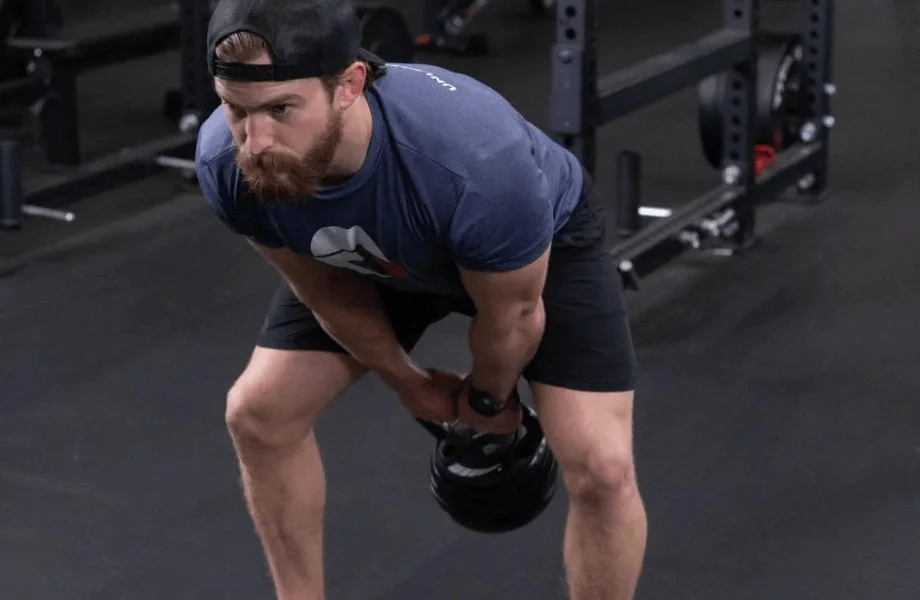
Just like you wouldn’t use a powerlifting barbell for Olympic lifts, you don’t want to choose the wrong type of kettlebell for swings. Even though many kettlebells look similar, design nuances can make one better than another for this movement. With both fixed and adjustable options, you may be wondering which route to go when it’s time to swing.
In my experience, fixed kettlebells can work best for swings since they typically feature a single-piece, cast-iron design with a consistent shape that helps keep the center of mass stable. The classic cannonball-like shape helps distribute the weight evenly, allowing the kettlebell to move smoothly.
RELATED: Adjustable Kettlebell Vs Standard
On the other hand, adjustable kettlebells vary widely from a design standpoint. Some closely mimic a traditional kettlebell design and can work just fine for swings. Others—such as the PowerBlock Adjustable Kettlebell—have an awkward shape that’s ill-suited for swings.
Another key factor is the handle quality. Ideally, you want a handle that’s wide enough for a comfortable two-handed grip with a smooth or lightly textured surface that allows the ‘bell to rotate slightly without damaging your hands. You’ll also need to take note of the handle diameter (35 millimeters is the standard) to ensure you can maintain a comfortable grip without running into fatigue issues. These are all elements the Garage Gym Reviews team carefully analyzes when researching and testing kettlebells, so make sure to do your due diligence before you add one to your strength training arsenal.
Double Kettlebell Swing: Final Thoughts
Double kettlebell swings are just the ticket when looking for variety and a challenge in your kettlebell training. They are tougher to perform than the typical two-handed single kettlebell swing but have considerable benefits:
- Improved grip strength
- Works more muscle
- Improved cardiovascular endurance
- It helps fix strength imbalances and improves balance
They can add variety to your training to keep you more engaged. So, what are you waiting for? Get to swinging.
Double Kettlebell Swing: FAQs
Are double kettlebell swings good?
Yes, double kettlebell swings are good, provide variety in your training, and can help improve your grip strength and cardiovascular capacity. Be warned, though; they are tough. Make sure you have the single kettlebell swing form down before attempting this exercise.
What muscles do double kettlebell swings work?
Double kettlebell swings work the hamstrings, glutes, lower back, upper back, lats, and forearms. Studies2 show double kettlebell swings work more muscle than single kettlebell swings, particularly the muscles surrounding the hips and ankles.
Can you do kettlebell swings with two kettlebells?
Yes, you can swing two kettlebells, but there are a couple of adjustments you need to make over doing the single kettlebell swing. First, you need a wider stance for space to swing between your legs. Second, you must grip the kettlebells with your wrists in a neutral orientation with your palms facing each other through the entire set.
References
- Raymond LM, Renshaw D, Duncan MJ. Acute Hormonal Response to Kettlebell Swing Exercise Differs Depending on Load, Even When Total Work Is Normalized. J Strength Cond Res. 2021 Apr 1;35(4):997-1005.
- Levine NA, Hasan MB, Avalos MA, Lee S, Rigby BR, Kwon YH. Effects of kettlebell mass on lower-body joint kinetics during a kettlebell swing exercise. Sports Biomech. 2020 Mar 4:1-14